TRANSITION · LAYER 5 OF START
Infrastructure nobody uses isn't infrastructure.
Adoption and behaviour change. We move industries and communities from circular intent to circular practice — the strategy, training and engagement that turn standards, passports, measurement and policy into something people actually use.
From intent to practice
Responsibility sets the obligations. Transition is whether anyone meets them in practice. You can establish the standards, build the passports, measure the impact and design the policy — and still change nothing, because the people meant to use it never adopted it. This is the layer organisations skip, and the one that decides whether the rest was worth building.
Behaviour is harder to change than systems, and it is where most circular initiatives quietly fail — not through bad design, but through no adoption. A passport no supplier completes, a target no team owns, a scheme no community trusts: all of it is effort that never reaches practice. Infrastructure nobody uses isn't infrastructure.
Transition is where the system starts to live.
The gap between ambition and effect
The direction is set. The EU Green Deal commits Europe to climate neutrality by 2050, and the science it answers to is unambiguous — seven of the nine planetary boundaries that keep the Earth habitable are now breached, and on current trends the global economy runs well beyond the ecological ceiling that Kate Raworth's doughnut model defines as the edge of a safe and just space.
But ambition and evidence change nothing on their own. A target is not an outcome; a regulation is not a behaviour. Between the policy that mandates circularity and the market that practises it sits a gap — and that gap is exactly where value is won or lost. Transition is the work of closing it.
The loop in motion: the Symolem 6M Model
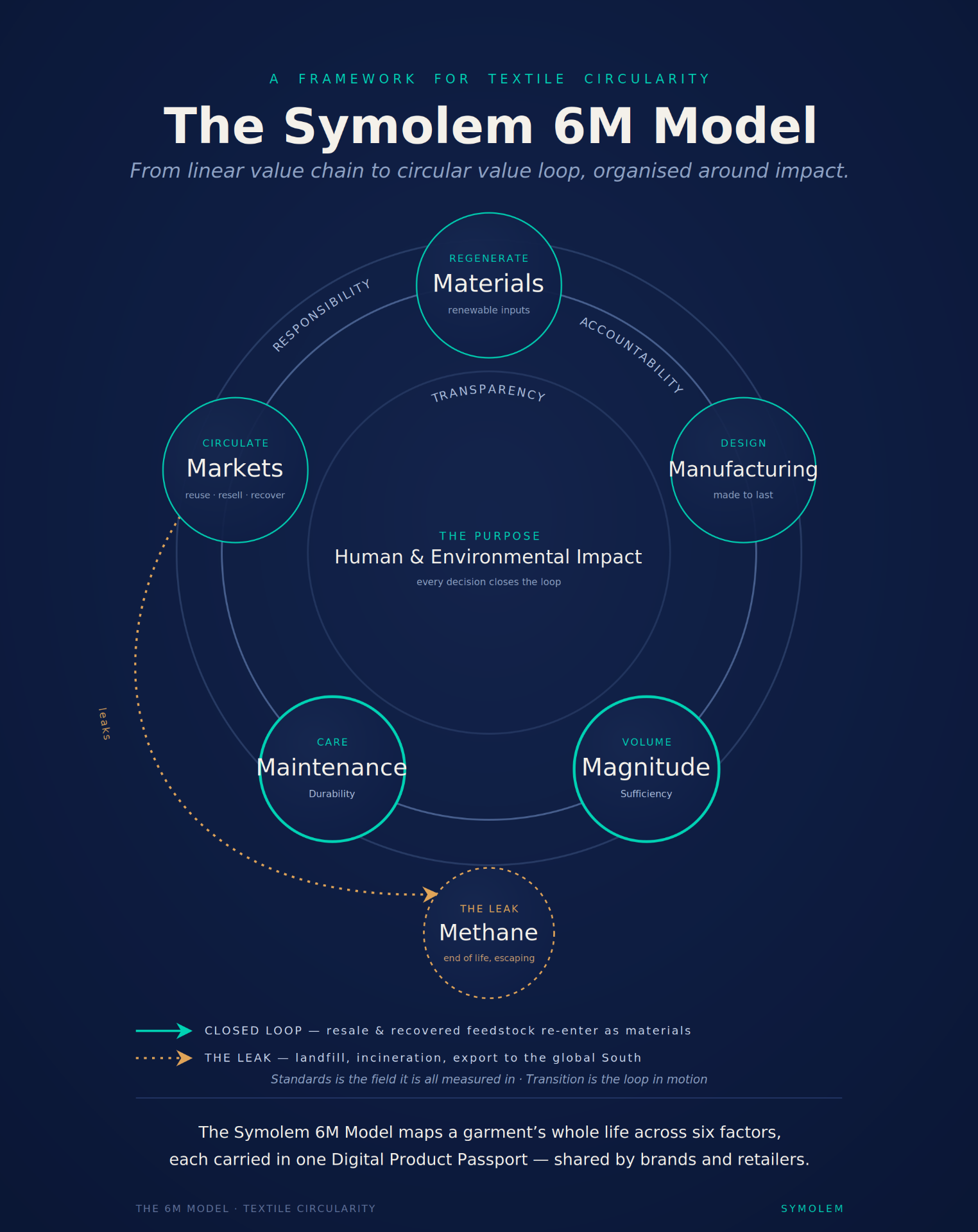
Our 6M Model maps a garment's whole life across six factors — Materials, Manufacturing, Magnitude, Maintenance, Markets and Methane — each one carried in a single Digital Product Passport, shared by brands and retailers.
Five of the six keep the garment in the loop: regenerative Materials, Manufacturing made to last, Magnitude held to sufficiency, Maintenance that extends a product's life, and Markets that reuse, resell and recover. The sixth — Methane — is the leak: what escapes when the loop fails. Landfill, incineration, and export to the Global South, where discarded textiles rot and release methane far from the market that produced them.
Transition is the loop in motion. Everything beneath it in START — standards, passports, measurement, policy — exists to make that loop turn. Adoption is what actually turns it. Without it, the system leaks.
A transition that leaks isn't a transition
The leak is not only an emissions problem. It is a justice problem. A circular economy that closes its loop by exporting its waste hasn't closed anything — it has moved the cost to people who never had a say. That is the opposite of a Just Transition: the principle that the shift to a sustainable economy must be fair to the workers and communities it affects, not built on their backs.
We design transitions that don't leak. That means bringing the downstream — the sorters, recyclers and communities who handle what the market discards — into the change as participants, not as its dumping ground. It is the same conviction that runs through our policy work: built with, not applied to.
Where the 6M Model sits
Transition has a literature. Diffusion-of-innovation curves explain how adoption spreads; the multi-level perspective explains how niche practices displace incumbent systems; just-transition frameworks insist the shift be equitable. We build on all of it. The 6M Model is what that thinking becomes when it is made specific to textiles and organised around impact rather than process — a model you can act on, not just cite.
What we do
We design the move from intent to practice, and build the capability to sustain it.
Circular adoption strategy — We design how a circular change is actually taken up — by whom, in what order, against what incentives — so adoption is planned and measured, not left to goodwill and hoped for. The difference between a scheme that moves and one that stalls in year one.
Stakeholder engagement design — Circular systems touch suppliers, staff, customers and communities at once. We design how each is brought in, consulted and kept engaged, so the people a change depends on are part of it rather than subject to it — and don't quietly opt out.
Training and capability building — A system is only as good as the people running it. We build the training and capability — internal teams, suppliers, partners — that lets an organisation operate what it has put in place, long after the consultants have left. You own the capability, not a dependency.
Awareness and outreach programmes — We design the awareness and outreach that shift understanding at scale — the campaigns, materials and programmes that move a market or a community from not knowing to acting, grounded in the research that tells you what will land.
What you walk away with
- A circular adoption strategy — who adopts what, in what sequence, and how it is measured.
- A stakeholder engagement plan across suppliers, staff, customers and community.
- A training and capability programme that leaves the organisation able to run it itself.
- An awareness and outreach programme, built on evidence of what changes behaviour.
Why Transition comes last
START is a sequence, and Transition sits at the top because it depends on everything beneath it — there is nothing to adopt until standards, transparency, accountability and responsibility are in place. But being last does not make it least. It is the layer where the whole structure either comes to life or stands unused. Skip it, and the four below become expensive scaffolding around a change that never happened.
THAT COMPLETES START
Five layers, in order, each enabling the next: Standards to know the rules, Transparency to prove them, Accountability to measure, Responsibility to govern, and Transition to make it real. We work across all five — because the circular economy doesn't break at one point. It breaks wherever a layer is missing.