


What a Head of Sustainability costs you
£6,500+ a month
- 1 × Head of Sustainability salary
- Employer's NI contributions
- Pension contributions
- Software subscriptions
- Recruiter fees
- Holidays and sick days
- Three months' notice to leave
Product compliance platform and advisory for fashion
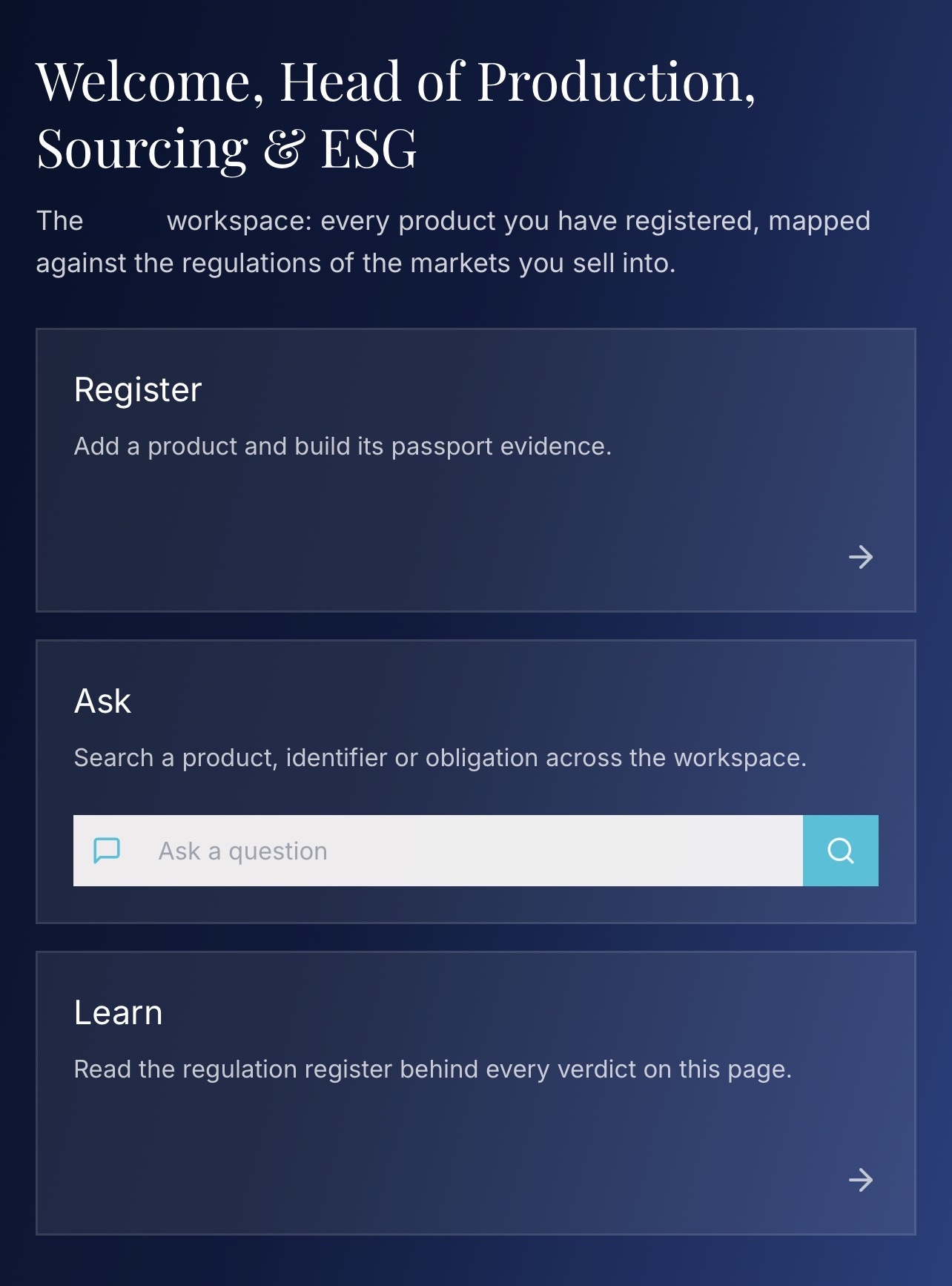
One digital product identity for every product. Every compliance regulation and all green claims checked and verified.
ESPR, EmpCo green claims, PPWR, packaging EPR, the UK Plastic Packaging Tax and Digital Product Passports — handled as market access and supply-chain resilience, not a reporting exercise.
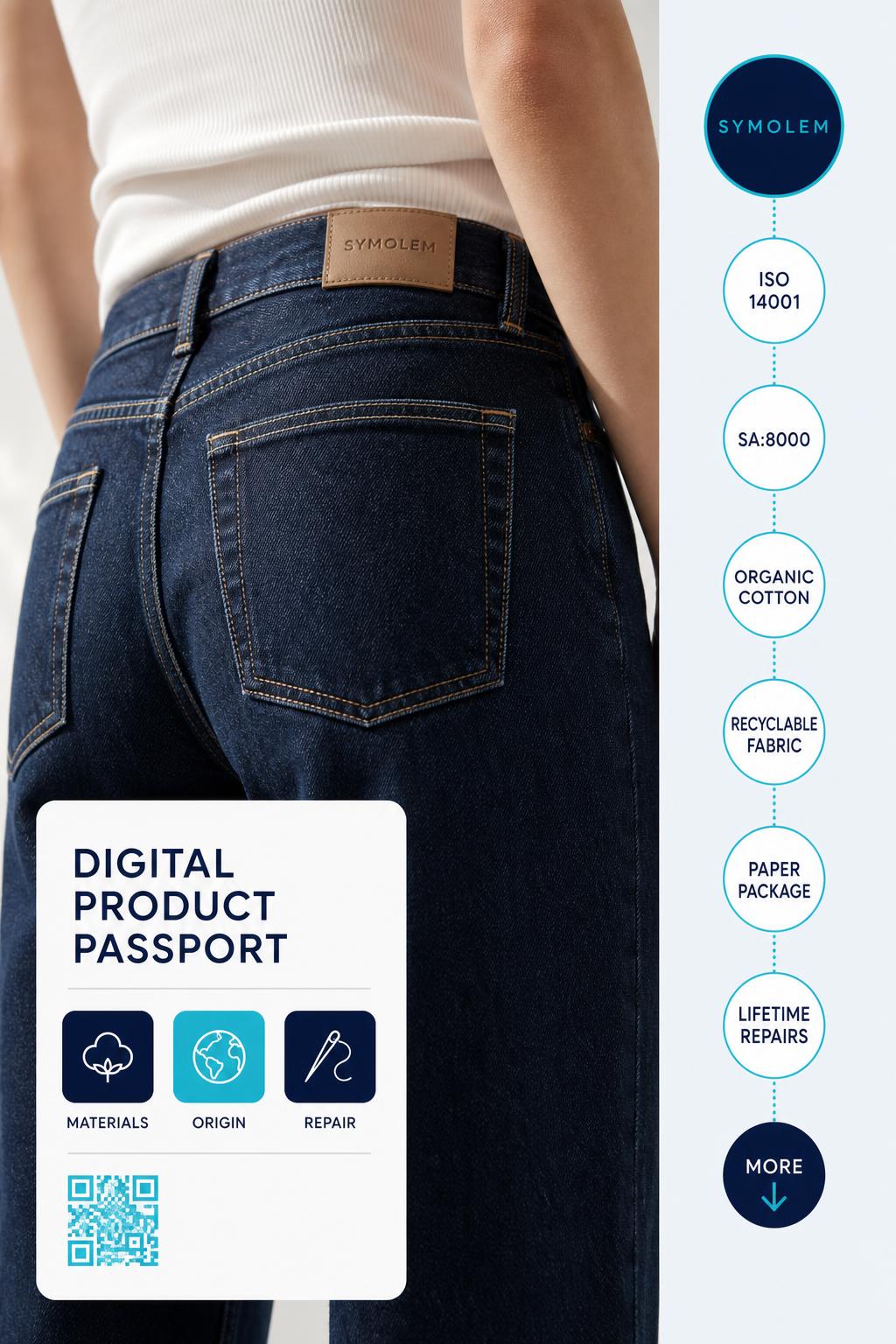
Our Digital Product Passport code was accepted by the EU registry on the day it opened — 20 July 2026.
Free check: enter your website and see how many of your products carry green claims wording that may not conform to UK law.
No sign-up needed to see your headline counts.
For retailers and marketplaces: screen incoming brand ranges against 50+ regulations before you sign the PO.
For brands: we retrieve the missing supplier data and document the social accounting behind your tiers.
Inaugural conference · Free to attend
Sustainability for fashion is product compliance. It means knowing what each garment is made of, where it comes from, and what you can prove.
A garment is either legal to sell in a market or it is not. That turns on what it is made of, where it came from, what is printed on the label and the product page, and what you can prove when someone asks. The decision attaches to the SKU, and it is made again for every market the product enters.
It is not ESG reporting, which describes the company. It is not a factory audit, which describes the site. Both feed it. Neither answers whether this dress can be listed in Germany next season.
The three things that decide it are held together and kept current: the rules in each market, the evidence you hold, and the product record they attach to. The output is a status per product, per market — cleared, action needed or blocked — and the file behind it.
The easiest way to think of it: Product · Regulations · Markets. For every product you sell, we connect what it is, what the law demands, and where you sell it — so nothing you put in front of a customer is left unproven.
Every SKU, feed, claim and care label
ESPR, EmpCo, UFLPA, packaging EPR
UK, EU, US and everywhere you sell
Check hundreds of SKUs against 50+ regulations in seconds, before you sign the PO or clear customs. See blocked lines, unproven claims and missing test certificates before stock is made or shipped.
Software portals stall in fashion because spinning mills and dye houses do not log into client dashboards. Our specialists chase and verify lab tests, transaction certificates and fibre origins directly from source factories.
Worker welfare, wage verification and grievance data compiled into auditable evidence packs that satisfy EU CSDDD, German LkSG and US forced-labour enforcement, not generic policy PDFs.
Symolem-ID is product compliance intelligence software for fashion. It holds the evidence behind each product, checks that record against the markets where it is sold and gives every party in the chain the same verified answer.
See whether a product is cleared, blocked or cannot yet be determined in each market — with the missing evidence and its owner named.
ESPR, EmpCo, EPR and packaging obligations are mapped to the products and jurisdictions they affect, then re-checked as the rules change.
Certificates, test reports, supplier attestations and passport data sit against the product, so a buyer or regulator can follow a claim back to its source.
Inspection record · ESPR
Symolem prepares your product data and audits your evidence against global requirements, starting with the EU ESPR. Fibre composition, certificates, named Tier 1 and Tier 2 sites and every green claim, checked and owned before they go anywhere near a label.
Whichever Digital Product Passport provider you choose, the passport is only as good as the audited data behind it. The textile delegated act sets which fields must be carried and who is accountable for each one. We make sure your suppliers can answer for them. Start with our ESPR Digital Product Passport checklist.
Select a data group to see the kind of entries we inspect and verify against the evidence.
inspection record · Product identity
We track the rules so your product and sourcing teams don't have to.
No ESPR equivalent yet, but the CMA can act directly on misleading environmental claims under the Digital Markets, Competition and Consumers Act.
No federal regime — obligations are set state by state, including California's SB 707 textile EPR, the FTC Green Guides, and Proposition 65 chemical disclosure.
Norway, Iceland and Liechtenstein take EU acts through the EEA Joint Committee on a different timetable; Switzerland is EFTA but not EEA.
Symolem holds a seat on the UN/CEFACT working group developing the UN Transparency Protocol (UNTP), the open standard for verifiable product and sustainability data, and contributed to its public review.

The people behind the record
A single garment involves fibre origins, spinning mills, wet-processing chemistry, blended yarns, trims and packaging weights, often across four countries. Software alone cannot verify that chain. Our specialists chase the evidence at source, so your product records survive a statutory audit.
Before you sample, we check which styles fall in scope of ESPR, EPR, the UK Plastic Packaging Tax and green-claims rules in each market — and which supplier data you do not yet have.
Fibre origin, transaction certificates, chemical test files and composition chased directly out of your suppliers, so the label matches what is in the product and can survive a check.
Worker welfare, fair pay and human-rights due diligence documented into an auditable file that answers CSDDD, LkSG and US forced-labour rules — not a policy PDF.
The hidden cost of hiring
£6,500+ a month
£2,000 a month
~70% saving
Illustrative monthly comparison. Employment costs vary by salary, benefits and recruitment terms.
Environmental and Social, on demand
Many fashion brands under £50m have no one whose job this is. A senior lead from Symolem takes the role, builds the function, and hands it over working.
For brands and retailers with no in-house sustainability lead, or one person who needs senior cover.
£2,000 a month. Three-month minimum, then rolling.
Led by Lavinia Fernandes, a UN/CEFACT UNTP Supply Chain Working Group member.
See the embedded manager deliverables →When you need more than a department
Some obligations need a project, not a person. Four scoped pieces of work, each with a fixed output and a clear end.
Each step has a fixed output and a clear end. Stop at any one of them, or keep the consultant until the obligation is current.
Every style checked against ESPR scope, EPR registration, green-claims rules and UK packaging obligations, market by market, with the dates each one stops being sellable.
The missing evidence chased directly out of Tier 1–3 suppliers: fibre origin, transaction certificates, chemical test files, composition and packaging weights. Collected once, structured, and linked to the products it belongs to.
Worker welfare, fair pay and labour evidence documented across your supply chain into an auditable social file that answers CSDDD, LkSG and US forced-labour requirements.
One audit-ready record per product, with expiry dates, named owners and a runbook your sourcing team can run. It clears retail onboarding, customs queries and feeds whichever DPP provider you choose.
Scoped against range size, number of markets and supplier count. Consultancy engagement: 3, 6 or 12 months. Fixed output at every step.
Where it goes wrong
Under EU ESPR, EmpCo and the UK DMCC, retailers share liability for the third-party brands they list. Symolem-ID screens a brand's line sheet in seconds and gives buying and legal teams a status per SKU before intake: cleared, blocked or missing evidence, with the gap named.
Stockists and customs are asking for proof you do not have on file. We chase your suppliers for the missing lab tests and transaction certificates, and tie every green claim to its evidence, so wholesale orders are not delayed and claims hold up under EmpCo and the UK DMCC.
Tier maps and audit PDFs are not a Digital Product Passport and do not tell you whether a silk blend clears AGEC, PPWR or the textile delegated act. We take the outputs you already hold, map them to the passport fields and the rules, and audit the record, then hand one Verification ID to whichever DPP provider you choose, with the proof pack.
A red flag with no remediation path is a stock dropout, a withdrawn claim or a blocked listing. We investigate the supplier data gap, run the social accounting and corrective action plan with the supplier, and upload the verified resolution back into the platform that raised it.
Plain English
Short answers, no jargon. If yours is not here, ask us directly and we will answer it the same way.

Whether you are working out what stopped on 27 September, which suppliers can evidence what they claim, or who carries the obligation on an FOB order — start with your own claims, or 20 minutes with us.