
Product compliance platform and advisory for fashion
Product compliance intelligence for fashion.
One digital product identity for every product. Every compliance regulation and all green claims checked and verified.
ESPR, EmpCo green claims, PPWR, packaging EPR, the UK Plastic Packaging Tax and Digital Product Passports — handled as market access and supply-chain resilience, not a reporting exercise.
Our Digital Product Passport code was accepted by the EU registry on the day it opened — 20 July 2026.


Inaugural conference · Free to attend
What do your clothes really cost?
Product compliance is a decision about a product, not a report about a company.
Sustainability for fashion is product compliance. It means knowing what each garment is made of, where it comes from, and what you can prove.
What product compliance intelligence is
A garment is either legal to sell in a market or it is not. That turns on what it is made of, where it came from, what is printed on the label and the product page, and what you can prove when someone asks. The decision attaches to the SKU, and it is made again for every market the product enters.
What product compliance intelligence is not
It is not ESG reporting, which describes the company. It is not a factory audit, which describes the site. Both feed it. Neither answers whether this dress can be listed in Germany next season.
What compliance intelligence means
The three things that decide it are held together and kept current: the rules in each market, the evidence you hold, and the product record they attach to. The output is a status per product, per market — cleared, action needed or blocked — and the file behind it.
One product compliance record. Every obligation. Every retailer.
Symolem-ID is product compliance intelligence software for fashion. It holds the evidence behind each product, checks that record against the markets where it is sold and gives every party in the chain the same verified answer.
Market access, country by country
See whether a product is cleared, blocked or cannot yet be determined in each market — with the missing evidence and its owner named.
- Blocked
- CAP active
- Cleared
Compliance rules attached to products
ESPR, EmpCo, EPR and packaging obligations are mapped to the products and jurisdictions they affect, then re-checked as the rules change.
Evidence behind every EmpCo green claim
Certificates, test reports, supplier attestations and passport data sit against the product, so a buyer or regulator can follow a claim back to its source.
Request platform access
Market access: which products can be sold where
Tell us what you sell and where. We'll set up a walkthrough of Symolem-ID against a slice of your own range, and show you exactly what lands in your dashboard after an engagement.
- A dashboard row for every style you sell, mirrored from your ecommerce range
- Per-market status — cleared, action needed or blocked — for EU, UK and US rules
- The evidence file behind each status, so you can answer a surveillance request the same day
- A proof pack for auditors — structured evidence behind every claim, ready for a surveillance visit or due-diligence request
- Weekly re-checks against the EU DPP registry, with an email when a status changes
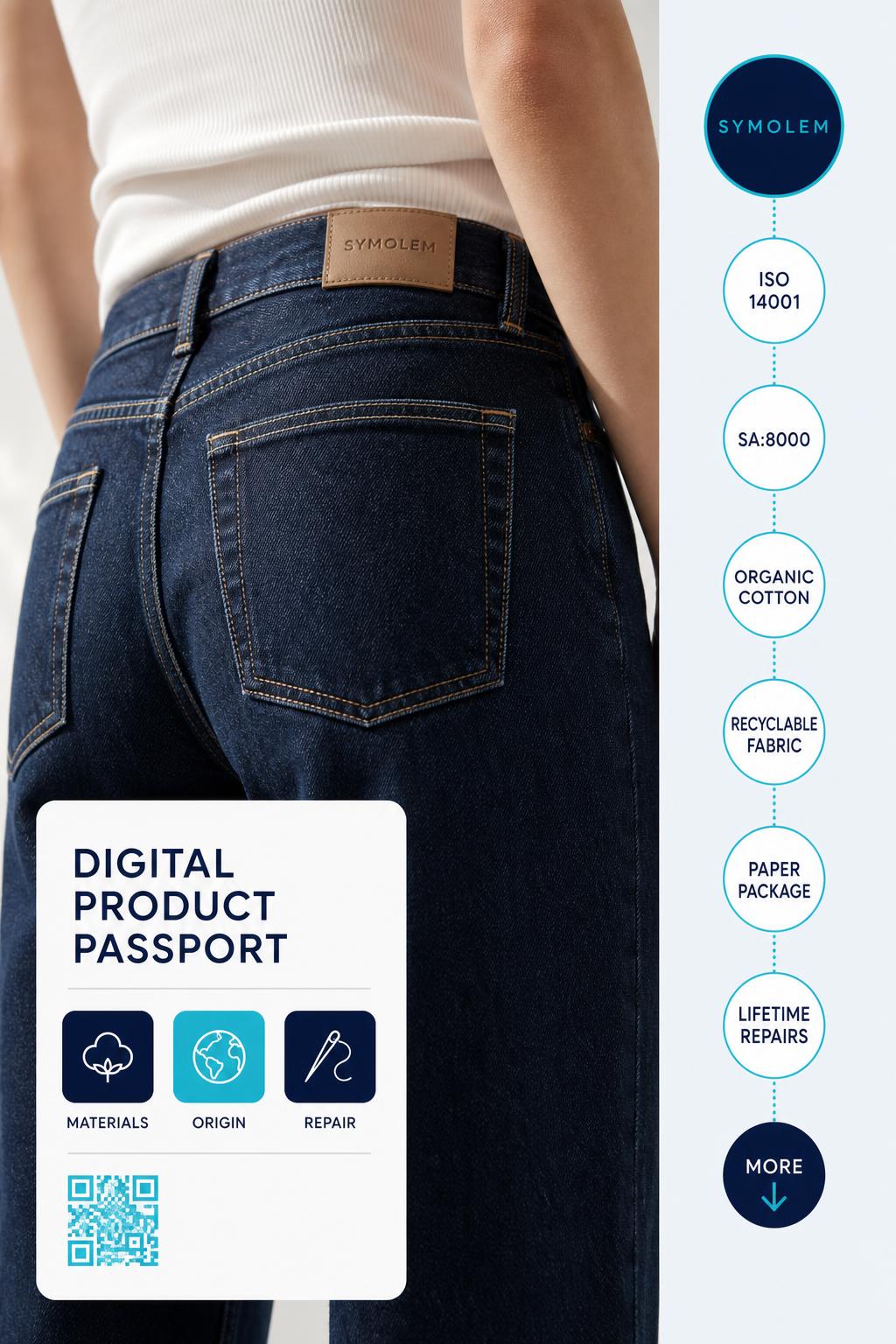
product level evidence
A Digital Product Passport is a data carrier.
The QR code on the label is not the passport. It is the carrier: scanning it resolves to a structured record held against a unique product identifier. The picture shows what a shopper, an auditor or a market surveillance officer sees when they scan a garment — the same file, read at different depths.
Under ESPR the delegated act for textiles sets which fields must be carried, who is accountable for each one, and how long the record must stay available. Badges on a product page are marketing. A Digital Product Passport is a regulated data set with an owner, a date and a source behind every line — and from 2027 it decides whether the product can be placed on the EU market at all.
The passport data behind the code
Select a data group to see the kind of entries we collect and hold for it.
example passport entries · Product identity
- GTIN 05012345678900 · GS1 Digital Link
- Model: Wide-leg denim, style DN-402
- Batch 2026-07-WK29 · EU registry ID issued
- Economic operator: brand legal entity and EORI
Market access depends on the product, not just the company.
We track the rules so your product and sourcing teams don't have to.
Great Britain
No ESPR equivalent yet, but the CMA can act directly on misleading environmental claims under the Digital Markets, Competition and Consumers Act.
United States
No federal regime — obligations are set state by state, including California's SB 707 textile EPR, the FTC Green Guides, and Proposition 65 chemical disclosure.
EEA / EFTA
Norway, Iceland and Liechtenstein take EU acts through the EEA Joint Committee on a different timetable; Switzerland is EFTA but not EEA.
Built on the UN/CEFACT UN Transparency Protocol.
Symolem holds a seat on the UN/CEFACT working group developing the UN Transparency Protocol (UNTP), the open standard for verifiable product and sustainability data, and contributed to its public review.

The people behind the record
Software can hold the compliance evidence. Someone still has to find it.
The facts a passport needs sit across bills of materials, supplier files, test reports and factory records. Our consultants work inside your sourcing and product teams to collect them, test them and turn them into a product record that can survive scrutiny.
Range reviews that flag ESPR at-risk styles
Before you sample, we check which styles fall in scope of ESPR, EPR, the UK Plastic Packaging Tax and green-claims rules in each market.
Supplier evidence that matches the garment
Fibre origin, processing location and composition pulled out of Tier 1 and Tier 2, so the label matches what is in the product and can survive a check.
Packaging data your returns can stand on
Packaging weights, material splits and recyclability captured per component, so PPWR, packaging EPR and UK Plastic Packaging Tax returns are built from evidence, not estimates.
Embedded compliance specialists
When the compliance obligation arrives before the hire does.
A fixed-term vacancy, parental leave or a compliance deadline can leave essential work without an owner. We embed for 3, 6 or 12 months, take responsibility for defined outputs and leave the process with your team.
Embedded compliance cover for 3, 6 or 12 months
An embedded consultant owns the same remit a permanent coordinator or manager would: packaging and product compliance, reporting cycles, supplier follow-up and internal guidance.
Output: obligation map, data gaps listed, owner named for each.
Someone owns the packaging compliance numbers
Packaging weights, material splits and recyclability collected per component and reconciled against volumes, so PPWR, packaging EPR and UK Plastic Packaging Tax submissions hold up.
Output: packaging dataset built, returns prepared, reporting pack repeatable.
The supplier evidence chasing gets done
We run the follow-up with Tier 1 and Tier 2 suppliers, translate the requests into their language and formats, and close the gaps rather than logging them.
Output: evidence chase closed on priority lines, exceptions escalated with options.
What the consultants deliver
From range review to compliance evidence.
In four steps.
Four steps, delivered by a consultant embedded for 3, 6 or 12 months. You find out which styles are at risk, we fix the sourcing data behind them, and you end with a file you can hand to a buyer or a regulator.
Each step has a fixed output and a clear end. Stop at any one of them, or keep the consultant until the obligation is current.
Map the range against ESPR
Every style checked against ESPR scope, EPR registration and UK packaging obligations, market by market, with the dates each one stops being sellable.
Prove the fibre with traceability evidence
Composition, fibre origin and processing location tracked back from product to Tier 1 or Tier 2. We work with your upstream traceability providers and logistics teams so the evidence is collected once and available to your entire team — and your shoppers.
Clear the green claims
Recycled, organic and low-impact claims substantiated or withdrawn before trims, tickets and labels go to order. Each claim is linked in Symolem-ID to the certificate or attestation behind it, so the substantiation outlives the engagement.
Hold the compliance file
Certificates, test reports and passport data in one place, with expiry dates, named owners and a runbook your sourcing team can run. The same file becomes the passport proof pack for auditors and market surveillance.
Scoped against range size, number of markets and supplier count. Consultancy engagement: 3, 6 or 12 months. Fixed output at every step.
Where it goes wrong
Four ESPR questions a buyer, a marketer or an auditor will ask before you are ready.
Do we have market access for this product?
Third-party brands arrive with claims and passports you did not make and now share liability for. We give buying and merchandising a status per SKU before the PO is signed: cleared, blocked, or can't determine, with the missing evidence named.
Can we prove the green claim under EmpCo?
"Responsibly sourced" is marketing until it points at a transaction certificate. Under EmpCo and the UK DMCC it is a liability. Every claim sits in a register tied to its evidence, owner and expiry, and is flagged before it is bought, listed or reprinted.
We have traceability data. Why isn't it a passport?
Tier maps and audit PDFs are not a Digital Product Passport and do not tell you whether a silk blend clears AGEC, PPWR or the textile delegated act. We take the outputs you already hold, map them to the passport fields and the rules, and issue the record and the proof pack.
An ESPR finding came back red. What now?
A red flag with no remediation path is a stock dropout, a withdrawn claim or a blocked listing. We run a corrective action plan with the supplier, keep the product under containment while it is fixed, and upload the verified resolution back into the platform that raised it.
Specialist compliance capability, for as long as the obligation needs it.
No Compliance Team?
Common in businesses under £50m and in most emerging brands. The obligations apply in full regardless of size. Symolem operates as the function: registrations, evidence, claims and filings run externally, with your product team briefed rather than burdened.
The most common position in heritage and mid-market brands. Your team knows the supply base and can get answers out of it. What is missing is the reading, which regulation applies to which product, in which market, from which date. Symolem supplies the interpretation and the structure; your team supplies the relationships.
One person carrying UK, EU and US across every product category. Capable, and structurally unable to cover it. Symolem takes defined workstreams, a market, a filing cycle, a data collection programme, so the internal lead keeps ownership without carrying the whole surface.
Plain English
The ESPR and EmpCo questions we get asked most
Short answers, no jargon. If yours is not here, ask us directly and we will answer it the same way.

Let's talk about your market access.
Whether you are working out what stopped on 27 September, which of your suppliers can evidence what they claim, or who carries the obligation on an FOB order. A 30-minute conversation is the place to start.