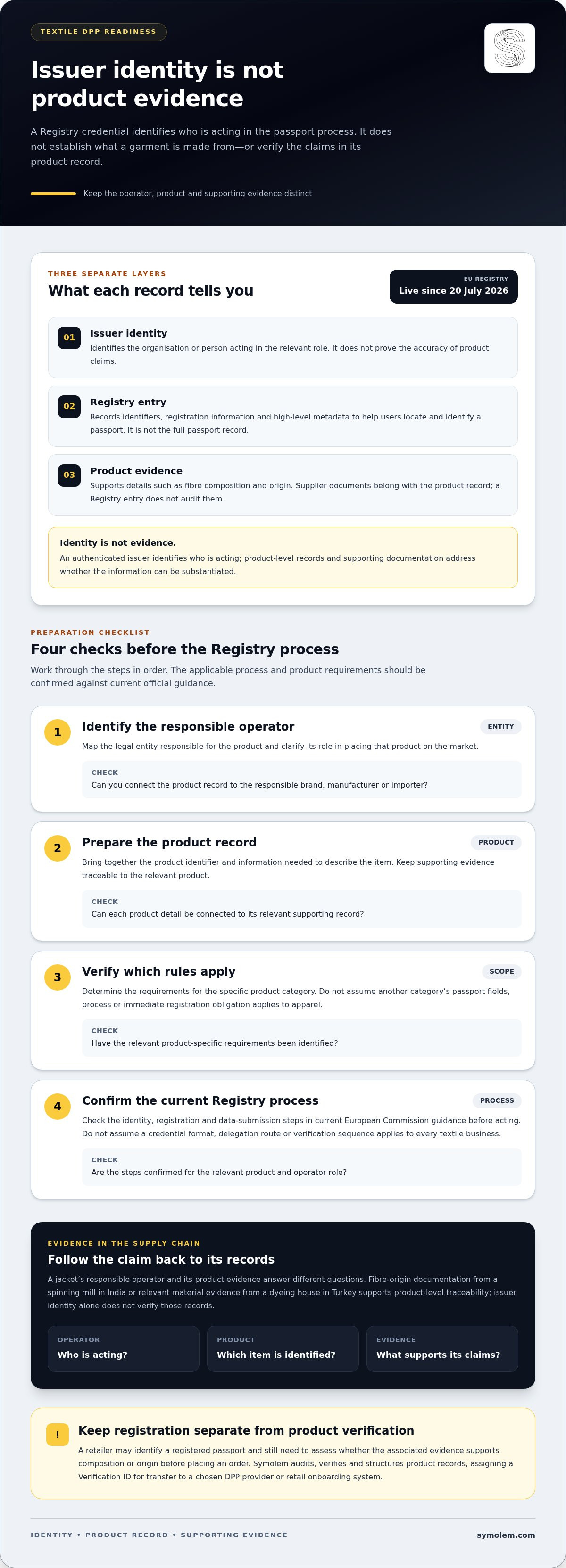
EU DPP Registry Issuer Credentials: A Compliance Guide
An issuer credential can establish who is registering a Digital Product Passport. It cannot prove what a garment is made from. That distinction matters: the EU DPP Registry issuer credential verifies an economic operator’s identity, while evidence of fibre composition, origin and supplier processes belongs to the product record.
Fashion businesses are right to focus on registration, but identity checks are only one part of readiness. The EU Registry, operational since 20 July 2026, acts as a directory for passport identifiers and related metadata; it does not hold the full passport data or validate every underlying product claim. A verified issuer status is therefore not a certificate that a passport’s evidence is complete or accurate.
This guide clarifies what issuer verification establishes, how Registry records differ from detailed passport information, and what apparel businesses should prepare before registration. It also explains how traceable supplier documentation, from fibre-origin records to test reports, supports product-level evidence verification without confusing that work with passport issuance. The result is a clearer preparation path for brands managing complex textile supply chains and retailers assessing product compliance before purchase orders are signed.
Key Takeaways
- Map which legal entity is responsible for each product and how its role connects to the brand, manufacturer or importer before preparing registration records.
- Prepare identifiers and product information in a structured format, then assess what evidence is available to support composition, origin and other product claims.
- Treat the EU DPP Registry issuer credential as an identity step, not a substitute for product-level verification or supplier documentation.
- Check the Registry process against current Commission guidance and the rules applicable to the relevant product category; don’t assume every apparel business has the same immediate registration obligation.
- Symolem audits, verifies and structures product records, assigning a Verification ID for transfer to a chosen DPP provider or retail onboarding system.
Table of Contents
- EU DPP Registry issuer credentials: what they identify and why the distinction matters
- How Registry identity checks fit into a Digital Product Passport workflow
- Issuer credential, Registry entry and passport evidence: three different layers
- How fashion teams can prepare for issuer verification without confusing it with compliance
- How Symolem supports verified product records without issuing consumer passports
EU DPP Registry issuer credentials: what they identify and why the distinction matters
Identity is not evidence. An issuer credential concerns the entity acting in the passport process; it does not establish that a garment’s fibre composition, origin or other product claims are accurate. For fashion businesses, treating these as separate controls is essential: the legal entity responsible for a record and the documents supporting that record answer different questions.
The EU DPP Registry went live on 20 July 2026. It forms an EU-level index within a broader decentralised architecture: the Registry records identifiers, registration information and high-level metadata that help connect a passport to its relevant data, rather than holding the complete product record. The Registry’s launch should not be confused with a product-specific obligation. Whether a textile product must have a passport, and what information it must contain, depends on the applicable requirements for that product category.
What does an issuer credential establish?
In practical terms, issuer identity relates to the organisation or person acting in the relevant role. It is distinct from a product identifier, which points to a product or passport record, and from a supplier’s identity, which may be part of the product’s traceability information. The phrase EU DPP Registry issuer credential may be used as shorthand, but teams should check the formal terminology and scope in current European Commission guidance and applicable legal texts. Don’t assume a particular credential format, delegation route or verification sequence applies to every textile business.
Authenticated issuer identity identifies who is acting; verified product evidence supports whether the product information can be substantiated. For example, identifying the responsible operator for a jacket does not verify a fibre-origin document from a spinning mill in India or confirm that a dyeing house in Turkey supplied evidence for the relevant material.
What the EU DPP Registry is designed to record
The Registry’s indexing role helps distinguish the passport’s registration and reference information from the detailed data associated with the product. The operator remains responsible for the detailed passport information and for ensuring that product claims are supported by appropriate records. A Registry entry can help authorities or other permitted users locate and identify a passport, but it should not be treated as an audit of its contents.
This separation has operational consequences. A retailer may be able to identify a registered passport while still needing to assess whether the associated evidence supports claims about composition or origin before placing an order. Brands, in turn, need a clear link between each product record, its responsible operator and the supplier documentation underpinning it. The wider architecture and implementation considerations are explored in Implementing Digital Product Passports: A Strategic Framework for Textile Compliance, while the EU Digital Product Passport overview provides broader context on the framework and its legal basis.
How Registry identity checks fit into a Digital Product Passport workflow
Registry identity checks are one control in a wider process, not a shortcut through product compliance. Fashion teams need to connect the responsible economic operator to a defined product record, assess what rules apply to that product, and then follow the relevant Registry process. The exact registration steps and data requirements must be checked against current European Commission guidance and the legislation applicable to the product category.
A practical preparation sequence is:
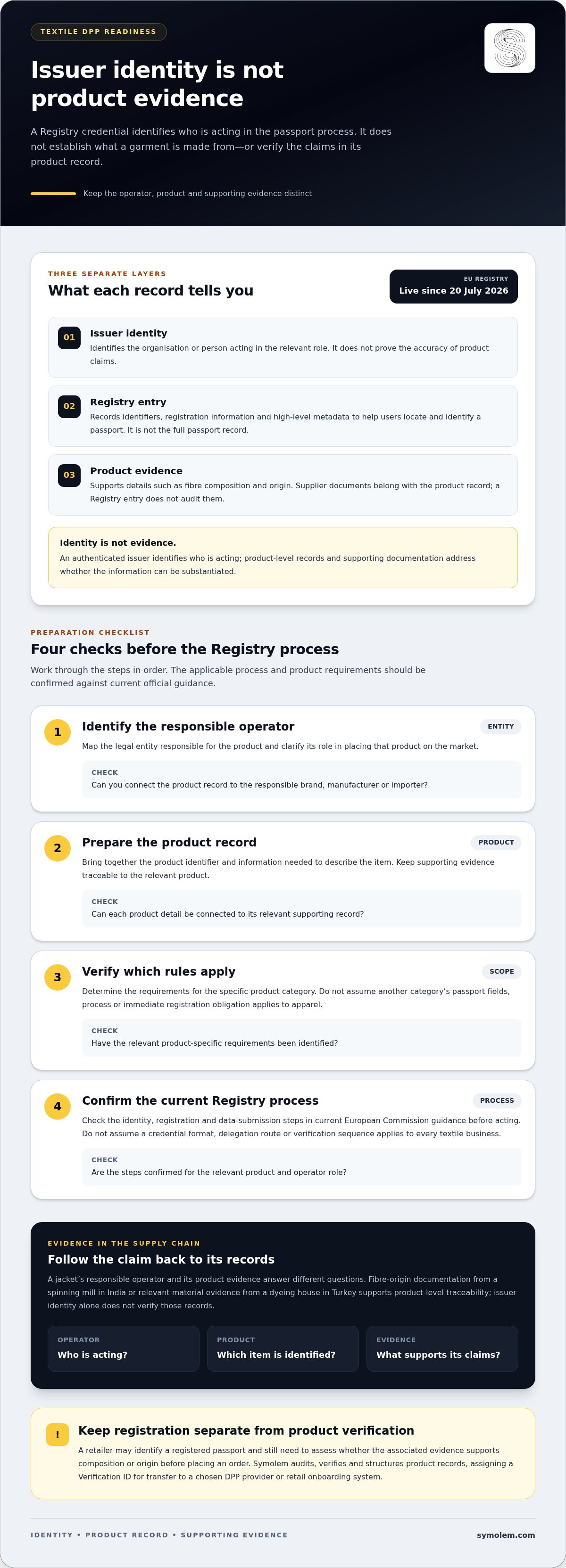
- Identify the responsible operator. Map the legal entity responsible for the product and clarify its role in placing that product on the market.
- Prepare the product record. Bring together the product identifier and the information needed to describe the relevant item, keeping its supporting evidence traceable.
- Verify the applicable rules. Determine which product-specific requirements apply, rather than assuming that another category’s passport fields or process also applies to apparel.
- Follow the relevant Registry process. Confirm current identity, registration and data-submission steps through the applicable official guidance before acting.
From economic operator identity to a registered product record
These stages connect different records, but they are not interchangeable. The operator’s identity identifies who is acting; a product identifier points to the item; and the passport record contains product information and related evidence. The EU DPP Registry issuer credential is sometimes used as shorthand for identity checks, but that phrase alone should not be treated as proof of a particular credential type, mandatory sequence or delegation mechanism for textiles.
Consider a retailer reviewing a jacket. Its team needs to establish which brand or other responsible operator is associated with the passport record, then connect the product identifier to the relevant information and evidence. If a supplier has provided fibre-origin documents or chemical test reports, those records must be linked to the product as appropriate; an identity check does not establish that the documents are complete or substantiate a claim.
Technical or administrative tasks may be carried out by a service provider where the applicable arrangements allow it. Delegating an action does not, by itself, transfer the relevant operator’s legal responsibility for the product information. Before a textile-specific process is established, teams should avoid treating a workflow used elsewhere as a settled apparel requirement.
Why battery-registration examples need careful boundaries
Battery passport material can illustrate how product categories may have distinct rules and implementation processes. It cannot establish the credential steps, registration sequence or technical data requirements for clothing. Apparel teams should rely on the Commission’s current guidance and the legal rules applicable to textiles, not transplant battery-specific instructions; DPP Index can provide broader orientation, but it is not a substitute for those official sources.
For brands, the operational priority is to map responsible entities, product identifiers, supplier evidence and existing data systems before registration procedures become a bottleneck. Symolem’s product compliance evidence verification audits, verifies and structures product records, assigning a Verification ID that can feed a chosen DPP provider or retail onboarding system.
Issuer credential, Registry entry and passport evidence: three different layers
These layers answer different compliance questions. Combining them into a single “DPP approved” status can conceal whether a check covered identity, registration or the evidence behind a garment’s claims. Separate them in product records and retailer reviews.
Issuer identity
Identifies the organisation or person acting in the relevant role. It does not establish whether product details are accurate.
Registry entry
Records the passport’s identifier and registration information, helping connect the record to its associated data. It is not a substantive review of every claim.
Detailed product evidence
Supports product information, such as fibre composition or origin. Its relevance and sufficiency depend on the claim and applicable requirements.
The EU-accepted passport sample contained 67 data points, while a UNTP-conformant passport can carry up to 236. These figures describe a sample and a data framework, respectively; neither is a universal textile requirement or a definitive checklist for every garment. Textile data obligations must be determined from the applicable product-specific rules.
Identity and registration proof are not product verification
An authenticated actor can still submit information that is incomplete, inconsistent or weakly supported. A registration record may show that a passport has been registered, but that status alone does not establish the truth, completeness or auditability of the data associated with it. The distinction is material for retailers making pre-purchase-order decisions: a visible record does not remove the need to assess evidence relevant to product claims.
A Registry credential cannot prove a garment’s fibre composition or establish that its origin claim is supported by traceable supplier records. The EU DPP Registry issuer credential concerns the actor’s identity; product verification concerns whether the information about the product is substantiated. Treating one as a substitute for the other creates a control gap.
Where textile evidence sits in the passport chain
Consider a garment made with yarn from a spinning mill in India, dyed at a facility in Turkey and assembled by a CMT factory in Portugal. The passport’s product record may need to connect relevant fibre-origin documentation, chemical test reports and transaction certificates to the garment or its materials. The brand must preserve enough structure to show which supplier document supports which product attribute, rather than placing unrelated files in a general folder.
Evidence quality depends on traceability and fit. A test report must relate to the relevant material or product; an origin document must support the stated origin claim; and transaction records need to connect to the relevant supply-chain movement. A retailer can then distinguish missing evidence from a claim that has been reviewed and supported, instead of treating Registry presence as a blanket compliance clearance.
For teams mapping those attributes, “Textile DPP Data Requirements: Essential Checklist” provides a deeper attribute-level treatment. The operational task is to connect each required product field to its source, owner and supporting record, while keeping registration status distinct from evidence quality.
How fashion teams can prepare for issuer verification without confusing it with compliance
Preparation should start with the product and the organisations responsible for its records, not with an assumed registration deadline. Apparel businesses shouldn’t infer that every product must be registered immediately or that one process applies across all textile categories. Confirm the applicable product-category rules and current Registry procedures through official sources before treating any step as a legal requirement.
A practical readiness exercise can still begin now. Map product ownership, responsible parties, identifiers and existing data systems; then assess whether supplier evidence can be retrieved, linked and reviewed. This separates the work that establishes who is acting from the work that supports what the passport says.
Build an operator and product-record map
For each relevant product flow, document the roles of the brand, manufacturer, importer and retailer. Identify which organisation is accountable for each data element, where its source record sits and how the product identifier connects the information to the correct item. This map gives teams a basis for resolving ownership questions before they approach Registry procedures. The discussion in “UNTP Digital Product Passports: A Strategic Explanation” provides a standards-focused perspective on structuring passport information.
Keep the map operational. If a brand sources a garment from an overseas manufacturer and sells it through a retailer, record the relevant entities and their roles rather than assuming that the factory, brand and importer are interchangeable. Link internal product codes to the corresponding product records, identify which systems hold supplier documents, and note where the same information is maintained in separate files or tools.
Resolve evidence gaps before a passport record is relied upon
Next, inventory gaps across Tier 1-3 suppliers and assign an owner to retrieve and review each missing record. Prioritise fibre-origin documents, chemical test reports and transaction certificates according to the product information they are intended to support. A missing document is a visible gap; an untraceable or mismatched document is a different problem and shouldn’t be treated as proof.
For each record, capture its source, the product or material it covers, its date and any unresolved limitation. That discipline helps teams assess whether evidence is relevant and current for the intended claim without overstating confidence. It also gives retailers a clearer basis for pre-purchase-order review when supplier documentation is incomplete.
Supplier-data retrieval, Registry identity checks and passport-provider implementation are separate workstreams. A credential process cannot fill an evidence gap, and a provider workflow cannot determine which textile rules apply. The phrase EU DPP Registry issuer credential should therefore sit within a controlled readiness plan, alongside assigned responsibilities and documented evidence status, rather than being treated as a product-compliance result.
Fashion brands that need to structure and verify product records can use Symolem’s product compliance evidence support to prepare evidence for a chosen DPP provider or retail onboarding system.
How Symolem supports verified product records without issuing consumer passports
Evidence verification and passport issuance are different functions. Symolem is a product compliance intelligence platform and evidence advisory for fashion, footwear and textiles. It audits, verifies and structures product compliance records, then assigns a Verification ID that can feed a chosen DPP provider or retail onboarding system. The DPP provider’s system supports the passport; the EU Registry records the relevant registration information. These roles should not be collapsed into one.
That separation matters commercially. An identity check may establish which organisation is acting, but it does not retrieve a missing laboratory report or test whether a supplier document supports a product claim. Symolem’s work addresses the evidence gap, while the relevant operator remains responsible for its records and any applicable obligations.
For retailers and marketplaces: screen third-party ranges before the PO
Retailers need a repeatable control before purchase orders are signed, particularly when they assess apparel ranges made by suppliers they do not directly manage. Symolem-ID screens third-party brand ranges against 50+ global textile regulations in seconds and assigns a per-SKU status: Cleared, Blocked or Missing Evidence. This supports procurement governance by making evidence gaps visible at product level before a buying decision.
A Missing Evidence status, for example, can flag a garment where the brand has not supplied a relevant test report or origin record. That is a procurement signal, not a Registry identity result: it helps teams determine where follow-up or review is needed, rather than treating an issuer credential as evidence that product claims have been substantiated. Retail screening and Registry identity checks address separate risks.
For fashion brands: retrieve and verify the evidence behind product records
For brands, incomplete supplier records are often the practical bottleneck. Symolem Advisory undertakes forensic Tier 1-3 evidence retrieval, including chemical laboratory tests, fibre-origin documentation, transaction certificates and packaging weights. A spinning mill in India, dyeing house in Turkey and CMT factory in Portugal may each hold records relevant to different parts of one garment’s chain; those documents must be traceable to the product information they support.
Symolem reviews and structures product records, and verified records can receive a Verification ID for transfer to a selected DPP provider or retail onboarding system. This does not mean Symolem builds or issues a consumer-facing passport. Nor does it make a supplier’s unsupported claim true. It creates a clearer, organised evidence record for the responsible business to use within its chosen implementation process.
Keep the roles distinct: Symolem verifies and structures product evidence; the chosen provider operates its passport system; and the EU Registry performs its registry function. The EU DPP Registry issuer credential concerns identity, not the quality of the garment evidence. Brands can use the Free Assessment to identify evidence and readiness gaps; retailers can screen third-party ranges before committing to a PO.
Screen third-party brand compliance before signing the PO. Explore Symolem-ID or run a free product scan.
Need to retrieve missing Tier 1-3 supplier evidence or substantiate social accounting for retail stockists? Take the 5-minute Free Assessment or Book an Advisory Consultation.
Make readiness a defined operational priority
Turn passport preparation into an owned operational task, not a label applied to a product after the fact. Assign responsibility for resolving open product-record and supplier-evidence gaps, and track whether each issue has been addressed or remains outstanding. That gives buying and compliance teams a clearer basis for decisions as product-specific requirements develop.
For retailers, the next step is to make evidence status visible in procurement decisions before orders are committed. For fashion brands, it is to establish who will retrieve missing supplier records and maintain their link to the relevant products. Neither task replaces official guidance on applicable Registry procedures.
Clear ownership makes readiness actionable. Start with the unresolved issue that poses the greatest barrier to a defensible product record, then build from there.
Frequently Asked Questions
What is an EU DPP Registry issuer credential?
An EU DPP Registry issuer credential is a cautious term for identity-related evidence or authorisation associated with the organisation or person acting as an issuer. It concerns the actor, not the garment or its passport data. The exact formal meaning, credential format and process should be checked against current European Commission guidance and rules for the relevant product category. Don’t infer textile requirements from terminology used in another sector.
Does an issuer credential prove that a Digital Product Passport is compliant?
No. Identity or authority verification concerns who is acting; compliance depends on the requirements that apply and whether the passport’s information is accurate, complete and supported. A Registry record should not be treated as validation of every product claim. For a garment, review relevant source documents separately, checking that records relate to the product and support claims such as fibre content or origin.
When did the EU DPP Registry go live?
The EU DPP Registry went live on 20 July 2026. That launch date does not mean every textile product must already have a registered passport. Product obligations and timing depend on applicable legislation and product-specific rules. Before setting internal deadlines or making registration a condition of supplier onboarding, check current official EU sources for the relevant category and confirm which requirements apply to the products being placed on the market.
Does the EU DPP Registry store the full Digital Product Passport?
No. The Registry functions as an EU-level index for identifiers, registration data and high-level metadata, rather than as the repository for every detailed passport field. The relevant economic operator remains responsible for product information, which may be hosted separately. For textile teams, this means a Registry entry alone won’t provide the supplier documents needed to support claims about a garment’s materials, composition or origin.
Is an issuer credential the same as a product identifier or Verification ID?
No. An issuer-related credential concerns an actor’s identity or authority; a product identifier points to a particular product or record. Symolem’s Verification ID is assigned to verified product records and can feed a selected DPP provider or retail onboarding system. These identifiers serve different functions and shouldn’t be substituted for one another or described as the consumer-facing passport itself.
Can a third party register a DPP on behalf of a fashion brand?
That depends on the applicable Registry process and product rules. Don’t assume a third party can perform particular actions for a fashion brand because a battery-passport example describes that arrangement. Technical assistance and legal responsibility are separate considerations: the relevant operator remains accountable for the information for which it is responsible. Verify any delegation mechanism against current official sources before incorporating it into supplier or provider procedures.
What evidence should a fashion brand prepare before DPP implementation?
Start by identifying product-linked records such as fibre-origin documents, chemical test reports, transaction certificates and packaging weights. Which information is required depends on the applicable rules and the purpose of the product record. Map which supplier tier holds each document, who is responsible for obtaining and reviewing it, and where gaps remain. Keep this evidence work distinct from issuer identity checks and the Registry’s registration process.