
Textile Life Cycle Assessment Strategy: A Technical Guide to Regulatory Readiness
The era of voluntary environmental storytelling has officially collapsed under the weight of regulatory scrutiny. For too long, the textile industry has operated on a foundation of aspirational narratives and fragmented data, but the introduction of the Green Claims Directive and the Ecodesign for Sustainable Products Regulation (ESPR) has transformed sustainability from a brand preference into a high-stakes legal imperative. If you're currently struggling with the high cost of primary data collection or the paralysis caused by conflicting methodologies, you're not alone. The industry's structural failures are being exposed by a new European landscape that demands clinical precision over marketing hyperbole.
This technical guide provides the structural blueprint you need to master a rigorous textile life cycle assessment strategy that's audit-ready and defensible. We'll move beyond the superficial and focus on the systemic integrity required to navigate the Digital Product Passport (DPP) framework and the August 2026 packaging requirements. By the end of this article, you'll have a clear roadmap for LCA implementation that ensures regulatory compliance for EU markets and secures your market access. We'll unpack the diagnostic steps necessary to transition from fragmented supply chain chaos to a verified, data-driven infrastructure that satisfies both auditors and regulators.
Key Takeaways
- Transition from aspirational "cradle-to-grave" storytelling to "data-to-compliance" mandates to ensure legal market access under the new EU regulatory landscape.
- Establish a rigorous textile life cycle assessment strategy by aligning ISO 14040 methodologies with the specific requirements of the EU Product Environmental Footprint (PEF).
- Identify the structural necessity of moving from proxy screening to primary data collection across Tier 1 to Tier 4 suppliers to achieve audit-ready accuracy.
- Map your technical environmental indicators directly to the 814 mandatory fields required for the upcoming Digital Product Passport (DPP) integration.
- Utilize a methodical five-step framework to transform fragmented supply chain data into a defensible strategic asset that satisfies both auditors and regulators.
What is a Textile Life Cycle Assessment (LCA) Strategy?
Compliance is not optional. A textile life cycle assessment strategy serves as the technical architecture for documenting the environmental reality of a product from its molecular origin to its eventual disposal. It represents a fundamental move away from the "Cradle-to-Grave" metaphors that have characterized sustainability marketing for the past decade. Instead, we're entering the era of "Data-to-Compliance" mandates, where environmental impact is treated with the same clinical precision and fiscal rigor as financial accounting. This isn't a marketing exercise; it is a legal necessity for continued market access in a regulated economy.
July 2026 marks a structural shift in the EU market. With the Ecodesign for Sustainable Products Regulation (ESPR) coming into force, the window for voluntary environmental storytelling is closing permanently. Brands must now utilize a standardized Life Cycle Assessment (LCA) methodology to establish a defensible "structural truth" across their global supply chains. This process replaces fragmented, unverified data with a diagnostic map that reveals the precise environmental cost of every fiber, dye, and transport leg. It creates a system of record that is resilient enough to withstand the scrutiny of a regulatory audit and provides the clarity needed to navigate complex value chains.
The Core Components of an Audit-Ready Strategy
An effective strategy requires more than software; it requires rigid governance. First, system boundaries must be defined from raw material extraction through to end-of-life recovery. Second, brands must adopt the EU’s Product Environmental Footprint (PEF) standards to ensure methodological consistency. Finally, internal governance is critical. Organizations must determine who owns the data and how it flows into the mandatory fields required for regulatory reporting.
LCA vs. Carbon Footprinting: Understanding the Scope
Carbon is a singular metric. It represents only one of 16 critical environmental indicators required for a comprehensive textile life cycle assessment strategy. While emissions are vital, they don't account for water scarcity, land use, or aquatic toxicity. Mastering these broader metrics is a prerequisite for any ESPR readiness diagnostic. Regulators demand a holistic view of impact that prioritizes systemic integrity over simple carbon offsetting.
Technical Standards and Methodological Rigour
Standards are no longer suggestions. ISO 14040 and 14044 provide the technical bedrock for environmental management, but the EU Product Environmental Footprint (PEF) is the new operational reality for brands. Methodological "cherry-picking" is now a high-stakes legal risk. Under the Green Claims Directive, which applies from September 2026, selecting a framework simply because it yields a more favorable result constitutes a regulatory failure. Brands must move toward third-party audited impact measurement and MRV (Monitoring, Reporting, and Verification) to ensure their environmental claims are defensible and audit-ready. This shift requires a clinical approach to verification that prioritizes systemic integrity over superficial marketing narratives.
Selecting the Right Methodological Framework
Choosing between standards is a strategic decision that affects global market positioning. The Product Environmental Footprint Category Rules (PEFCR) for apparel and footwear provide a standardized language, yet the choice between "Cradle-to-Cradle" and "Cradle-to-Grave" boundaries fundamentally alters circularity claims. To support these methodologies, brands must establish a robust textile supply chain traceability framework. This structural integrity is vital as LCA data becomes a mandatory component of the Digital Product Passport for the textile sector. Without this deep mapping, your textile life cycle assessment strategy will fail to meet the requirements of the textile delegated acts anticipated for 2027.
Managing Impact Categories and Midpoint Indicators
Carbon is a reductionist metric. A comprehensive textile life cycle assessment strategy must account for midpoint indicators like eutrophication, acidification, and abiotic depletion. These indicators reveal the precise environmental cost of textile processing, from water-intensive cotton cultivation to the chemical toxicity of synthetic dyeing. Weighting factors vary between standards; for example, how a framework values water use versus greenhouse gas emissions can shift the entire impact profile. Consistency in these data fields is a clinical necessity for year-on-year comparisons and regulatory scrutiny. If your current data mapping lacks this depth, consider an ESPR Readiness Diagnostic to identify the structural gaps in your impact measurement before the 2028 compliance deadlines. Relying on outdated or inconsistent metrics is no longer a viable business path in a transparent market.
The Data Accuracy War: Primary Data vs. Proxy Models
Averages are the enemy of compliance. While secondary Life Cycle Inventory (LCI) databases like Ecoinvent provide a necessary starting point for initial screening, they cannot support the weight of a legal environmental claim. Relying solely on proxy data creates a systemic vulnerability that regulators will exploit. A robust textile life cycle assessment strategy necessitates a calculated migration from industry averages to primary data sourced directly from the factory floor. This transition isn't just about accuracy; it's about establishing a "Data Quality Pedigree" that proves the reliability of every input across the value chain. As the EU Digital Product Passport (DPP) framework matures, the use of primary data for high-impact categories will shift from a recommendation to an absolute mandate. Brands that continue to hide behind global averages will find themselves unable to meet the 814 mandatory data fields required for textile compliance.
The "Data Quality Pedigree" serves as a diagnostic tool for assessing the reliability of supply chain inputs. It categorizes data based on its source, age, and geographical relevance to ensure that the impact profile isn't distorted by outdated or irrelevant information. Without this audit trail, your environmental score is nothing more than a statistical guess. Regulators don't want guesses; they want systemic integrity. The coming DPP requirements will effectively penalize brands that lack this level of detail, making the cost of primary data collection a secondary concern compared to the cost of market exclusion.
The Strategic Transition from Proxies to Primary Inputs
Building a defensible database happens in deliberate stages. First, use secondary databases to identify environmental hotspots within your product portfolio. This screening phase allows you to prioritize resources where they matter most. Second, engage Tier 1 and Tier 2 suppliers to capture direct energy, water, and waste metrics. Finally, move toward automated data integration to enable real-time impact measurement. This methodical progression ensures that your textile life cycle assessment strategy remains scalable while building the granular accuracy required for the 2028 reporting cycles. Don't wait for a perfect system; start with the hotspots and build the infrastructure for primary data collection one tier at a time.
Addressing the "Black Box" of Tier 3 and Tier 4 Suppliers
The deepest layers of the supply chain often remain the most opaque. Mapping technical data fields for raw material cultivation and chemical processing requires more than just a survey; it requires a structural incentive for transparency. You've got to move beyond asking for data and start building the infrastructure that makes data sharing a prerequisite for partnership. By integrating circular economy frameworks into supplier contracts, brands can transform Tier 3 and Tier 4 entities from black boxes into active participants in the verification process. This level of mapping is essential for accurately capturing the abiotic depletion and land use metrics discussed in previous sections. The "Data Gap Penalty" is the mandatory downward adjustment of a product's environmental score by regulators when a brand fails to provide verified primary data for high-impact life cycle stages.
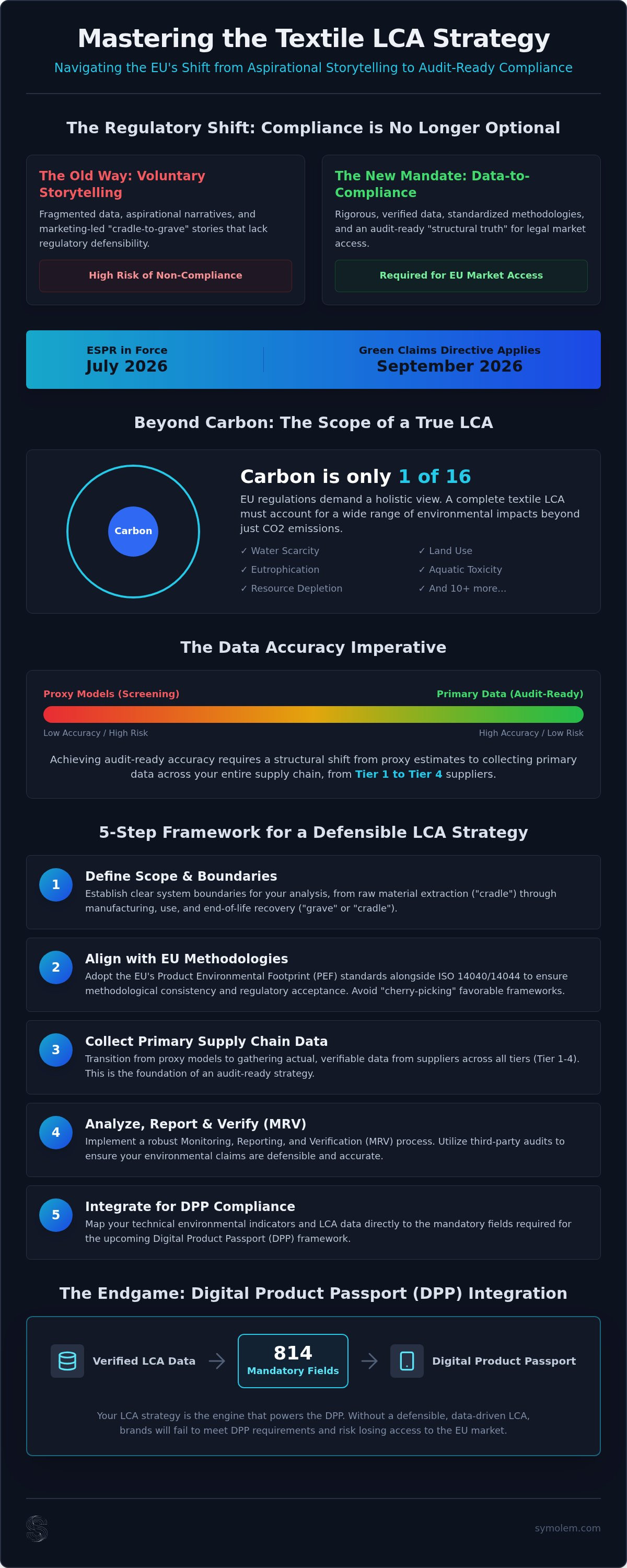
How to Build a Textile LCA Strategy: A 5-Step Framework
LCA is not a static report; it's a dynamic operational engine. Treating impact measurement as a one-off academic study is a strategic failure that leaves brands vulnerable to the 2026 regulatory shift. A robust textile life cycle assessment strategy must be integrated into the core business architecture to ensure that every product decision is backed by verified data. This framework moves beyond simple calculation and focuses on the systemic mapping required to navigate the textile regulation impact on business models. Strategy is survival. It requires a clinical commitment to data integrity and a willingness to dismantle opaque supply chain structures.
Step 1 & 2: Scoping and Inventory Mapping
Scoping determines the legal defensibility of your claims. Functional units must evolve; the traditional "one t-shirt" metric is functionally obsolete under new durability-focused regulations. Instead, brands must define units based on wear cycles and longevity to satisfy ESPR requirements. Inventory mapping (LCI) involves tracking every chemical input and energy output from spinning to sewing. This process requires a rigid data governance structure within the organization to ensure that information isn't siloed but flows directly into the impact assessment phase. Without clear ownership, the inventory remains a collection of unverified fragments.
The third step, Impact Assessment (LCIA), translates this inventory into 16 validated environmental indicators. This is where the raw data becomes a diagnostic tool, revealing the precise environmental cost of your production choices. It's the bridge between raw numbers and strategic action.
Step 4 & 5: From Interpretation to DPP Integration
Interpretation is about identifying structural failures. Once the indicators are clear, brands must use these results to redesign circular business models and the underlying infrastructure. This isn't about minor tweaks; it's about re-architecting the value chain to minimize abiotic depletion and water scarcity. The final step is external communication and compliance. This involves preparing the technical documentation required for EU market entry and ensuring the textile life cycle assessment strategy supports the Digital Product Passport (DPP) technical requirements. Your LCA data is the primary fuel for the 814 mandatory fields that will soon define market access.
Success in this landscape requires a clinical audit of your current data infrastructure. To identify your structural gaps before the 2026 deadlines, secure an ESPR Readiness Diagnostic to build a defensible path forward. Transitioning from storytelling to systemic verification is the only way to secure your position in the future textile economy.
Integrating LCA into the Digital Product Passport (DPP) Framework
Static reports are dead. The Digital Product Passport (DPP) has arrived as the definitive vessel for product environmental data, transforming the textile life cycle assessment strategy from a passive document into a dynamic, machine-readable record that dictates market access. Mapping these technical data fields is a clinical exercise in precision. LCA indicators must populate a significant portion of the 814 mandatory fields currently identified for the textile sector. Without a verified data foundation, your DPP will be a shell that fails the first regulatory audit it encounters. This is the new reality of market entry; your data integrity is your license to operate.
Software is a tool, not a solution. Many brands mistakenly believe that a SaaS subscription can solve an underlying lack of supply chain integrity, but it can't. Strategic advisory is required to bridge the gap between raw data collection and the structural verification required by the ESPR. You don't just need a dashboard; you need an architect to design the data flow from Tier 4 suppliers to the final digital passport. Positioning your brand as a leader in systemic transparency requires more than a software license. It requires a commitment to the clinical diagnostic work that identifies and fixes data gaps before they become legal liabilities.
The Link Between LCA and Circularity Infrastructure
LCA data provides the economic justification for textile recovery systems. It allows brands to quantify the avoided impacts of circularity, turning ethical sentiment into a hard financial case for infrastructure investment. This measurement informs the design of Extended Producer Responsibility (EPR) schemes, ensuring that fees are based on verified performance rather than generic category averages. Symolem acts as the bridge between this technical data and strategic policy, helping brands navigate the transition from linear production to systemic circularity. We help you build the infrastructure that makes circularity both technically feasible and economically defensible.
The Future of Impact Measurement: Real-time and Predictive
The industry is moving beyond post-production forensics. A future-proof textile life cycle assessment strategy will focus on eco-design simulation tools that allow designers to predict the environmental cost of a garment before a single fiber is spun. Integrating LCA into Product Lifecycle Management (PLM) systems enables early-stage intervention, allowing brands to optimize for durability and recyclability at the point of conception. This shift from reactive reporting to proactive design is the hallmark of a market leader. It's time to stop measuring failures and start designing for compliance from the outset.
Market access is no longer guaranteed; it's earned through data integrity. To secure your position in the EU market, you must move beyond superficial narratives and adopt a clinical approach to verification. Secure your market access with an ESPR Readiness Diagnostic today to ensure your strategy is resilient enough for the 2026 mandates.
Securing Market Access in a Regulated Value Chain
The transition from aspirational narratives to audited reality is no longer a strategic choice. It's a prerequisite for European market entry. By mastering a rigorous textile life cycle assessment strategy, brands move beyond the vulnerability of proxy data and establish a defensible system of record. We've established the necessity of primary data, the technical rigor of PEF standards, and the methodical steps required to populate the 814 mandatory fields of the Digital Product Passport. This structural integrity ensures that your environmental claims are resilient enough to withstand the scrutiny of the Green Claims Directive and the ESPR mandates.
Symolem provides the independent advisory expertise needed to navigate this complex policy landscape with clinical precision. We specialize in mapping Digital Product Passport technical requirements and circular economy infrastructure costing to ensure your business model remains viable. Don't let fragmented data jeopardize your market access. The window for preparation is closing, but the path to compliance is clear for those willing to embrace systemic transparency. Request an ESPR Readiness Diagnostic for your textile value chain to identify your structural gaps and build a future-proof foundation for growth.
Frequently Asked Questions
What is the difference between a product LCA and a corporate carbon footprint?
A product LCA evaluates the specific environmental burden of a single unit across 16 midpoint indicators, whereas a corporate carbon footprint is an organizational aggregate of Scope 1, 2, and 3 emissions. While carbon footprints provide a high-level view of emissions, a textile life cycle assessment strategy offers the granular, technical data required for product-level regulatory compliance. It moves beyond atmospheric impact to include water scarcity, land use, and aquatic toxicity.
Is LCA mandatory for fashion brands under the new EU ESPR regulations?
Mandatory requirements are imminent through the Ecodesign for Sustainable Products Regulation (ESPR). While the overarching framework applies in 2026, specific delegated acts for textiles are anticipated in 2027 with compliance deadlines around 2028. These rules will mandate the disclosure of environmental performance data via the Digital Product Passport, making LCA methodology the only viable path for legal market access in the EU.
How much does it cost to conduct a comprehensive textile life cycle assessment?
Costs are dictated by supply chain complexity and the required depth of primary data. Investing in a comprehensive textile life cycle assessment strategy involves expenses related to data collection across four tiers of suppliers, methodological modeling, and third-party verification. Brands should focus on the structural risk of market exclusion rather than the initial capital outlay for data integrity. The price of non-compliance far exceeds the cost of technical verification.
Can I use industry average data (proxies) for my Digital Product Passport?
Industry averages are insufficient for final compliance. While proxy data serves as a diagnostic tool for identifying hotspots during initial screening, the Digital Product Passport (DPP) requires specific technical data that reflects your actual value chain. Relying on proxies for high-impact categories will result in a "Data Gap Penalty," which lowers a product's environmental score and risks regulatory rejection under the 2026 mandates.
How often should a textile LCA be updated to remain compliant?
Assessments must be updated whenever a significant structural change occurs in the supply chain or production process. A clinical approach suggests annual reviews to ensure data remains relevant for the 814 mandatory DPP fields. The new ISO 14001:2026 standard emphasizes continuous lifecycle thinking, moving the industry away from static, one-time reports toward a model of real-time environmental accounting.
What are the main challenges in collecting primary data from textile suppliers?
Data fragmentation remains the primary barrier to accuracy. Tier 3 and Tier 4 suppliers often lack the digital infrastructure or the economic incentive to share granular energy and chemical inputs. Overcoming these "black boxes" requires a structural shift in supplier relationships, moving from transactional purchasing to integrated frameworks that mandate transparency as a condition of partnership and market access.
Does the Green Claims Directive require third-party verification of LCA results?
Verification is a legal requirement under the Green Claims Directive starting September 2026. Explicit environmental claims must be substantiated by independent, accredited third parties to prevent significant greenwashing penalties. This shift eliminates the era of self-certified sustainability narratives and establishes a new standard for audit-ready documentation that prioritizes systemic integrity over superficial marketing.
How does LCA support circular economy business models in fashion?
LCA provides the technical justification for circularity by quantifying the avoided impacts of recovery and reuse systems. It allows brands to design Extended Producer Responsibility (EPR) schemes based on actual environmental performance rather than generic estimates. By measuring the displacement of virgin materials, LCA turns circularity from an ethical sentiment into a defensible economic asset that satisfies both investors and regulators.