Alternatives to destroying unsold apparel: reuse or sell
Destroying unsold stock is no longer a default clearance route for large companies selling in the EU. Since 19 July 2026, EU rules prohibit those companies from destroying unsold clothes and shoes, making resale, donation, repair, refurbishment and remanufacturing operational alternatives.
That doesn’t mean every garment can return to sale or that disposal is never permitted. The right route depends on the item’s condition and safety, whether a suitable reuse option exists, and whether an exception applies. Treating all surplus stock as waste can overlook ways to recover its value and create compliance exposure.
This article explains practical ways to recover unsold stock, how repair, refurbishment and remanufacturing differ, and when the EU destruction ban applies, including its limited exceptions. It also covers controlled markdowns and alternative sales channels. The key is to classify stock by condition and potential use, then document a defensible route for each product group.
Key Takeaways
- EU large companies have been subject to the ban on destroying unsold clothes and shoes since 19 July 2026; the rules extend to medium-sized companies from 2030.
- Map each surplus item by condition and potential route: resale, donation, repair, refurbishment or remanufacturing.
- Destruction is limited to specific cases, such as unsafe or damaged goods, and requires a documented basis.
- Use markdowns and alternative sales channels to recover value before treating unsold stock as waste.
- Build clear product records and evidence trails to support decisions on reuse, sale or permitted disposal.
Table of Contents
- When will the EU ban on destroying unsold apparel take effect?
- EU ban on destroying unsold clothes and shoes
- Preparing unsold apparel for reuse through repair, refurbishment or remanufacturing
- EU ban on destroying unsold apparel
- Selling unsold apparel through discounts or alternative markets
- Symolem
When will the EU ban on destroying unsold apparel take effect?
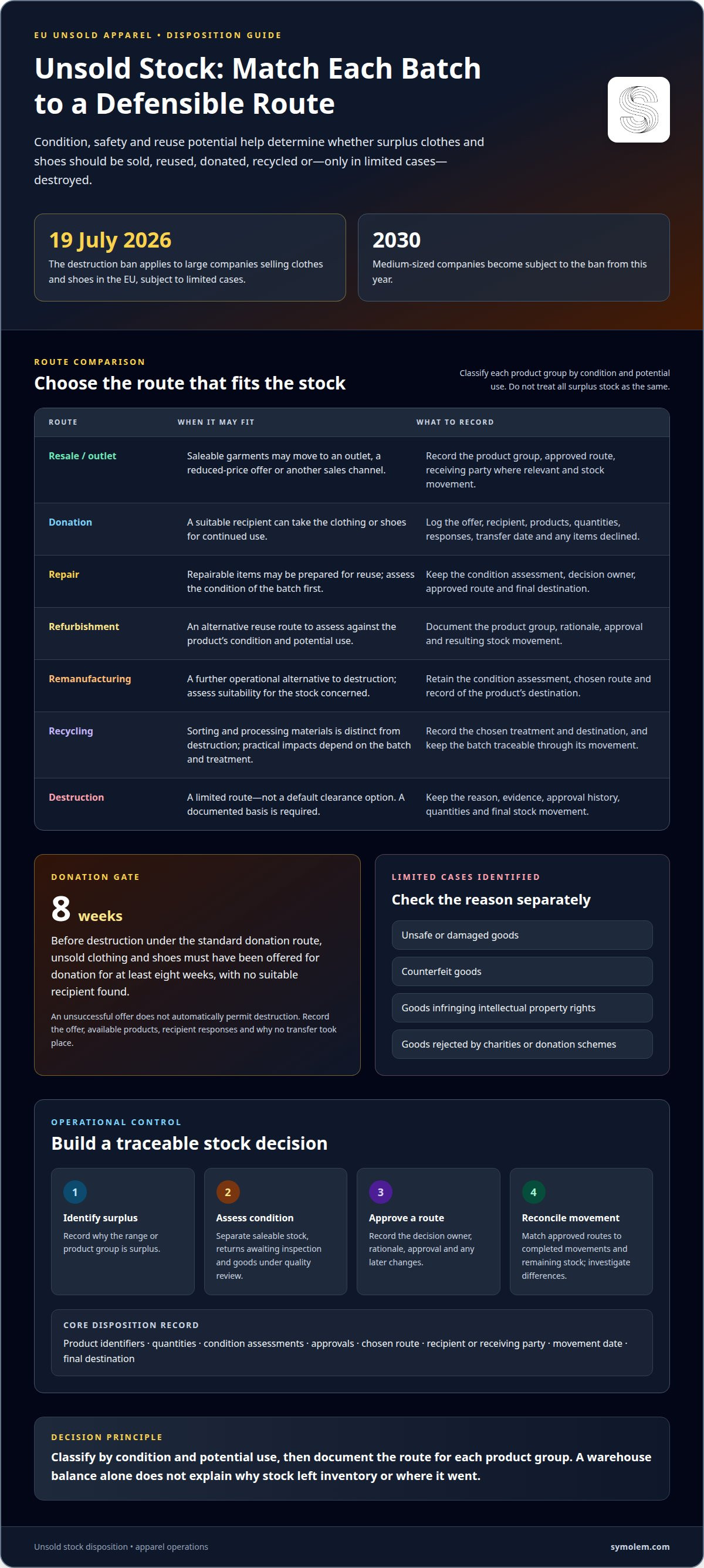
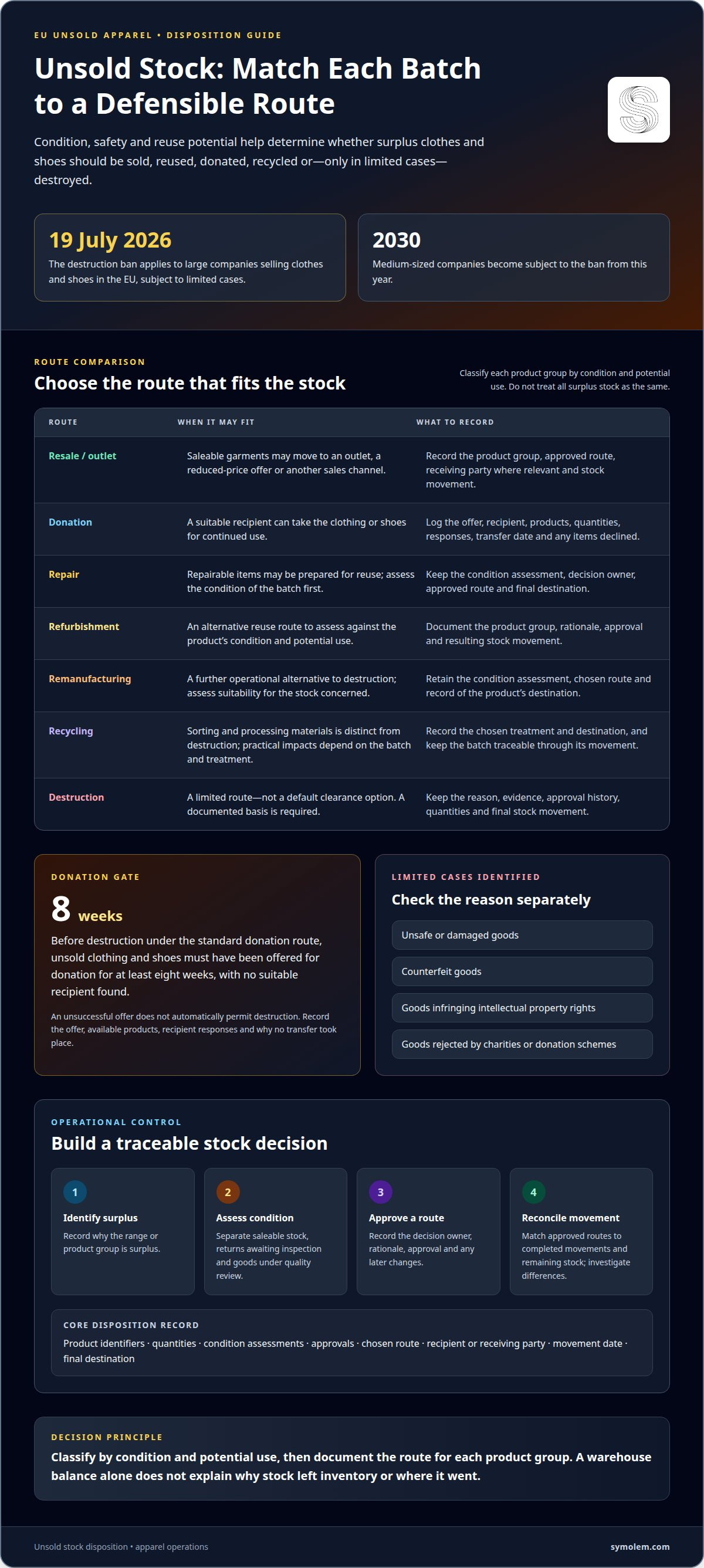
The EU prohibition already applies to large companies. From 19 July 2026, large companies must not destroy unsold clothes and shoes, except in limited cases. Medium-sized companies become subject to the ban from 2030. The Ecodesign for Sustainable Products Regulation came into force in the EU in 2024, according to the European Union.
Resale and donation are practical alternatives to disposal. Retailers can move suitable garments into an outlet channel, offer them at a reduced price, or transfer them to a charity or social enterprise. Each route keeps products in use, but needs a clear inventory trail showing what happened to the stock.
Donation is not a last-minute label for disposal. Under EU rules, unsold clothing and shoes may be destroyed only after they have been offered for donation for at least eight weeks and no suitable recipient has been found. A donation programme can document the offer, the products available, recipient responses and why no transfer took place.
An unsuccessful donation offer does not automatically permit destruction. The rules allow limited exceptions, including items that are unsafe or damaged, counterfeit, infringe intellectual property rights, or are rejected by charities or donation schemes. A damaged batch needs a different assessment from saleable garments that simply missed a season.
Choose a route by assessing condition, safety, resale potential, recipient suitability and why the stock remains unsold. Saleable coats might go to an outlet; repairable trousers could be prepared for reuse; unusable items need a separate waste-treatment decision. Match the decision to each product group instead of treating all surplus stock alike.
Recycling and destruction have different cost and environmental profiles. Recycling involves sorting and processing materials, while destruction ends a product’s potential for direct reuse. The relative impacts depend on garment condition, composition, transport and treatment, so compare practical options for each batch rather than assuming either is always preferable.
For US operations, map applicable federal, state and local waste and disclosure requirements to each operating location before choosing a route. Branded donations and discounts also carry risks: uncontrolled resale may affect pricing, distribution or brand presentation, so channel terms and recipient arrangements matter.
Take-back and resale programmes generally collect eligible garments, assess their condition, then route reusable items to resale or donation and unsuitable items to material recovery. US reuse and recycling options include retailer-operated take-back schemes, charities, social enterprises and textile recyclers. Their roles differ, so programme terms should explain what they accept and how they handle unsold or rejected stock.
EU ban on destroying unsold clothes and shoes
For EU apparel businesses, the main operational challenge is linking stock decisions to reliable records. A warehouse balance alone cannot explain why goods left inventory or where they went. Build a disposition record connecting product identifiers, quantities, condition assessments, approvals and final destinations. This creates a traceable account from the initial surplus decision to the closing stock movement.
Separate stock into operational categories before any transfer or treatment. For example, distinguish unopened saleable products from returns awaiting inspection and garments held for quality review. Assign each category a named owner and a defined status in the inventory system. This prevents products under review from being counted as cleared for sale, donation or another route.
Use one controlled workflow for decisions across merchandising, warehouse operations and compliance. Merchandising can identify why a range is surplus; warehouse teams can record physical condition and movements; compliance can review the documented rationale. Retain the approval history so later changes do not erase the basis for an earlier decision.
Keep a clear record of what was offered for donation and what was accepted. Record the recipient, product groups, quantities, transfer date and any items declined. A declined batch should return to pending disposition status, not be treated as donated. Distinguishing offers, responses and completed transfers makes the stock trail easier to reconcile.
For stock moving between legal entities or sales channels, record when responsibility transfers. A transfer to an outlet, reseller or charitable recipient should identify the receiving party and products involved. Align contract terms with warehouse records, particularly when a third party handles storage, transport or resale. This reduces gaps between commercial documents and physical movements.
Inventory systems should support controlled status changes rather than rely on free-text notes. Useful fields include the product reference, stock location, condition category, decision owner, approved route and movement date. Restrict edits to authorised roles and preserve previous values. These controls make it easier to investigate mismatches between stock counts and disposition records.
Reconcile opening surplus against approved routes, completed movements and remaining stock. Investigate unexplained differences before reporting periods close. For example, if a transfer record shows fewer units than the warehouse dispatch, keep the batch open until the discrepancy is resolved. A documented correction is more reliable than silently adjusting the inventory total.
Test the process with a sample batch before applying it across the business. Trace selected products from the surplus decision to their final recorded destination, checking that approvals and movement data agree. This practical control can reveal weak handovers, missing statuses and inconsistent records before they affect wider stock reporting.
Preparing unsold apparel for reuse through repair, refurbishment or remanufacturing
Reuse starts with classification, not a blanket decision about surplus stock. Separate garments by condition, construction and likely repair needs before assigning a route. A missing button on a shirt calls for a different intervention from a split seam or damaged zip. This initial assessment identifies which products can return to sale and which need further work.
Repair restores an item without fundamentally changing its design. Typical fixes include replacing a button, stitching a seam, repairing a zip or removing a loose thread. A batch of shirts with detached buttons, for example, may be repairable with matching components and established sewing instructions. Record the defect, repair and inspection outcome against the relevant product group.
Refurbishment addresses a broader range of condition issues. A garment might need cleaning, pressing, minor repairs and a renewed quality inspection before resale. A coat returned with a damaged lining could be assessed for repair, then checked for stains, fastenings and overall wear. Clear acceptance criteria help teams distinguish refurbished stock from products unsuitable for resale.
Remanufacturing changes or reconstructs a product using existing apparel or components. A manufacturer might convert unsold shirts into another garment style, or recover usable panels and trims for a redesigned item. This route needs a defined design, material assessment and production plan. It is not simple repair, because the finished product and its construction may differ from the original.
Maintain operational control at every stage. Record the incoming quantity, condition category, intervention, quality result and final destination. Keep damaged pieces separate from saleable stock while they await assessment. This reduces the risk of defective items returning to normal inventory before repair and inspection are complete.
Quality checks should reflect the garment and the work done. After seam repairs, inspect the repaired seam and adjacent fabric; after replacing a zip, test the fastening through its full movement. For refurbished trousers, check stitching, closures and visible marks. A failed inspection should prompt another repair assessment or a different disposition route, not an automatic return to sale.
Material and component availability can determine whether reuse is practical. Matching buttons, zips, thread and lining may be needed to preserve a garment’s function and appearance. A repair plan should account for product specifications and traceable components. If a suitable replacement cannot be identified, teams can consider redesign or remanufacturing instead.
These measures prevent discarded apparel from being treated as one undifferentiated category. Selling, donating or preparing products for reuse preserves the possibility of continued use, while recycling remains relevant for items that cannot be reused. Giving each batch a documented route provides inventory, quality and production teams with a shared basis for action.
EU ban on destroying unsold apparel
The European prohibition makes stock disposition a controlled business process, not a discretionary warehouse decision. Large companies have been prohibited from destroying unsold apparel and footwear since 19 July 2026. Medium-sized companies become subject to the ban from 2030. A retailer therefore needs to classify both its business size and its unsold products before setting disposal controls.
The rules distinguish companies by employment and turnover thresholds. They apply to large and medium-sized enterprises employing more than 50 people and with annual turnover exceeding EUR 10 million. Micro and small companies employing fewer than 50 people and with annual turnover not exceeding EUR 10 million are exempt from these requirements. Group structures need careful assessment of the entity holding stock.
Destruction remains possible only in limited cases. These include clothing that is unsafe or damaged, counterfeit, infringes intellectual property rights, or is rejected by charities or donation schemes. Link the relevant reason to the specific product batch. A general statement that stock is obsolete does not establish one of these circumstances.
When a company relies on an exception, it must retain records for five years after initial disclosure. If logos or design elements cannot realistically be removed and reuse is impossible, evidence supporting that rationale must also be kept for five years. A defensible record should identify the products, the applicable exception and the basis for the decision.
The reporting system adds another operational control. Large companies must use the new disclosure format from 2 March 2027, with disclosures due within 12 months after the relevant financial year ends. Companies relying on exceptions must publish annual reports detailing what they discarded. Inventory reporting should reconcile to the business’s annual figures.
Published information must be structured, not merely descriptive. The implementing regulation requires the quantity, weight, product category and waste treatment method for discarded unsold products. Relevant consumer products use four-digit CN codes. A stock report, for example, should connect garment categories and recorded weights to the correct treatment route.
When destruction is allowed, the waste treatment hierarchy prioritises recycling. The treatment outcome must therefore form part of the decision record, not be left solely to a warehouse contractor. Record the selected method and retain evidence linking it to the relevant stock, particularly when several apparel categories leave the site together.
National authorities can impose fines for violations. Regulatory exposure can therefore span inventory decisions, supplier and warehouse processes, published disclosures and retained evidence. Retailers can reduce gaps by assigning ownership at each stage: merchandising identifies surplus, operations records movements, and compliance reviews exceptions before disposal is authorised.
Selling unsold apparel through discounts or alternative markets
Selling preserves more commercial value than writing off stock. First identify garments that remain saleable, then match each product group to a suitable channel. A current-season jumper may suit a controlled markdown, while last-season sizes may fit an outlet or off-price channel. Choose a route that reflects the product, customer and remaining demand.
Markdowns can be staged rather than applied uniformly. Merchandising teams can start with a limited price adjustment, review the sales response, then revise the offer for slow-moving sizes or colours. If one colourway sells while another remains in stock, for example, a targeted promotion avoids discounting the entire range. Set approval limits and record each change against the relevant product group.
Separate channels can protect the main retail offer. Outlet stores, dedicated sale pages and private sale events give products a distinct selling context. A brand can group end-of-season stock by style and size, then list it through a separate outlet channel. Keep product descriptions accurate, especially when garments have defects or have been repaired.
Alternative markets can reach buyers beyond a retailer’s usual customer base. Options include wholesale clearance, resale platforms, employee sales and business-to-business stock transfers. A retailer with excess coats, for instance, could offer them to an off-price buyer rather than mix them into a current-season launch. Each route needs clear terms for product condition, title transfer and onward sale.
Resale requires more than listing stock. Teams need to grade items, confirm completeness, capture accurate images and distinguish new goods from used or refurbished products. Returned denim may need inspection before resale; garments with missing tags or visible wear should not be presented as pristine. Consistent grading reduces disputes and supports reliable inventory records.
Discounting can also create commercial risks. Deep reductions may conflict with channel agreements, affect price expectations or expose products to uncontrolled resale. A branded item sold through a secondary buyer may appear in a different market or context. Define permitted channels, product presentation standards and restrictions in the sale terms before releasing stock.
A sustainable disposition plan treats resale as a managed inventory route, not an end-of-season scramble. Compare expected demand, product condition, channel requirements and operational effort for each batch. Then record quantities transferred, sales outcomes and remaining stock. This evidence helps teams distinguish successful clearance from stock that still needs donation, repair or another route.
Retailers and brands can strengthen these decisions by mapping product records to the stock being transferred. Use a product compliance review to structure evidence for apparel ranges before commercial decisions are made.
Symolem
Symolem helps fashion businesses connect unsold-stock decisions with the evidence and compliance controls behind their product ranges. As a product compliance intelligence platform and evidence advisory for fashion, footwear and textiles, it supports retailers screening third-party ranges before purchase orders and brands managing evidence across suppliers.
For stock disposition, this matters when product records, supplier documentation or regulatory readiness are fragmented. Symolem-ID screens third-party brand ranges against 50+ global textile regulations, while advisory work can retrieve missing Tier 1–3 evidence. For unsold stock, reviewing these records can help clarify what evidence is available before a disposition decision.
These services support clearer product records and compliance decisions, but do not replace a retailer’s choice of sale, donation, repair or recycling route. Contact Symolem to discuss the compliance evidence relevant to your apparel business.
Make the next stock decision evidence-led
Build unsold-apparel decisions into inventory controls instead of waiting until disposal becomes urgent. Assign clear ownership for grading, channel selection and documentation so each product group has a traceable route. A markdown, donation, repair or resale decision is stronger when the product condition and business rationale are recorded together.
The strongest alternatives to destroying unsold apparel depend on more than stock condition. Retailers also need reliable product compliance information, while brands may need supplier records to support retail requirements. Symolem-ID screens third-party brand ranges before purchase orders; its Tier 1–3 Regulations Data Retrieval Advisory pursues missing supplier evidence, and Social Accounting & Due Diligence Advisory supports auditable evidence on worker welfare and fair wages.
Symolem’s capabilities address evidence and compliance needs alongside commercial stock decisions. They do not replace the operational assessment of which garments can be sold, donated or prepared for reuse.
Contact Symolem to discuss apparel reuse and the evidence needed to support your next stock decision.
A disciplined process keeps decisions clear, documented and ready for action.
Frequently Asked Questions
So how big is the problem of unsold stock?
Unsold inventory is a material issue across the clothing market. A European meta-analysis found that unsold stock averages 21% of all clothing placed on the market. That figure describes stock that remains unsold, not the share ultimately destroyed. For an individual business, the scale depends on buying volumes, demand forecasting, returns and how long products remain commercially saleable. Separating unsold stock from returned or damaged goods gives a clearer operational picture.
What can be done about it?
Businesses can reduce disposal by intervening at different points in the stock cycle. Merchandising teams can adjust buying and replenishment; inventory teams can identify slow-moving sizes early; and sales teams can route eligible garments into markdowns or outlet channels. Once stock is surplus, assess its condition and route it to resale, donation, repair, refurbishment or material recovery. Link each action to a product group and recorded outcome.
What happens to branded apparel that cannot be reused?
Assess branded apparel that cannot be resold, donated or repaired for material recovery before any permitted disposal. A garment with a prominent logo may need a different decision from plain fabric, particularly if branding affects reuse or removal. Record why reuse is unsuitable, the treatment selected and the stock involved. Where EU rules apply, destruction is restricted, and any applicable exception needs supporting evidence.
What are alternatives to destroying unsold apparel?
Practical alternatives include full-price resale, markdowns, outlet sales, resale channels, donation and preparation for reuse. Repair can fix a loose seam or missing button; refurbishment can restore a garment’s saleable condition; remanufacturing can turn existing material into a different product. Recycling is another option when direct reuse is unsuitable. Match each route to the item’s condition, material, likely demand and the records needed to track its final destination.
How can brands donate unsold clothing to charities and shelters?
Brands can start by grouping garments by type, size, condition and season, then finding recipients whose needs match the stock. Provide an accurate item description and agree on the transfer process, including collection, delivery and handling of rejected items. Record quantities offered and transferred, recipient details and the handover date. Clear records distinguish a completed donation from stock merely allocated to a programme or awaiting collection.
How can unsold apparel be resold through outlets, discount channels, or online marketplaces?
Choose a channel based on the stock’s condition, volume and intended buyer. An outlet may suit grouped end-of-season styles, while an online marketplace can list products individually with accurate images, sizing and condition details. Keep pricing and descriptions consistent with the actual goods, especially for repaired or imperfect items. Track dispatched stock, returns and remaining units so unsold inventory stays visible in internal records.
Can unsold clothing be repurposed, upcycled, or turned into new products?
Yes. Repurposing can redirect garments or components into another use, while upcycling changes their form to create a new product. For example, surplus denim could be cut into panels for accessories if its condition and construction suit the design. First assess fibre composition, colour, trims and usable fabric area. Then define the new product, production steps and quality checks, and record the resulting material and stock movements.
Frequently Asked Questions
Talk to a consultant
Have a question about how this applies to your brand?
Ask Lavinia Fernandes directly. Tell us your products and markets and you get a straight answer on what applies and what to do first.