
Textile Impact Measurement and MRV: Verification Rigor for ESPR Compliance
In 2026, the era of narrative-driven sustainability is dead. For years, the textile industry relied on aspirational marketing to bridge the gap between production reality and consumer perception, but the Ecodesign for Sustainable Products Regulation (ESPR) has effectively criminalized ambiguity. With the Green Claims Directive now enforceable, vague environmental assertions are no longer just poor branding; they're a liability that carries a penalty of up to 4% of annual turnover. You're likely facing the daunting task of verifying textile sustainability claims for ESPR while grappling with fragmented data across Tier 1 through 4 suppliers. It's a systemic challenge where theoretical life cycle assessments often fail to survive the scrutiny of a rigorous audit.
We understand that the shift from voluntary transparency to mandatory compliance feels like navigating a minefield of technical requirements. This article provides the definitive roadmap for building a Measurement, Reporting, and Verification (MRV) framework that satisfies EU regulators and secures your market access. We'll examine the structural mechanics of impact measurement, the necessity of ISO 17029 accreditation for third-party verifiers, and the precise data fields required to populate a defensible Digital Product Passport. This is not a guide for generalists; it's a strategic blueprint for the technical architecture of compliance.
Key Takeaways
- Understand how MRV transitions from a voluntary ESG framework into a mandatory legal architecture for EU market access under 2026 mandates.
- Learn to replace unreliable industry averages with primary, site-specific metrics that ensure the structural integrity of your impact data.
- Discover the technical requirements for mapping core impact indicators, such as carbon footprint and recycled content, into Digital Product Passport (DPP) data fields.
- Master the rigorous protocols for verifying textile sustainability claims for ESPR to mitigate the legal and financial risks of the Green Claims Directive.
- Identify the specific steps for conducting a diagnostic gap analysis to standardize metrics and bridge data silos across all four supply chain tiers.
Beyond Aspiration: The Regulatory Mandate for Textile MRV
Narrative is no longer a currency in the European textile market. For decades, the industry operated on a system of voluntary disclosures and aspirational storytelling, but the regulatory floor has shifted. Measurement, Reporting, and Verification (MRV) now serves as the structural backbone of textile accountability. It's the mechanical process of quantifying environmental impact, documenting those findings in standardized formats, and submitting them to independent third-party scrutiny. This framework is not an administrative burden; it's a legal prerequisite for survival. Without a robust MRV system, a brand's claims are legally invisible.
The Ecodesign for Sustainable Products Regulation (ESPR) transforms MRV from a niche ESG exercise into a hard market mandate. While the original Ecodesign Directive focused primarily on energy-related products, the new ESPR framework (Regulation 2024/1781) targets the systemic inefficiencies of the textile sector. This transition mandates a shift from qualitative marketing language to audited, quantitative performance data. By 2026, the Green Claims Directive will enforce this transition with clinical precision. Brands failing the test of verifying textile sustainability claims for ESPR face fines of up to 4% of their annual EU turnover, effectively ending the era of unsubstantiated greenwashing.
The Cost of Compliance vs. The Price of Exclusion
Compliance is an infrastructure investment, not a reporting overhead. By July 19, 2026, large enterprises are prohibited from destroying unsold apparel and footwear, a move that necessitates precise inventory and impact tracking. Beyond simple bans, MRV rigor directly influences the economic viability of products through Extended Producer Responsibility (EPR) schemes. Regulators are moving toward fee modulation, where the cost of placing a product on the market is tied to its verified environmental performance. If your data is fragmented or unverified, you'll pay the highest premium. In this landscape, the price of exclusion from the market far outweighs the technical cost of implementing a diagnostic MRV architecture.
MRV as a Diagnostic Tool for Circularity
Verification rigor acts as a high-resolution lens for identifying structural failures in supply chains. When a brand commits to verifying textile sustainability claims for ESPR, it uncovers the disconnect between theoretical circularity and real-world recovery. MRV outputs provide the granular data necessary for the strategic redesign of business models. They reveal where materials are lost, where carbon intensity peaks, and where recycled content claims lose their integrity. This data doesn't just satisfy a regulator; it provides the diagnostic clarity required to build a resilient, circular enterprise that can withstand the scrutiny of a transparent global economy.
The Architecture of Integrity: Defining Measurement, Reporting, and Verification
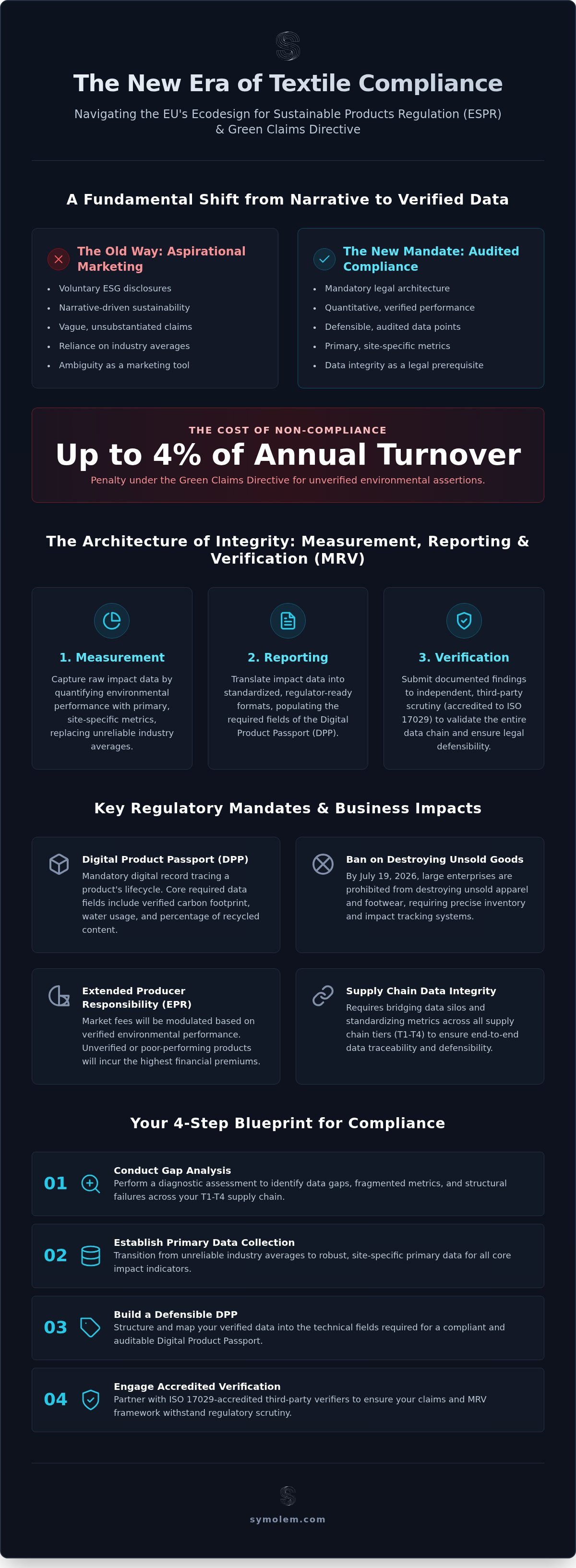
Integrity isn't a sentiment; it's a structural property of data. In the context of the EU's Strategy for Sustainable and Circular Textiles, integrity requires a three-tiered architecture. Measurement captures the raw impact. Reporting translates that impact into a standardized language. Verification provides the external scrutiny that validates the entire chain. Without these three pillars working in unison, a brand's sustainability profile is a house of cards. The regulatory shift demands that each pillar is built on a foundation of clinical accuracy rather than marketing intuition.
This architecture creates a diagnostic feedback loop. It exposes the "black boxes" in your supply chain where data disappears or integrity breaks down. By identifying these structural failures, you can refine your traceability protocols and improve systemic performance. This isn't just about ticking a box for a regulator. It's about building a data-driven infrastructure that supports long-term business resilience. If you're unsure where your data gaps lie, conducting an ESPR Readiness Diagnostic can pinpoint the specific vulnerabilities in your current reporting architecture.
Measurement: The Precision of Primary Data
Most brands currently rely on secondary industry averages to estimate their environmental footprint. This is no longer sufficient. To succeed in verifying textile sustainability claims for ESPR, you must shift toward primary, site-specific data from Tier 2 and Tier 3 facilities. This requires a robust textile life cycle assessment strategy that accounts for chemical use, water consumption, and carbon intensity at the facility level. Relying on generic database values creates a margin of error that regulators will exploit. Precision is the only shield against the 4% turnover fines mandated by the Green Claims Directive. When your data comes directly from the source, your legal defense is built on fact rather than extrapolation.
Reporting and Verification: Establishing Truth
Reporting is the bridge between internal data and external accountability. It demands standardized formats to ensure interoperability across global value chains and within the upcoming Digital Product Passport (DPP) ecosystem. However, reporting without verification is merely self-declaration. Verification establishes a defensible audit trail. Under the new mandates, brands must distinguish between "limited assurance" and "reasonable assurance." While limited assurance might suffice for voluntary reports, reasonable assurance involves deeper testing and evidence gathering. For high-stakes claims, reasonable assurance is becoming the de facto requirement for legal safety. Verifying textile sustainability claims for ESPR through accredited third-party auditors ensures that your data survives the scrutiny of both regulators and competitors.
Strategic Integration: Aligning MRV with Digital Product Passports (DPP)
The Digital Product Passport (DPP) is not a marketing accessory. It is the legal vessel for impact data. In the regulatory landscape of 2026, the DPP functions as the primary delivery mechanism for MRV outputs to EU authorities. If MRV is the substance of your environmental performance, the DPP is the standardized container that makes that performance legible to the market. Without a robust MRV system, the passport becomes a hollow shell, leading to "garbage in, garbage out" failures that trigger immediate regulatory scrutiny. Verifying textile sustainability claims for ESPR requires a direct technical link between raw impact metrics and the passport's digital architecture.
This integration ensures that the digital profile of a garment reflects its physical reality. Every data point, from carbon intensity to the specific percentage of recycled content, must be mapped to the DPP’s technical fields with clinical precision. This alignment is a foundational element of a textile supply chain traceability framework. It provides the structural integrity needed to survive an audit under the Green Claims Directive, where the burden of proof rests entirely on the brand. Data that cannot be verified cannot be claimed.
Mapping Data Fields for Regulatory Readiness
By July 2026, the European Commission will establish the central DPP registry. This infrastructure deadline requires brands to have a diagnostic overview of the data fields mandatory for their product categories. Automating the flow from MRV systems into these digital fields is the only viable path for maintaining accuracy at scale. Manual data entry is a systemic liability; it introduces human error and creates the very inconsistencies that lead to non-compliance penalties. These operational hurdles represent the primary challenges of Digital Product Passport implementation. Success depends on bridging the gap between factory-floor data collection and cloud-based digital transmission.
Data Governance and Interoperability
Interoperability is the structural requirement for a functional DPP ecosystem. Impact data must remain portable and legible as it moves through different software environments and global supply chain tiers. Adopting standardized protocols, such as GS1, ensures that MRV data remains consistent across the value chain. Security is equally critical. Sharing granular impact data from Tier 3 and Tier 4 facilities requires governance models that protect proprietary information while satisfying transparency mandates. While blockchain provides a decentralized ledger for immutability, centralized databases often offer the practical agility required for internal auditing. The objective remains verifying textile sustainability claims for ESPR through a governance structure that prioritizes systemic truth over technical novelty.
Operationalizing Rigor: Bridging the Supply Chain Data Gap
Data fragmentation is the primary obstacle to compliance. To move from theory to execution, brands must operationalize a four-step framework that prioritizes systemic truth over superficial narratives. This process begins with a diagnostic gap analysis of existing data collection systems to identify where information is lost or distorted between tiers. Once these gaps are mapped, the next requirement is to standardize impact metrics across all supply chain tiers to ensure comparability. Without a unified unit of account, verifying textile sustainability claims for ESPR becomes a statistical impossibility.
- Step 1: Map internal and external data silos to identify structural blind spots.
- Step 2: Implement a unified reporting standard that all suppliers must adopt.
- Step 3: Deploy automated data ingestion tools to mitigate the human error inherent in manual spreadsheets.
- Step 4: Secure a verification schedule with accredited third-party auditors to validate the integrity of the collected data.
Automation is a critical defense against the risk of heavy penalties under the Green Claims Directive. By reducing the opportunity for human intervention, brands minimize the risk of accidental greenwashing. Conducting an ESPR Readiness Diagnostic is the logical starting point for identifying these structural data gaps and building a defensible audit trail.
Solving the Tier 4 Visibility Crisis
Visibility typically evaporates beyond Tier 2. To solve this, brands must engage raw material suppliers through long-term contracts that mandate data transparency as a condition of business. Incentives are necessary to secure high-quality, site-specific data from remote facilities that lack sophisticated digital infrastructure. In regions where self-reporting remains unreliable, ground-truth verification through satellite imagery and IoT sensors provides a clinical layer of scrutiny. This multi-layered approach ensures that verifying textile sustainability claims for ESPR is based on physical reality rather than supplier promises.
The Economics of MRV Infrastructure
Compliance is a capital allocation decision. Cost-modeling the implementation of a brand-wide MRV system for 2026 requires balancing the need for granular data with the operational costs of collection. While high-resolution data increases compliance security, it also increases the technical burden on the supply chain. Strategic architects must find the equilibrium point where data quality satisfies regulatory rigor without paralyzing production. Data ROI is the ratio of compliance security to implementation cost.
Securing Market Access: The Symolem Framework for Impact Verification
Software isn't a strategy. It's an instrument. Many brands mistake SaaS subscriptions for compliance readiness, but without a structural framework, automated tools only accelerate the distribution of flawed data. Symolem operates as the strategic architect for high-stakes MRV implementation. We don't just provide data; we build the systems that ensure data is legally defensible. In an environment where the burden of proof has shifted entirely to the producer, independent advisory provides the technical rigor that software alone cannot replicate.
The first step in this architecture is the ESPR Readiness Diagnostic. This isn't a surface-level survey. It's a clinical assessment of your current data infrastructure, identifying the specific technical and legal gaps that threaten your market access. Verifying textile sustainability claims for ESPR requires an independent advisory perspective that can challenge internal assumptions and audit the structural integrity of your circular economy strategy. We bridge the gap between fragmented supply chain metrics and the cohesive data required for regulatory submission.
Diagnostic Precision Over Generic Consulting
Generic consulting often produces reports that look good in a boardroom but fail in an audit. Symolem focuses on diagnostic precision. We map technical data fields, such as durability scores and specific chemical compositions, directly to the regulatory mandates of the ESPR. This moves your organization away from aspirational sustainability reports toward a clinical compliance framework. By auditing your circular economy strategy with an independent eye, we ensure your claims are backed by a verifiable audit trail that withstands the scrutiny of EU regulators. We replace superficial narratives with systemic integrity.
Future-Proofing Against Evolving Regulations
Regulation is a moving target. An MRV system built specifically for the 2026 mandates must be agile enough to adapt to the next wave of global transparency requirements. Symolem's policy advisory services provide the foresight necessary to anticipate these shifts, ensuring your investment in circular infrastructure remains relevant as standards evolve. We don't just help you meet today's requirements; we ensure your business is architected for a future where transparency is the default setting. Verifying textile sustainability claims for ESPR is the baseline for a much larger shift in global trade dynamics.
Verified data is the only currency that matters in the 2026 economy. Brands that cannot prove their impact will be economically marginalized, facing both legal penalties and market exclusion. You can't afford to guess. Secure your market access with a Symolem Compliance Diagnostic and transform your regulatory burden into a verified competitive advantage.
Architecting a Defensible Future for Textile Compliance
The transition from voluntary disclosures to mandatory verification is absolute. Compliance in 2026 demands more than just data collection; it requires a systemic overhaul of how your organization manages truth across the entire supply chain. We've established that the Digital Product Passport is the final delivery vessel, but its integrity depends entirely on the rigor of the underlying MRV framework. By prioritizing primary metrics over secondary averages and automating data ingestion, you mitigate the severe legal risks inherent in verifying textile sustainability claims for ESPR.
Symolem acts as the technical architect for this transition. We provide a clinical focus on systemic integrity, offering independent advisory that bridges the gap between fragmented global value chains and rigorous regulatory mandates. Our expertise in mapping technical data fields ensures that your DPP framework is built on a foundation of verifiable reality rather than marketing speculation. It's about risk mitigation in a high-stakes landscape where narrative is no longer a substitute for evidence.
Secure your regulatory readiness with a Symolem Compliance Diagnostic.
The path to compliance is complex, but it's also a strategic opportunity to build a more resilient and transparent enterprise that can thrive under the new rules of global trade.
Frequently Asked Questions
What is the difference between impact measurement and MRV?
Measurement is the granular act of data collection; MRV is the systemic framework of Measurement, Reporting, and Verification that ensures data integrity. While measurement provides the raw impact metrics, MRV establishes the audit trail and standardized reporting formats required for regulatory submission. It's the difference between having a data point and having a defensible legal proof-point.
Why is MRV critical for ESPR compliance in 2026?
MRV is the structural prerequisite for maintaining market access under the 2026 mandates. It transforms environmental data from a marketing asset into a legal requirement. Without a verified MRV framework, verifying textile sustainability claims for ESPR is impossible, leaving the brand exposed to fines of up to 4% of annual turnover under the Green Claims Directive. It's the only way to prove compliance to EU authorities.
How does MRV interact with the Digital Product Passport (DPP)?
MRV acts as the authoritative data engine that populates the Digital Product Passport. While the DPP is the digital delivery mechanism for regulators and consumers, the MRV system provides the verified substance that fills the passport's technical fields. If the MRV process is flawed, the DPP becomes a vessel for "garbage in, garbage out" failures that trigger immediate audits.
Can we use secondary data for our textile MRV reporting?
Secondary data is becoming a systemic liability. While industry averages were acceptable for past voluntary ESG reports, the ESPR mandates a shift toward primary, site-specific data from Tier 2 and Tier 3 facilities. Relying on generic database values creates a margin of error that regulators will no longer tolerate. Precision is the only shield against non-compliance penalties.
What are the common pitfalls in textile impact verification?
The most frequent failures include fragmented data silos between supply chain tiers and a reliance on unverified supplier self-reporting. Many brands lack a standardized unit of account, leading to inconsistent metrics that fail under independent scrutiny. These structural gaps often result in "limited assurance" rather than the "reasonable assurance" required for high-stakes regulatory claims.
How much does it cost to implement a full MRV system for a fashion brand?
Implementation costs are highly variable and depend on supply chain complexity, the number of SKUs, and existing digital infrastructure. Expenses typically cover data mapping, supplier engagement protocols, and the mandatory fees for accredited third-party auditors. Brands should view these costs as a capital investment in circular infrastructure rather than a simple reporting overhead.
What is the role of third-party verification in the Green Claims Directive?
Third-party verification serves as the clinical filter for all public assertions of environmental performance. The Green Claims Directive requires that any sustainability claim be validated by an accredited independent body before reaching the consumer. This ensures that the process of verifying textile sustainability claims for ESPR is objective, transparent, and legally defensible against accusations of greenwashing.
How do we get primary data from our Tier 3 and Tier 4 suppliers?
Securing granular data from deep supply chain tiers requires moving beyond simple questionnaires toward long-term partnership contracts. Brands must mandate data transparency as a condition of business and provide technical support to facilities with limited digital maturity. In regions where self-reporting is unreliable, utilizing ground-truth technologies like satellite imagery or IoT sensors provides the necessary layer of verification rigor.