
ESPR compliance for wholesale brands and the textile timeline
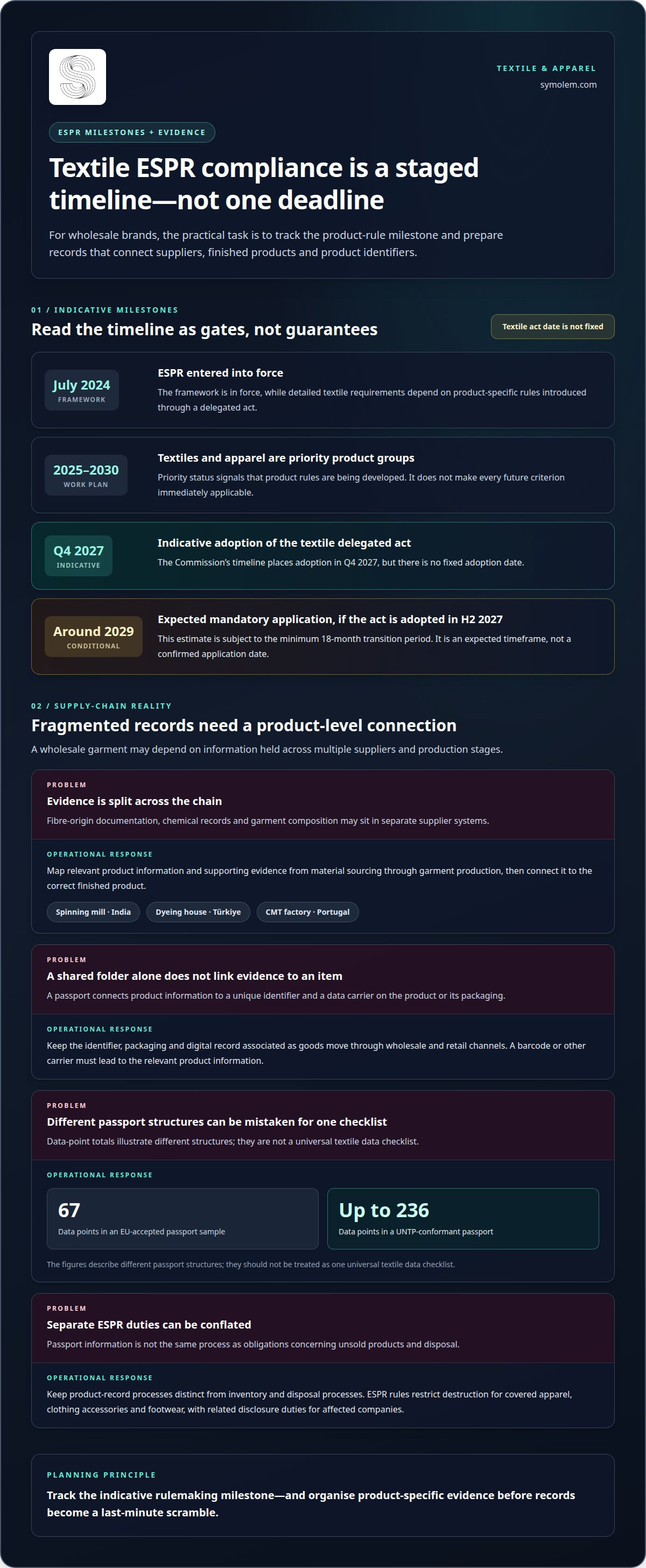
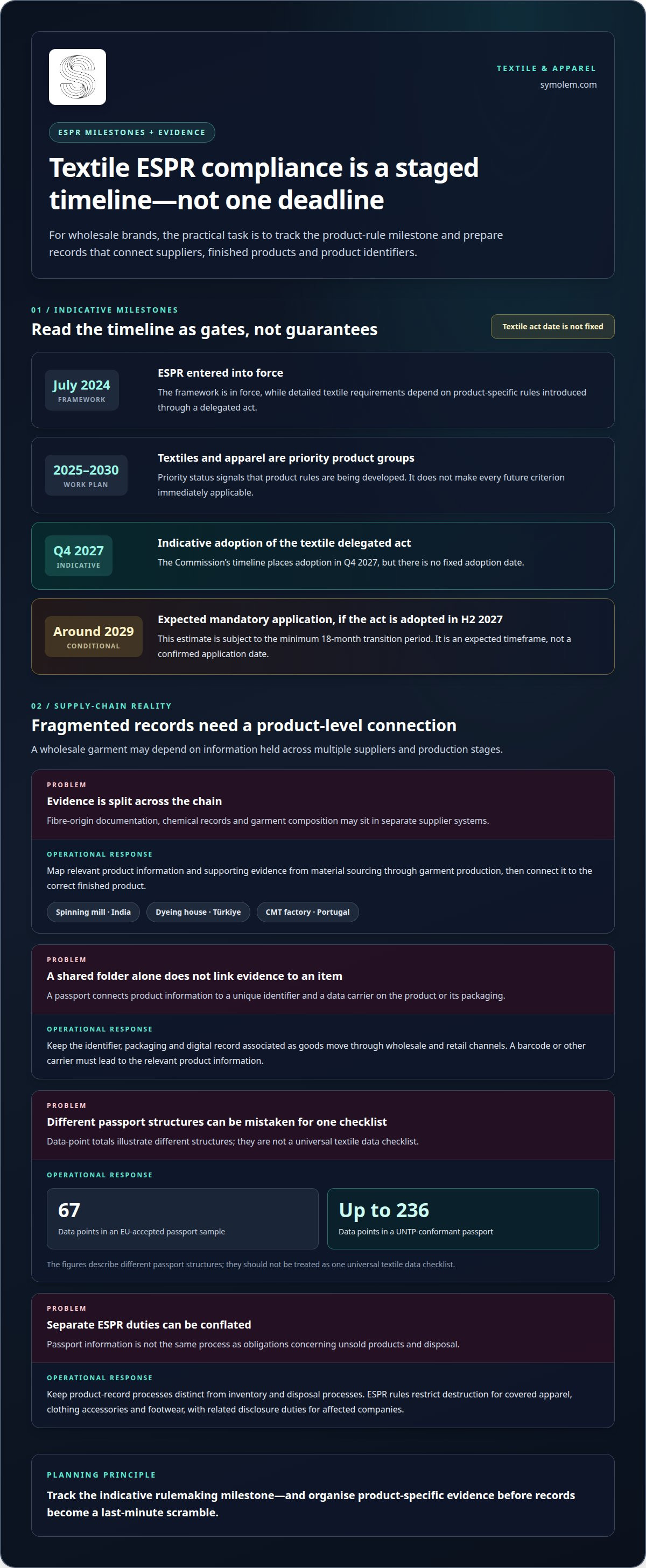
The textile ESPR timeline is staged, not a single compliance date. Textiles and apparel are priority product groups in the EU’s 2025-2030 Working Plan, and the Commission’s indicative timeline places adoption of the textile delegated act in Q4 2027, with no fixed adoption date. If adopted in the second half of 2027, mandatory application is expected around 2029, subject to the 18-month minimum transition period. ESPR compliance for wholesale brands therefore depends on both the final product rules and the evidence supporting each product.
That distinction matters. A wholesale brand may sell into the EU while relying on a spinning mill in India, a dyeing house in Türkiye and a CMT factory in Portugal. If product information and supplier records are fragmented, preparing for new requirements becomes an operational challenge, not just a legal one.
This article explains the textile timeline, what Digital Product Passports mean for wholesale supply chains, and how responsibilities can reach brands and manufacturers outside the EU when products are placed on its market. It also distinguishes obligations already in force from requirements that depend on future product rules, helping you separate immediate duties from upcoming milestones.
Key Takeaways
- Distinguish the textile delegated-act timeline from obligations that already apply, so planning is based on the right regulatory milestone.
- Understand how product identifiers and data carriers connect Digital Product Passports to textile products and their records.
- Map where product information and supporting evidence sit across suppliers, from material sourcing through garment production.
- Recognise how durability, repairability and recyclability requirements may shape product data and design decisions as detailed rules are introduced.
- See how Symolem’s ESPR & DPP Readiness Diagnostic can identify readiness gaps against EU ESPR technical standards and UNTP data protocols.
Table of Contents
- What is required in a digital product passport?
- What is the ESPR timeline for textile brands?
- ESPR implementation timeline
- Implications for non-EU manufacturers and global supply chains
- Textile and fashion industry obligations
- Symolem: ESPR & DPP Readiness Diagnostic (Free & In-Depth) Structured readiness audits and gap analyses benchmarked against EU ESPR technical standards and UNTP data protocols.
What is required in a digital product passport?
A Digital Product Passport (DPP) links product information to a unique identifier and a data carrier on the product or its packaging. For wholesale brands, the practical question is whether reliable records can follow each product through suppliers, importers and retailers.
Digital Product Passport Data
A DPP is a digital record of product information linked to a unique product identifier. The ESPR framework points to information such as environmental footprint, durability, repairability, recyclability and substances of concern. For a wholesale garment, records need to connect the finished product with relevant material and production evidence, rather than rely on a generic brand-level statement.
Passport Transparency Requirements
DPP transparency means making relevant product lifecycle information accessible through the passport, not merely publishing broad environmental claims. The information can help buyers and users understand a product’s characteristics, including durability and end-of-life options. For example, a retailer comparing two garments needs product-specific records; a general claim about a brand’s range cannot explain each item’s composition or repair information.
Passport Implementation Timelines
The DPP timeline depends on product-specific rules under the sustainable products regulation. The ESPR entered into force in July 2024, but detailed textile requirements depend on a delegated act. Its indicative timeline places adoption in Q4 2027, with no fixed adoption date. If adopted in the second half of 2027, mandatory application is expected around 2029, subject to the minimum transition period.
The technical link between a physical item and its digital record matters. Under the ESPR, a data carrier on product packaging connects the passport to a unique product identifier. A barcode or other carrier must lead to the relevant product information, so the identifier, packaging and digital record need to remain associated as goods move through wholesale and retail channels.
The European Commission’s EU Digital Product Passport Registry went live on 20 July 2026. An EU-accepted passport sample carried 67 data points, while a UNTP-conformant passport carries up to 236. These figures illustrate different passport structures; they should not be treated as a single, universal textile data checklist.
This affects how wholesale teams organise evidence. A spinning mill’s fibre-origin documentation, a dyeing house’s relevant chemical records and a garment’s material composition may sit in separate systems. The passport depends on connecting applicable product information to the correct identifier, not simply collecting documents in a shared folder.
DPPs should also be distinguished from other ESPR duties. Rules concerning unsold apparel and disclosure of discarded products, for example, address inventory and disposal, not the data carrier itself. Keeping these obligations separate helps wholesale brands assign information to the right process and avoid treating one product record as evidence for every regulatory duty.
What is the ESPR timeline for textile brands?
The ESPR creates a framework for product-specific requirements, so its effect on fashion depends on the product category and relevant measures. Wholesale brands need to distinguish requirements that already apply from criteria introduced through later measures.
Textiles and apparel are identified as priority product groups in the European Commission’s work programme. Priority status signals that product rules are being developed for these categories, but it does not make every future criterion immediately applicable. Brands selling varied ranges should classify products accurately, rather than assume that one garment’s obligations automatically apply to every item.
Future ecodesign requirements may address characteristics such as durability, repairability and recyclability. The relevant measure will determine which characteristics and supporting information matter for a particular product. For example, a brand’s product team should distinguish evidence about a repairable jacket from specifications for a non-repairable accessory.
Compared with existing EU product sustainability and labelling laws, the ESPR establishes a framework for product-specific ecodesign requirements. Other rules can govern separate matters, including how environmental claims are presented. A product specification and a marketing label therefore serve different purposes: evidence for a design characteristic does not, by itself, substantiate every environmental statement made to consumers.
The ESPR also addresses the destruction of specified unsold consumer products. Its rules restrict destruction for covered apparel, clothing accessories and footwear, while related disclosure duties require affected companies to report discarded products and relevant disposal information. These obligations concern inventory and disposal processes, not the design criteria established for individual product categories.
Penalties for ESPR non-compliance are set by Member States and must be effective, proportionate and dissuasive under Article 74. The applicable consequences therefore depend on the national enforcement provisions and the nature of the breach. For a wholesale business, retaining a clear record of product decisions and assigned responsibilities supports a more coherent response to regulatory scrutiny.
Wholesale teams can prepare by creating a product-category register and assigning an owner to monitor each relevant measure. Link category decisions to product records, supplier evidence and purchasing controls, so updates reach the teams managing ranges and orders. If a product is reclassified or its materials change, for example, the register should show which records and reviews need updating.
ESPR implementation timeline
Implementation requires more than watching a publication date. Under the ESPR, delegated or implementing acts specify product requirements and their application dates. Businesses need to connect regulatory monitoring with product categories and operating roles. A footwear range and an apparel range, for example, may follow different measures and require separate internal tracking.
According to the European Union, an ESPR delegated act must apply no earlier than 18 months after its entry into force, except in duly justified cases. This transition interval is measured from the act’s entry into force, not from a company’s first supplier request or annual buying cycle. Businesses need to capture the legal milestone and then translate it into internal deadlines for product records, sourcing decisions and review.
Start implementation by identifying which products the organisation places on the EU market and the economic-operator role it performs. A brand responsible for a product, an importer bringing it into the EU and a distributor making it available can have different assigned checks. Recording the role alongside each product category helps direct requests and decisions to the right function.
The European Commission’s ESPR roadmap is updated and made publicly available at least once every three years. This recurring update provides a planning reference, but it does not replace the product-specific acts that establish requirements. Compliance teams can use the roadmap to organise monitoring, then record the relevant act, product scope, responsible team and application date in their regulatory controls.
Operational planning should also distinguish product rules from information-management duties. For example, the ESPR implementing regulation on the disclosure format for discarded unsold consumer products applies from 2 March 2027. Companies affected by that requirement need a reporting process for the relevant information, separate from product-design reviews and supplier evidence management.
For apparel, specifications may develop through successive regulatory measures rather than one all-purpose checklist. A sourcing team can maintain a category register linking each garment group to its applicable measure and internal owner. If a product’s intended market or classification changes, the register gives compliance and purchasing teams a controlled way to identify which reviews need reconsideration.
Effective implementation also depends on assigning responsibility across teams. Product development holds design information, sourcing coordinates supplier records, compliance interprets the applicable measure, and purchasing applies the resulting status to commercial decisions. For a range with several material variants, a clear handover process helps prevent evidence for one variant from being treated as sufficient for every product in the range.
Implications for non-EU manufacturers and global supply chains
For a non-EU manufacturer, ESPR preparation is as much about coordinating evidence as it is about the product itself. Information must move between commercial partners in a form that stays connected to the goods it describes.
Non-EU Manufacturer Implications
A factory outside the EU may receive evidence requests from an EU customer even when it does not manage the customer’s regulatory process. The manufacturer can contribute precise, product-linked documentation and a clear route for corrections. If a finishing process changes, for example, the production team can identify which product records and customer files refer to the earlier specification.
This distinction helps prevent a common operational failure: treating a supplier’s general assurance as proof for every order. A mill’s material declaration, for instance, should be identifiable by fabric reference and production version. That gives the EU buyer a clearer basis for deciding whether the document relates to the goods under review.
Supply Chain Transparency and Due Diligence
Supply-chain transparency depends on explaining where product information came from, who supplied it and what it covers. Due diligence adds a review of whether that information is coherent enough to support a business decision. A sourcing team receiving a fibre declaration can record its issuer, material reference and intended product use, rather than storing it as an unlabelled attachment.
These controls are valuable when records pass through agents or intermediaries. If a supplier forwards a test report without its original scope, the receiving team may be unable to connect it to a material or order. A documented handover preserves context and makes follow-up requests specific, reducing ambiguity between commercial partners.
Supplier Traceability
Supplier traceability means connecting a product input with the supplier and production information relevant to it. For a garment using coated fabric, records may need to distinguish the base textile from the applied finish. Naming those inputs separately helps teams avoid treating one supplier’s document as evidence for a different material component.
A useful record structure gives each document an owner, reference and status, while preserving earlier versions when specifications change. If a replacement trim supplier provides a new composition sheet, for example, the sourcing file should show which order uses that trim. This supports targeted evidence retrieval and prevents superseded information from being mistaken for current production data.
Non-EU manufacturers can improve coordination by agreeing with customers how product references, document versions and supplier updates will be shared. A practical handover identifies the relevant order, material, document owner and change history. These details help an EU buyer resolve discrepancies without treating unrelated records as interchangeable.
Transparency also requires a way to correct inaccurate or incomplete records. If a supplier finds that a declaration names an earlier fabric composition, it can alert the customer and identify the affected product references. The buyer can then assess the correction against its own records and decisions, rather than allowing an outdated file to circulate through later orders.
Textile and fashion industry obligations
ESPR responsibilities depend on an operator’s role and the product measures that apply. Wholesale brands placing products on the European market must ensure applicable product requirements are met; importers and distributors perform assigned checks before making products available. The European Commission’s textile measures will define detailed criteria and application dates for products in scope. ESPR compliance for wholesale brands therefore requires teams to distinguish current duties from future product-specific criteria.
For wholesale brands, this means linking each style to evidence supporting its applicable requirements. If a future textile measure addresses durability, a buyer needs information relevant to the garment, not a general statement covering an entire collection. Product materials, construction records and supplier evidence may sit in separate systems, so product references must connect them. Effective ESPR compliance for wholesale brands also depends on making that evidence usable to purchasing and compliance teams.
Importers have a distinct operational role: they bring products made elsewhere into the EU market and must perform their assigned checks before making those products available. Distributors also have assigned checks at their point in the supply chain. For an imported jacket, the importer and a later distributor may handle different checks, while the manufacturer provides product records.
Online marketplaces need a role-specific assessment. Operating a sales platform does not, by itself, make a marketplace the importer or distributor for every listed garment. Responsibilities depend on the marketplace’s role in the transaction and the applicable rules. Marketplace teams should not assume seller declarations replace checks assigned to an economic operator.
Textiles and apparel are priority product groups in the 2025-2030 Working Plan. The Commission’s indicative timeline places planned adoption of the textile delegated act in Q4 2027, without a fixed adoption date. Until product-specific measures apply, businesses should distinguish existing ESPR duties from future criteria on durability, repairability and recyclability.
For a fashion range sourced internationally, evidence may pass through several organisations before reaching an EU buyer. Each record should identify the product or material it covers. A fibre-origin document for one fabric cannot automatically substantiate a different style or material blend, so range management needs to preserve those distinctions.
Wholesale buyers can make pre-purchase reviews more precise by separating product-level evidence from supplier-level declarations. A range-wide statement may identify a supplier without establishing which garment or component it covers. Connecting each record to the relevant style and bill of materials gives purchasing and compliance teams a clearer basis for assessing product status.
When an organisation needs a structured comparison of its records against ESPR technical standards and UNTP data protocols, Symolem’s ESPR & DPP Readiness Diagnostic provides that assessment. It can identify evidence gaps in the products and supply-chain records under review.
Symolem: ESPR & DPP Readiness Diagnostic (Free & In-Depth) Structured readiness audits and gap analyses benchmarked against EU ESPR technical standards and UNTP data protocols.
Symolem’s ESPR & DPP Readiness Diagnostic provides a structured review of product records against EU ESPR technical standards and UNTP data protocols. It is a practical next step when a wholesale brand needs to identify gaps between available evidence and the requirements relevant to its products.
The review can help pinpoint where supplier records, product information or internal responsibilities need attention before new textile measures apply. Where evidence is missing across suppliers, Tier 1-3 Regulations Data Retrieval Advisory can support the retrieval of chemical test reports, fibre-origin documents, transaction certificates and packaging weights. For retailers assessing third-party ranges before purchase orders, Symolem-ID provides pre-PO compliance screening.
Symolem audits and structures compliance records; it does not build or issue consumer Digital Product Passports. Contact Symolem to discuss the readiness diagnostic for your product range and evidence needs.
Make compliance evidence part of the buying decision
The next step is operational: make product evidence visible to the people who approve ranges, manage suppliers and release purchase orders. A disciplined approach to ESPR compliance for wholesale brands connects regulatory requirements with decisions across sourcing, product records and retail onboarding.
Symolem-ID screens third-party brand ranges against 50+ global textile regulations before purchase orders are signed. Tier 1-3 Regulations Data Retrieval Advisory helps retrieve missing chemical tests, fibre-origin records, transaction certificates and packaging weights. Social Accounting & Due Diligence Advisory supports auditable evidence on fair wages, worker welfare and human rights obligations under EU CSDDD, German LkSG and US UFLPA.
Choose the next step that addresses your immediate evidence or screening gap. Contact Symolem about ESPR compliance to discuss your requirements and move towards a more controlled, evidence-led process.
Frequently Asked Questions
What is the ESPR Regulation?
The Ecodesign for Sustainable Products Regulation is the EU framework for setting sustainability requirements for products placed on its market. Regulation (EU) 2024/1781 extends ecodesign beyond energy-related products, with requirements established through later product-specific measures. For a fashion business, the key distinction is between the framework’s general rules and detailed requirements that apply to a particular product category. This affects how teams classify products and organise compliance records.
How can brands start preparing today?
Start by grouping products into meaningful categories, then map the evidence and decision-makers associated with each group. For example, connect a style’s bill of materials to supplier records supporting its fibre and processing information. Identify who maintains each record and how updates reach product and purchasing teams. This makes it easier to respond when requirements for a relevant category become applicable.
What are the EU regulations for textiles?
Textile businesses must consider the rules relevant to both the product and the activity they perform; there is no single requirement that replaces all other applicable law. The ESPR concerns product sustainability requirements, while Directive (EU) 2024/825 addresses environmental claims and applies from 27 September 2026. A product file and its advertising therefore need separate review: evidence about a garment does not automatically substantiate every claim made about it.
What are the Ecodesign requirements of ESPR?
ESPR ecodesign measures can establish product-specific criteria, including durability, repairability, recyclability and information requirements. The precise criteria depend on the delegated or implementing act for the relevant category. In practice, fashion teams should distinguish design specifications from supporting evidence: a repair feature in a product description, for instance, needs a clear connection to the garment and its construction records.
What is required of companies?
Companies must carry out the checks and responsibilities assigned to their role in the supply chain and under applicable product measures. A brand, importer and distributor may handle different parts of the process, so assign responsibilities to named teams rather than leaving them between functions. For a seasonal range, a responsibility matrix can identify who owns product information, supplier records, review decisions and updates when specifications change.
When does ESPR apply to fashion?
The ESPR framework entered into force on 18 July 2024, but detailed textile requirements depend on product-specific measures. The Commission’s indicative timeline places planned adoption of a textile delegated act in Q4 2027, while mandatory application is expected around 2029 if adopted in the second half of 2027. Wholesale planning should distinguish framework obligations already in effect from criteria whose application follows the textile measure.
Where should companies start in practice, and how long does it take?
Begin with the products placed on the EU market, the company’s role for each product and the records needed to support applicable requirements. Then identify missing evidence, supplier owners and internal reviewers. Preparation time varies by business, depending on range complexity, the condition of existing records and supplier response processes. Defining the product scope helps make the work manageable.
What is the EU Ecodesign for Sustainable Products Regulation (ESPR), and when does it apply?
The EU Ecodesign for Sustainable Products Regulation is Regulation (EU) 2024/1781, adopted on 13 June 2024 and in force from 18 July 2024. It provides a framework for sustainability requirements across product groups, including textiles. For fashion, the timing of detailed product criteria is set through subsequent measures, so businesses should track the measure relevant to each product category rather than assume one date covers every garment.
Frequently Asked Questions
Talk to a consultant
Have a question about how this applies to your brand?
Ask Lavinia Fernandes directly. Tell us your products and markets and you get a straight answer on what applies and what to do first.