Verifying Green Claims Across Product Sectors
Green claims do not prove themselves. Verifying Green Claims means checking whether evidence supports a statement’s wording, scope and underlying data, rather than relying only on a label or supplier assurance. For retailers and brands selling in the US and Europe, the key question is whether the evidence supports the claim in each market where it appears.
That scrutiny matters when a claim spans a complex supply chain. A statement about recycled fibres, for example, should match material records and the product it describes. A broader claim about environmental impact needs a clearly defined basis and scope. The wording may be brief, but the evidence behind it rarely is.
This article explains when external verification can help, which records and methods can substantiate a claim, and how to cross-check evidence across products and markets. It also explains where verification ends: a conclusion should reflect the evidence reviewed and the claim’s boundaries, without implying more than the data supports.
Key Takeaways
- Match each environmental statement to the product, process or business activity it actually describes, and define the claim’s scope clearly.
- Trace claims back to primary records, calculations and supplier documentation; check that evidence supports the exact wording used.
- Cross-check information across suppliers and other available records to identify gaps, inconsistent figures or assumptions that need scrutiny.
- Compare the claim’s scope and supporting evidence with the rules relevant to each market where the product is sold.
- Reassess a claim when materials, manufacturing processes or supporting data change, so published wording stays aligned with the evidence.
Table of Contents
- When is external verification of a green claim beneficial?
- Cross-checking company claims against external sources
- Evidence needed to substantiate sustainability claims
- Sustainability claim verification across product sectors
- Claim verification for US and European retailers and brands
- Symolem-ID: Automated Compliance Screening
When is external verification of a green claim beneficial?
Use external scrutiny when a claim could affect purchasing decisions, involves several suppliers or relies on calculations consumers cannot readily assess. A structured review checks whether the wording, evidence and product scope align.
Third-Party Certifications and Eco-Labels
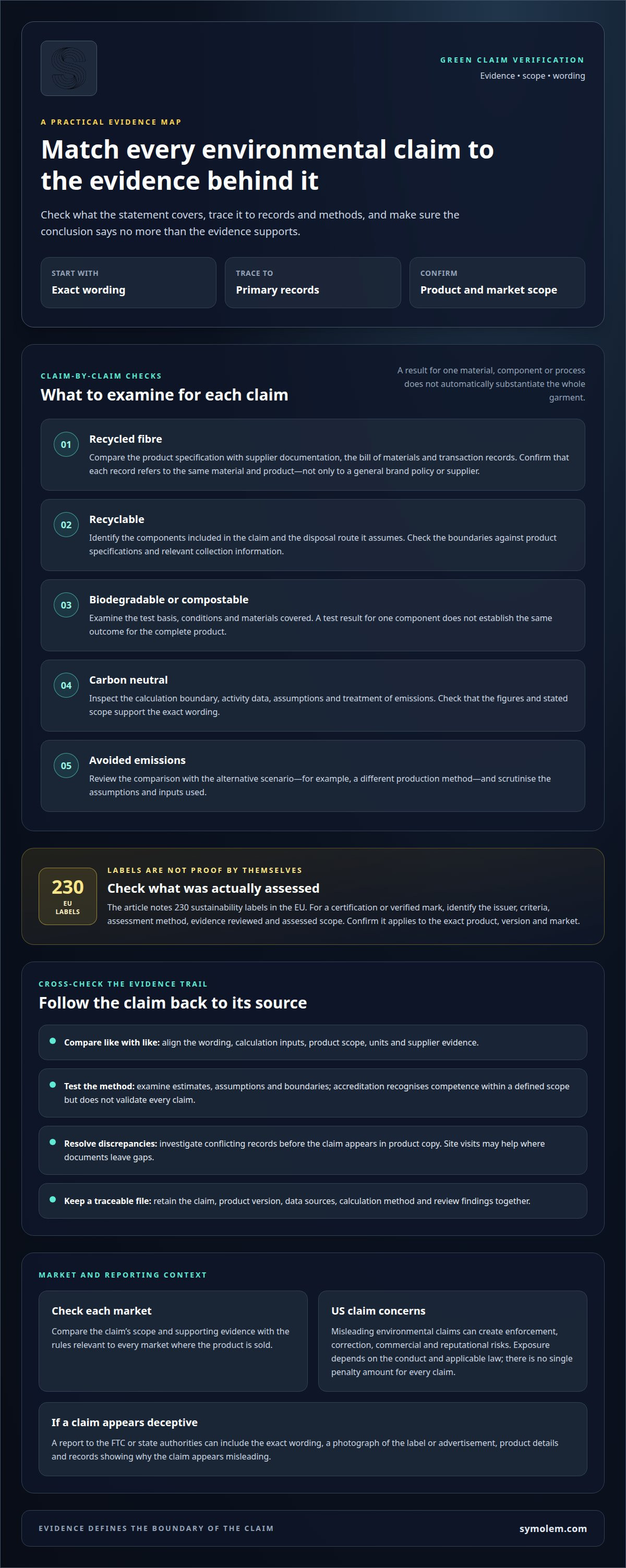
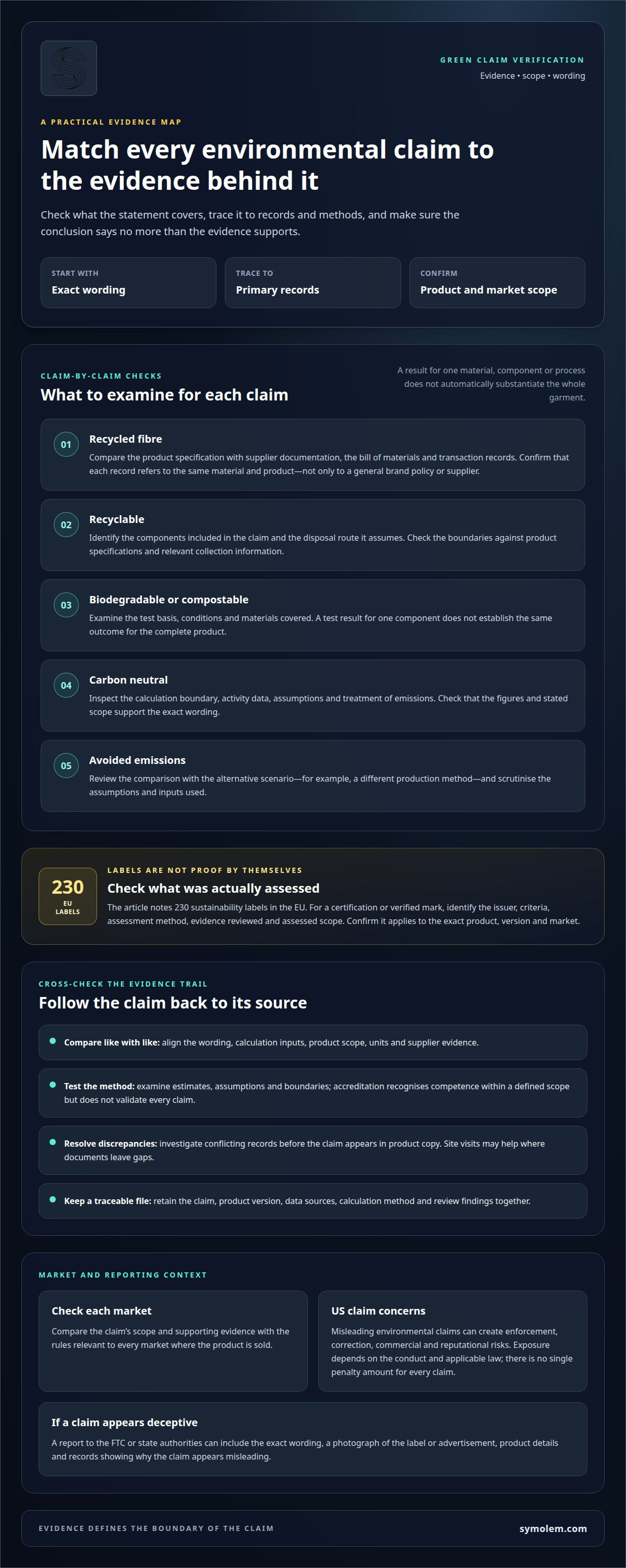
Third-party environmental certification can assess defined criteria, but its value depends on what the scheme covers. Check the certifier, assessment method, product or process scope, and evidence behind the result. An eco-label covering one fibre or component does not automatically substantiate a claim about an entire garment.
The EU has 230 sustainability labels, so a label’s presence is not proof of rigorous assessment. Ask what was verified, which sources were examined, and whether the result applies to the exact product being sold. A label covering a material input, for example, cannot establish the environmental performance of unrelated manufacturing stages.
Claim Substantiation and Verified Marks
Start substantiation with the precise claim. Gather the supporting records, calculations, assumptions and limitations, then test whether they justify the wording shown to consumers. For a recycled-fibre statement, compare the product specification with supplier documentation and transaction records instead of relying on a general brand policy.
If a product displays a Verified Environmental Claim Mark, inspect its issuer, criteria, assessed scope and supporting documentation. The mark itself is not evidence. Identify the claim assessed and check whether the verification applies to the product, version and market where the mark appears.
Misleading Claim Risks and Reporting
In the US, misleading environmental claims can create enforcement, correction, commercial and reputational risks. There is no single penalty amount for every claim; exposure depends on the conduct and applicable law. Retailers may also reconsider a product if its stated benefit cannot be substantiated.
Consumers who encounter a deceptive claim can report it to the FTC or their state authorities. Include the exact wording, a photograph of the label or advertisement, product details, and records showing why the claim appears misleading. These details help distinguish an ambiguous general statement from a specific claim contradicted by available evidence.
Verification of Specific Environmental Claims
For “recyclable”, identify the product components covered and the disposal route assumed, then compare that scope with product specifications and relevant collection information. For “biodegradable” or “compostable”, examine the test basis, conditions and materials covered. A result for one component does not establish the same outcome for the whole product.
For “carbon neutral”, inspect the calculation boundary, activity data, assumptions and treatment of emissions. Avoided-emissions claims compare actual emissions with an alternative scenario, such as a different production method. Review that comparison and its inputs, rather than simply repeating the headline claim.
Cross-checking company claims against external sources
A credible assessment tests company statements against records, not just marketing copy. Compare the claim wording, calculation inputs and supplier evidence, and investigate any mismatch before publication.
Verification and Accreditation
A robust review identifies who assessed the claim, which methods they used and what evidence they examined. Accreditation recognises an assessor’s competence within a defined scope; it does not automatically validate every claim they review. Check that the assessment covers the relevant environmental subject, product or activity.
Cross-check the company’s explanation against underlying sources. For a garment claim about recycled fibre, compare the statement with its bill of materials, supplier declarations and transaction records. The documents should refer to the same material and product. A certificate for a supplier or facility alone may not establish what is present in a specific finished item.
Reviewers may collect and examine evidence, analyse estimates and assumptions, and conduct site visits when necessary. For a textile claim involving a spinning mill in India, the review could compare the stated fibre input with production records and supplier documentation. Site-level findings can help resolve gaps that paper records leave open.
Benefits of Independent Review
A separate review can expose a calculation that appears sound only because key stages were excluded. For example, a company comparing two production methods should explain how it defined each scenario and selected its data. Reviewers can test whether assumptions, boundaries and units are consistent, then identify where the conclusion goes beyond the evidence.
Consumers benefit when claim wording reflects the assessment’s actual scope. A statement about one fabric component should not imply that the whole garment has the same environmental attribute. Clear boundaries also help buyers compare like with like, rather than treating different methods or product stages as equivalent.
For businesses, documented scrutiny provides a traceable basis for approving claims and answering retail partners’ questions. Keep the claim, product version, data sources, calculation method and review findings together. If a supplier record conflicts with a company summary, document the discrepancy and resolve it before using the claim in product copy.
This discipline matters for circular economy claims too. A label describing recycled content should match the product’s material records and the scope assessed. Distinguish verified inputs from assumptions, identify unresolved gaps, and avoid extending a finding beyond the evidence. The result is a clearer decision trail, not a broader claim by default.
Evidence needed to substantiate sustainability claims
Evidence must support the exact wording, product scope and environmental effect being claimed. In the EU, 40% of green claims have no supporting evidence, making a documented chain from source data to consumer-facing statement essential.
Businesses can substantiate environmental claims by defining the product boundary, collecting relevant lifecycle data, and recording the methods and assumptions used. Evidence should cover the stages from raw material extraction through end-of-life, or clearly identify which stages are included. Make the data and methodology transparent and verifiable.
Build a claim file around the product version and the statement consumers will see. For a cotton shirt, link fibre-origin records to the relevant material, then connect those records to the garment’s bill of materials. If a claim covers only fibre content, its wording should not imply that every manufacturing stage was assessed.
- Define the claim: Record its wording, product scope, comparison basis and any stated limitation.
- Map the evidence: Connect supplier records, test results and calculations to the material or process they describe.
- Record the method: Preserve data sources, assumptions, units and calculation steps so another reviewer can follow them.
- Check alignment: Compare the final statement with the evidence and remove any implication the data cannot support.
Evidence for restricted-substances compliance differs from evidence for broad sustainability claims. For textile products, organise chemical lab tests by material, colourway and relevant supplier stage, then match each report to the product components it covers. A test report for one fabric cannot, by itself, establish the chemical profile of trims, prints or every component in a finished product.
Keep the link between a lab report and the corresponding bill of materials visible. If a dyeing house in Turkey supplies a fabric report, record the fabric identification and production details needed to distinguish it from other materials. Missing or mismatched records weaken the basis for a claim about product composition.
Environmental calculations require the same discipline. Product carbon footprint assessments should account for how production electricity is generated and the carbon footprint of the materials used. Record these inputs alongside the calculation boundary. Changing the electricity source or material composition can alter the result and its relevance to the claim.
Comparative sustainability claims require particular care. ISO requires statements comparing competitor products to be supported by life cycle assessment calculations. The comparison should use a defined alternative, consistent boundaries and comparable data. Without the calculation basis, consumers cannot interpret what a headline percentage compares.
For each claim, keep the supporting evidence, methodology and limitations together. This lets a reviewer trace the statement to its source data and identify where a supplier declaration, test result or lifecycle assumption needs to be resolved.
Sustainability claim verification across product sectors
Verification should follow the subject of the claim, not a template copied between sectors. An environmental claim may concern a product, product group, service, project or part of an organisation. Define the subject first, then set the evidence boundary around the activity or item consumers will understand the claim to cover.
Different sectors create different evidence trails. A textile claim may depend on fibre inputs and manufacturing stages, while a packaging claim may concern material composition or end-of-life treatment. A company-wide statement needs organisational evidence, not just a product certificate. Before comparing findings, record which entity, product or process the assessment examines.
Life-cycle scope matters across sectors. Claims should consider impacts from raw material extraction through end-of-life, or clearly identify the stages included. They should also address trade-offs, including negative effects that arise alongside positive impacts elsewhere. For example, a material substitution may improve one stated attribute while creating a different impact at another stage.
- Set the claim boundary: Name the product, activity or organisational unit and define the stages assessed.
- Map relevant evidence: Identify which records support each stated environmental benefit.
- Test for trade-offs: Examine whether the claimed improvement shifts impacts elsewhere.
- Align the wording: Keep the published statement within the verified scope and conclusion.
Third-party verification should produce a statement linked to the evidence reviewed. A verification statement confirms the plausibility of a claim on its date of issuance; it has no defined validity period or expiry date. That does not make the underlying evidence permanent. Changes to materials, processes or data can undermine the original basis and warrant reassessment.
Supply-chain practices determine whether evidence can be traced between stages. A fashion brand can map the relationship between a spinning mill, a dyeing house and garment assembly, then attach relevant records to the claimed product. Train product and sourcing teams to distinguish a supplier-level statement from evidence covering a finished item. Staff should spot scope gaps before claims enter product descriptions or retailer submissions.
Packaging claims need a clear boundary. Specify whether a statement refers to one packaging component, the complete pack or a particular disposal stage. Compare the wording with composition records and evidence for the stated outcome. A claim about one packaging material should not imply the same result for every component in a multi-material pack.
Across sectors, the decisive check is alignment: does the evidence support this wording, for this subject, across the stages claimed? A documented review makes the decision traceable and helps prevent a narrow finding from becoming a broad marketing assertion.
Claim verification for US and European retailers and brands
Market coverage changes the verification task. A brand selling the same garment in the US and Europe needs evidence to support its wording in each market. Retailers also need a consistent way to assess third-party claims before purchase.
The European Commission adopted its proposal for a Directive on Green Claims in March 2023. The proposal addresses voluntary, explicit environmental claims to consumers that are not already covered by other EU rules. Separately, EmpCo has applied since 27 September 2026, so businesses must treat relevant consumer-protection requirements as active when reviewing claims in the EU.
Scrutiny is warranted. A 2020 European Commission study found that more than half of environmental claims contained vague, misleading or unfounded information. The research also reports that 53% of EU green claims give vague, misleading or unfounded information. For a retailer, an unqualified phrase such as “sustainable collection” creates a different review problem from a product-specific claim about recycled content.
In the US, the Federal Trade Commission’s guidelines govern environmental assertions. Assess the exact claim, product scope and supporting records rather than assuming EU review resolves US obligations. Market-specific review matters because identical wording may be judged against different requirements and consumer expectations.
- Identify the claim owner: Record whether the statement comes from a brand, supplier or retailer.
- Map the markets: Note where the item is sold and which version of the claim appears there.
- Match proof to wording: Link the statement to relevant product records, methods and calculations.
- Control publication: Route unsupported, broad or unclear wording for correction before use.
For example, a US retailer listing a European brand’s shirt should not treat a supplier certificate as automatic proof of every product claim. The retailer can map the statement to the garment, material records and supporting calculation, then record who approved the wording. If the claim changes for one market, the revised copy needs its own evidence match.
Transparency depends on keeping that decision trail intact. Store the published wording beside its assessment, evidence sources, market scope and approval record. If a material or production process changes, review whether the original basis still supports the claim before reusing it across listings. For fashion, footwear and textiles, Symolem is a product compliance intelligence platform and evidence advisory; its green claims verification can support review alongside product records.
Symolem-ID: Automated Compliance Screening
Symolem-ID helps fashion retailers and marketplaces screen third-party brand ranges before purchase orders are signed. It checks products against 50+ global textile regulations in seconds and assigns per-SKU status: Cleared, Blocked or Missing Evidence. For a green claim, that screening helps teams identify where product compliance records need attention before a range proceeds.
When claim substantiation depends on supplier documents that are missing, Tier 1-3 Regulations Data Retrieval Advisory provides hands-on evidence chasing for records such as fibre-origin documents and transaction certificates. The right next step depends on whether the immediate gap is pre-purchase screening or missing supply-chain evidence.
For support with product compliance evidence, contact Symolem or visit symolem.com.
Make claim governance part of product approval
Environmental wording should have an owner, an evidence trail and a review point in the product approval process. Treat each claim as a controlled business record, not copy to reuse unchanged whenever a product range or market changes. This discipline gives buying, compliance and merchandising teams a clear basis for decisions.
Verifying Green Claims works best when it is built into the point where evidence and commercial approval meet. Assess each claim before it reaches a product page or purchase decision, and route unresolved questions to the teams responsible for the underlying information. As products and processes change, revisit the claim record rather than relying on an old approval.
For fashion businesses that need to assess claim evidence or close gaps in product records, discuss a claim verification review with Symolem. A defined review process gives your team a practical next step towards clearer, better-supported claims.
Frequently Asked Questions
What are Environmental Claims?
Environmental claims describe or imply that a product, service or business has an environmental benefit or characteristic. Examples include “made with recycled fibre”, “lower impact” or “uses recyclable packaging”. The wording can appear on a label, product page or advertisement. Consumers may understand a broad phrase to apply to the whole product, so businesses should specify which attribute the statement describes.
What does verifying green claims mean?
“Verifying green claims” means examining whether evidence supports an environmental statement as presented. The review considers what the statement means to its audience, which product or activity it covers, and whether the supporting information matches. It can also identify limits that affect how the statement should be communicated. Verification is a reasoned assessment, not a guarantee that every related claim is accurate.
How can consumers verify environmental claims on products and services?
Consumers can start by finding the exact claim and identifying what it covers. For a garment described as “recycled”, look for an explanation of which material has that attribute rather than assuming it applies to every component. Check whether a label names its criteria and scope, and compare the statement with product details. If the claim appears deceptive, consumers can report it to the FTC or state authorities.
Which U.S. laws and FTC Green Guides govern environmental marketing claims?
The FTC Green Guides are federal guidance for assessing environmental marketing claims, but they do not name every legal requirement that may apply to a particular statement. The relevant rules can depend on the claim, product and market. Businesses should identify the applicable federal and state requirements for their specific marketing before publication, rather than treating the Guides as a substitute for assessing the rules that govern their conduct.
What documentation is needed to support green marketing claims?
Keep records that connect the exact marketing wording to its basis. Depending on the claim, the file may include supplier declarations, product specifications, test reports, invoices, calculation workbooks and the data sources behind those calculations. Record each document’s product or material reference and version. For a service claim, retain records of the activities assessed and the method used to determine the stated environmental benefit.
Frequently Asked Questions
Talk to a consultant
Have a question about how this applies to your brand?
Ask Lavinia Fernandes directly. Tell us your products and markets and you get a straight answer on what applies and what to do first.