
EU Environmental Rules
EmpCo tightens the rules for environmental claims and sustainability labels: businesses need clear wording and evidence to support what they say. The directive is in force and applies from 27 September 2026, according to the European Union. Under EmpCo, a credible-sounding statement is not a substitute for substantiation.
For fashion businesses, the pressure point is the evidence behind each claim: product and supplier records must support the wording, and broad or future-facing statements need particular scrutiny. This article explains EmpCo’s purpose, what documentation can support environmental and social claims, and how to distinguish a precise product statement from one that could mislead consumers. It also considers how EmpCo affects evidence reviews when records are incomplete or spread across the supply chain.
Key Takeaways
- Understand how EmpCo changes the consumer-protection rules governing environmental marketing and product information.
- Learn why broad environmental wording needs clear qualification and evidence tied to the claim.
- See what records can support claims based on supplier data, certification or future performance plans.
- Distinguish EmpCo’s legal requirements from voluntary standards and commercial tools used to organise evidence.
- Identify where supply-chain evidence gaps may weaken a claim before it reaches consumers.
Table of Contents
Evidence and documentation for environmental and social claims
Evidence must connect consumer-facing wording to the product, process or outcome it describes. According to the European Union, the EmpCo directive amended the Unfair Commercial Practices Directive 2005/29/EC and the Consumer Rights Directive. For fashion businesses, claim control belongs within product governance: the statement, its scope and its supporting records must align. A broad sustainability narrative cannot prove a specific product attribute.
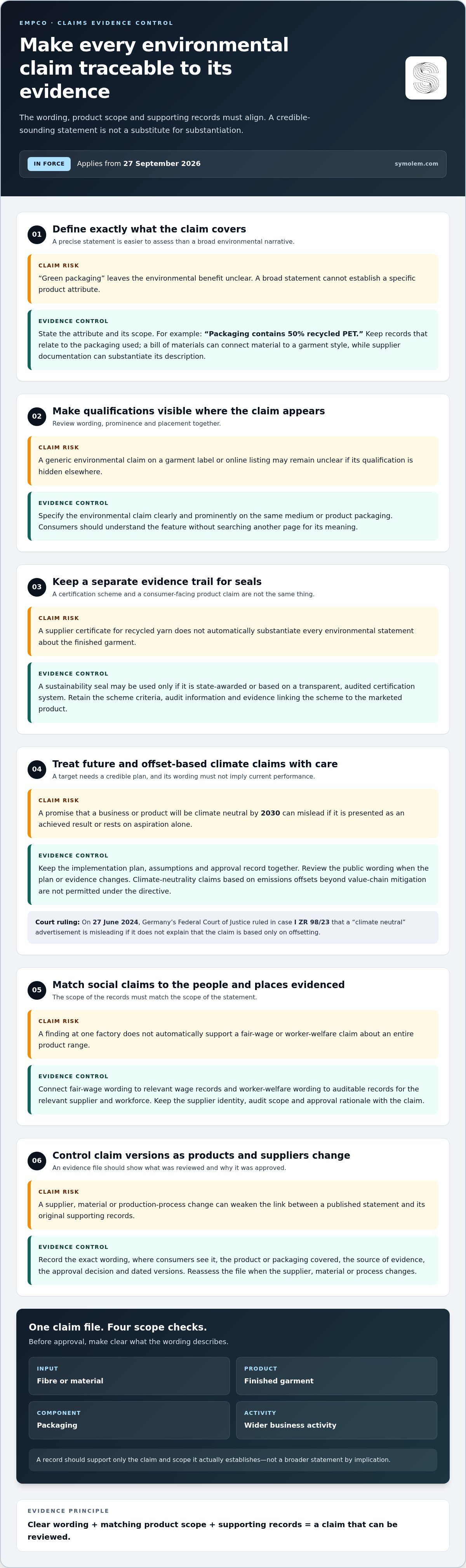
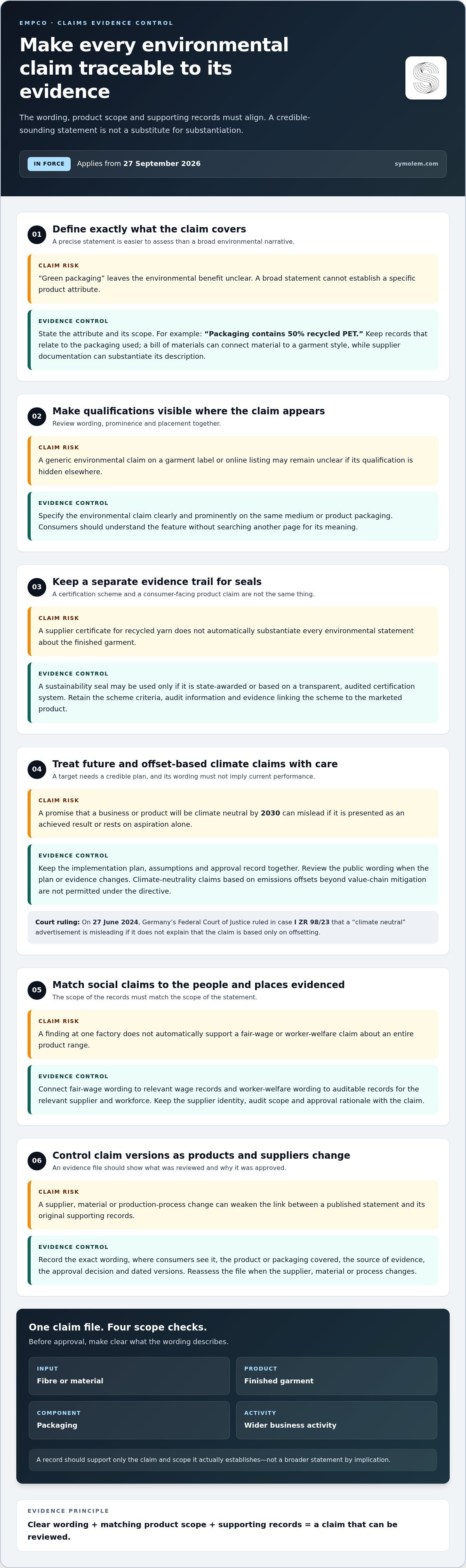
Start with the exact claim. Record its wording, where consumers see it, which product or packaging it covers, and the source of its evidence. EmpCo does not prohibit green claims; it requires companies to explain them precisely and support them with evidence. Assess statements on product listings, hangtags and packaging in context, since presentation can affect how consumers interpret the same words.
Specific language defines what needs substantiation. “Packaging contains 50% recycled PET” identifies an attribute and proportion; “green packaging” leaves the asserted benefit unclear. The specific claim still needs records relating to the packaging used. A bill of materials can connect a material to a garment style, while supplier documentation can substantiate its description. Neither record should be treated as proof of claims beyond its scope.
Generic environmental claims face restrictions. The EmpCo directive requires environmental claims to be specified clearly and prominently on the same medium or product packaging. A qualification elsewhere may not clarify an unqualified statement on a garment label or online listing. Review the wording, prominence and placement together. Consumers should be able to understand the environmental feature without searching another page for its meaning.
Certification seals need a distinct evidence trail. Under the directive, a sustainability seal may be used only if it is state-awarded or based on a transparent, audited certification system. Keep the scheme criteria, audit information and product-level link with the claim approval record. A certificate for recycled yarn may support that input, but it does not automatically substantiate every environmental statement about the finished garment.
- Material claim: Link fibre or recycled-content wording to records identifying the material and relevant product.
- Scope: State whether the claim concerns an input, finished garment, packaging component or wider business activity.
- Seal: Retain certification criteria and evidence showing how the scheme applies to the marketed product.
- Social claim: Connect fair-wage or worker-welfare statements to auditable records for the relevant supplier and workforce.
- Approval: Preserve the wording reviewed, supporting documents, approval decision and subsequent updates.
Future-facing claims need a credible implementation plan. A claim that a business or product will be climate neutral by 2030 needs a plan supporting the promised performance, not aspiration alone. Keep the plan, assumptions and approval record together. Ensure the wording does not imply that a future target describes current performance. Review the public statement whenever the plan or its underlying evidence changes.
Offset-based climate statements require particular scrutiny. Under the directive, climate-neutrality claims based on emissions offsets beyond value-chain mitigation are not permitted. On 27 June 2024, the German Federal Court of Justice ruled in case I ZR 98/23 that a “climate neutral” advertisement is misleading if it does not explain that the claim is based only on offsetting. The method behind the claim matters.
Social sustainability claims also need evidence that matches their scope. A fair-wage statement should connect to relevant wage records; a worker-welfare claim should identify the facilities and evidence it covers. A finding at one factory does not automatically support a claim about an entire range. Keep the audit scope, supplier identity and approval rationale with the statement so reviewers can see exactly what the documentation establishes.
Build review into the claims process. Assign responsibility for checking wording, evidence and product scope, then retain dated versions of the approved claim and its supporting records. Reassess the file when a supplier, material or production process changes. The European Commission’s review report on the EmpCo directive is due on 27 September 2031, making durable documentation and controlled updates important beyond a product’s initial launch.
Consumer demand matters: sixty percent of Norwegian consumers interviewed by the Norwegian Consumer Council wanted manufacturers to inform them whether the food they buy is produced sustainably. Seventy-three percent of European citizens say a product's environmental impact is very or rather important when making a purchasing decision.
For digital products, the EmpCo Directive requires traders to disclose the minimum software-update period. Under Austria's implementation, certain civil law claims relating to goods placed on the market on or before 27 September 2026 may be excluded for three years.
How does EMpco compare with its competitors?
Symolem has no commercial competitors. It is a European Union directive, not a certification label, audit method or claim-verification platform. The useful comparison is between the legal rules and the tools or schemes businesses use to organise evidence. Those tools can support compliance work, but they do not replace the legal test applied to a consumer-facing claim.
A certification scheme and a law perform different functions. A scheme may assess defined criteria and permit a seal; EMpco sets conditions for sustainability seals used in marketing. The seal must be state-awarded or based on a transparent, audited certification system. Companies must therefore distinguish the scheme’s verification from the separate question of whether their product claim is clear, accurate and supported.
That distinction matters in apparel sourcing. A supplier certificate for recycled yarn might support a claim about that input, but it does not automatically substantiate every environmental statement about a finished jumper. The evidence must link the claim to the product and its scope. For example, records from a spinning mill in India may support fibre composition, while the brand’s product records must connect that material to the garment being advertised.
EMpco also differs from voluntary standards because its requirements are not optional for businesses within its scope. A standard can define a method or provide documentation; the directive determines whether covered commercial practices are unfair. The distinction is practical: a company may use a recognised standard as part of its evidence file, but the standard’s name alone cannot make an unclear or overbroad claim acceptable.
National implementation adds another comparison. Member States transpose the directive into national law, so businesses encounter the rules through the applicable national framework. The directive is a maximum-harmonisation instrument in the areas it harmonises, meaning Member States generally cannot maintain or introduce divergent rules unless EU law allows it. For a retailer selling across borders, a shared claim-control process is therefore more useful than separate, improvised wording for each market.
EMpco also establishes a different level of exposure from an internal brand policy. A company policy can set approval steps, but it cannot displace statutory requirements. Member States must provide penalties that include fines with a maximum amount of at least 4% of annual turnover in the Member State concerned. The applicable national provisions and circumstances shape enforcement, so governance should connect marketing approval with legal review and product evidence.
- Against a certification scheme: The scheme may verify criteria; the directive governs covered claims and seals.
- Against a voluntary standard: The standard may structure evidence, but it does not replace legal compliance.
- Against company policy: Internal approval controls help manage claims, but cannot override statutory rules.
- Across Member States: National implementation gives the directive effect within each country’s legal system.
For practical comparison, assess each mechanism by its purpose. Ask whether it defines a legal obligation, verifies a specific product attribute, or manages internal approvals. A certification document may support one claim; a supplier declaration may support a different fact. Neither replaces checking the final wording and its scope.
Fashion businesses should map claims to product-level evidence, then identify where the proof originates and who approved its use. A dyeing house in Turkey may hold process records, while a CMT factory in Portugal may hold production documentation. Those records serve different purposes; treating them as interchangeable creates gaps between the advertised statement and the evidence for the product.
The EMpco Directive applies to companies of all sizes that communicate with consumers in the EU, including companies without a physical presence in the EU. This broad scope makes it important to assess claims by where consumers encounter them, not only by where a business is established. In Germany and Austria, EMpco-related adaptations are incorporated into the Unfair Competition Act (UWG). Germany adopted Section 15b of its Act Against Unfair Competition (UWG) for certain EMpco-related claims concerning products placed on the market before 27 September 2026.
For businesses, the practical distinction is between using a scheme to support evidence and remaining responsible for the claim itself. Symolem ensures that teams record, review, approve and keep environmental and sustainability claims up to date. A consistent process links each statement to its supporting records and helps identify when the claim or evidence needs review. Certification may contribute evidence, but it does not remove the need for ongoing oversight.
Symolem-ID: Automated Compliance Screening
Symolem-ID screens third-party fashion ranges before purchase orders are signed, helping retailers identify compliance gaps before products enter their buying process. It checks against 50+ global textile regulations in seconds and gives each SKU a status: Cleared, Blocked or Missing Evidence. For an EmpCo-related claim, that screening can flag where a product record needs further evidence; it does not replace substantiation of the claim itself.
When the supporting documents sit across suppliers, Tier 1-3 Regulations Data Retrieval Advisory helps retrieve records such as chemical test reports and fibre-origin documentation. Social Accounting & Due Diligence Advisory provides auditable evidence on worker welfare and fair wages. These services address distinct evidence needs, from product attributes to social claims. Visit symolem.com to discuss which compliance or evidence issue needs attention.
Make claim governance part of product control
The next step is to connect marketing approval with records held across your supply chain. Treat each claim as a controlled product attribute: assign an owner, identify the evidence source and ensure changes in materials or production trigger a review of affected wording. This makes EmpCo compliance an operational responsibility shared across buying, sourcing and marketing, not just a final copy check before publication.
Where supplier files remain incomplete, structured evidence retrieval can help close product-record gaps; where social statements are involved, auditable worker-welfare and fair-wage evidence gives those claims a defined basis. Symolem supports fashion businesses with evidence retrieval and social accounting, alongside pre-purchase-order compliance screening for retailers. Contact Symolem about your EmpCo evidence requirements and take the next step towards clearer, better-controlled claims.
Talk to a consultant
Have a question about how this applies to your brand?
Ask Lavinia Fernandes directly. Tell us your products and markets and you get a straight answer on what applies and what to do first.