
Global Textile EPR Compliance
Packaging rules make producers responsible for managing covered materials at end of life, with each jurisdiction defining what is included. Paper, plastics, metals and glass may be covered, but businesses need accurate material and weight records to report packaging correctly. Requirements differ across markets, so the same garment packaging can trigger different obligations in different countries.
That complexity matters for fashion businesses. Garment packaging may combine materials, and sourcing and sales can span multiple jurisdictions, making accurate identification and evidence essential. This article explains how producer responsibility programmes allocate duties, which packaging may be covered, how collective and individual models differ, and where to find programme resources. It also describes how fees are calculated and how these systems differ from traditional waste management, helping you assess what the rules mean for your textile supply chain.
Key Takeaways
- Packaging covered by producer responsibility rules is defined by each jurisdiction’s legislation or programme plan, so material and weight records are central to reporting.
- Collective compliance through a producer responsibility organisation is common, while some programmes also allow producers to comply individually.
- Fees can vary by material, weight and recyclability, making packaging choices relevant to both reporting and end-of-life costs.
- In the United States, Circular Action Alliance is identified as a producer responsibility organisation that helps producers comply with packaging laws.
- Retailers can use Symolem-ID to screen third-party brand ranges against textile regulations before purchase orders are signed.
Table of Contents
- Packaging materials covered by EPR
- Benefits and perceived drawbacks of EPR
- EPR program resources
- How are EPR fees calculated, and what do they cost?
- How does EPR compare with traditional recycling and waste-management programs?
- Symolem: Symolem-ID Automated Compliance Screening Automated pre-PO screening platform for fashion retailers and marketplaces to verify third-party brand ranges against 50+ global textile regulations in seconds.
Packaging materials covered by EPR
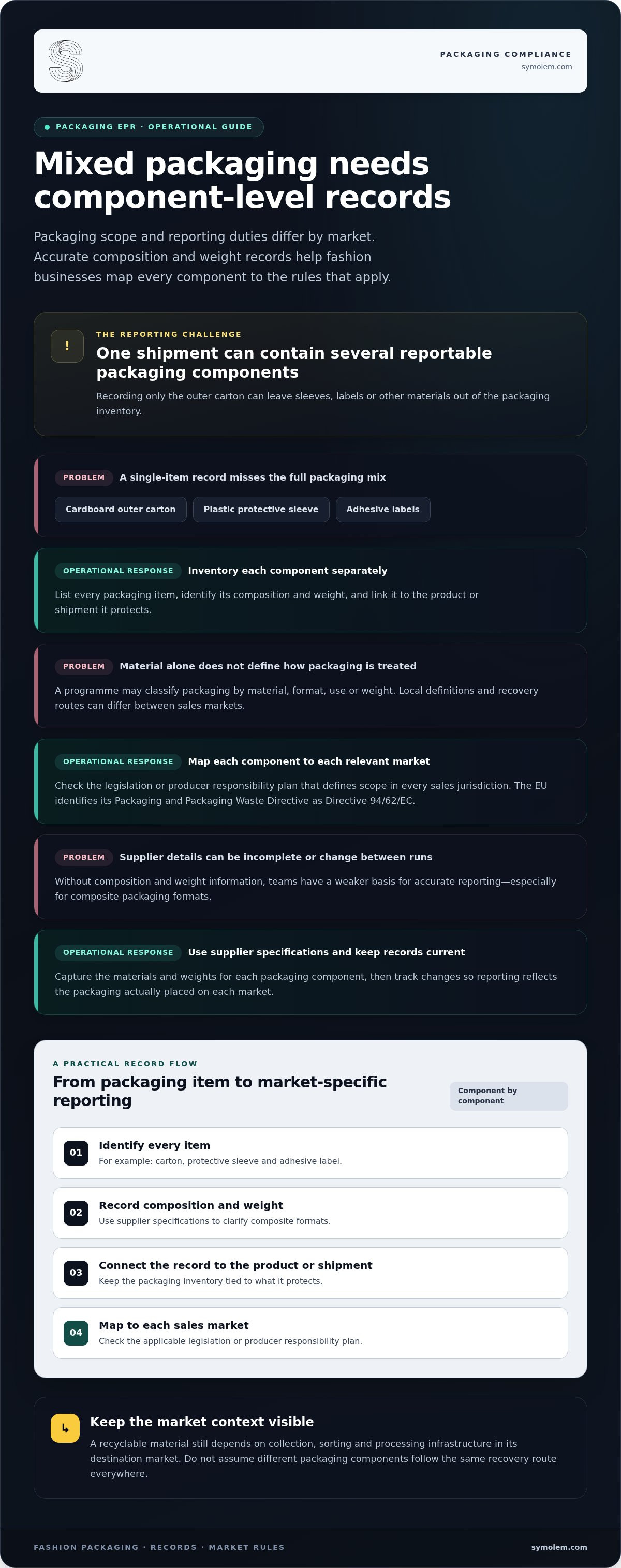
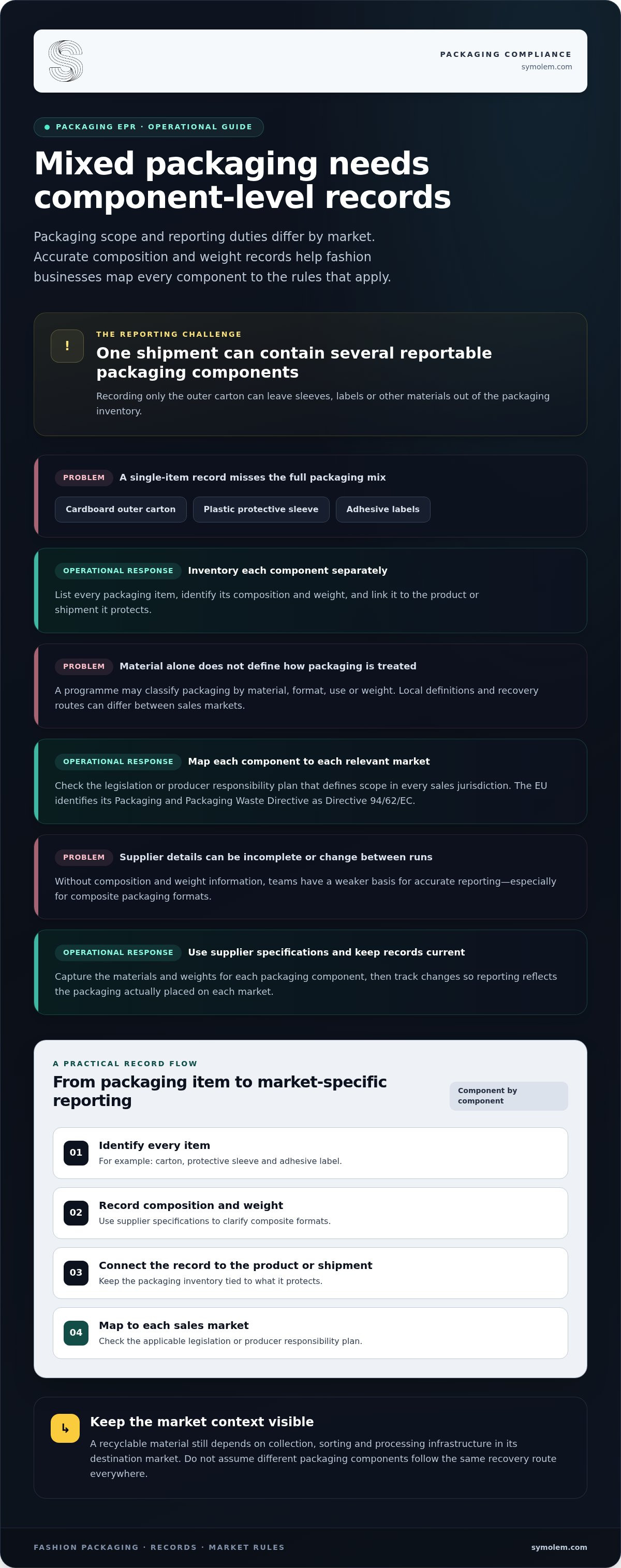
Legislation or a producer responsibility plan sets packaging scope in each market. Paper, plastics, metals and glass may be covered, but the material alone does not determine how it is treated. A programme may classify packaging by material, format, use or weight. When mapping reporting duties, distinguish a paper swing tag from a plastic garment bag.
The European Union identifies its Packaging and Packaging Waste Directive as Directive 94/62/EC. For textile businesses, the practical task is mapping every packaging component to the applicable market rules. A shipment might include a cardboard outer carton, a plastic protective sleeve and adhesive labels. Recording only the carton leaves other components outside the packaging inventory and weakens the basis for accurate reporting.
To understand why producer responsibility extends beyond packaging design, watch this relevant talk:
Material records should capture the packaging placed on each market, not just the finished garment. A brand shipping shoes in a cardboard box with a paper insert and plastic wrapping has several components to categorise. For composite formats, use supplier specifications to identify composition and weight. These details support reporting against the relevant programme definitions and help teams track changes between product runs.
Penalties for non-compliance depend on the jurisdiction and applicable rules. Consequences can vary by breach, such as inaccurate reporting or failure to meet a programme obligation, and by the enforcement provisions in that market. Map your sales jurisdictions and identify the producer duties that apply in each one.
Packaging choices also affect environmental outcomes after sale. A recyclable material still needs collection, sorting and processing infrastructure in its destination market, while combined materials can be harder to separate. For example, a retailer receiving garments from a CMT factory in Portugal should not assume cartons and protective bags follow the same recovery routes in every market. Local definitions make that distinction operationally important.
Start a reliable packaging record with a component-level inventory. List each item, its composition and weight, and the product or shipment it protects. Then map each entry to the legislation or producer responsibility plan in every sales market. This gives teams a shared basis for reporting, packaging decisions and stewardship duties, and shows where controls are needed.
Benefits and perceived drawbacks of EPR
California’s Plastic Pollution Prevention and Packaging Producer Responsibility Program shifts responsibility for plastic pollution from consumers to the plastics industry. This places responsibility closer to businesses introducing packaging into the market. For apparel brands, packaging choices affect both product delivery and end-of-life management. A mailer used to ship garments becomes part of the material stream that collection and recycling systems must handle.
Funding is a central benefit. Producer fees can support recycling infrastructure and consumer education, while some policy approaches also fund infrastructure improvements and markets for recycled materials. A producer responsibility organisation can coordinate programme activities, connecting business contributions with system needs. Check whether funding supports the collection, sorting and processing capacity required for covered materials.
California’s Mattress Stewardship Program illustrates the intended public value of product stewardship. It aims to reduce illegal dumping, increase recycling and lower local government costs for managing used mattresses. The same policy logic can apply to packaging: assigning responsibility may help address costs otherwise carried by public waste services. California product stewardship also supports materials-management goals and can encourage design changes that minimise environmental impacts.
The drawbacks are operational as well as financial. Producers must identify applicable programmes, maintain packaging records, and meet reporting and payment requirements. A fashion business selling across jurisdictions may need to manage different definitions and administrative processes. A packaging format may be categorised differently between markets, increasing coordination demands for sourcing, compliance and finance teams.
Administrative demands vary with an organisation’s resources and supply-chain structure. Collective compliance can centralise programme administration, but producers still need accurate information from packaging suppliers. If a supplier’s specification omits material composition or weight, the brand may need to obtain those details before reporting. This evidence work takes time, particularly when packaging changes are not communicated to record owners.
Programme design determines how these trade-offs are managed. Stakeholders should examine how a producer responsibility organisation allocates funding, supports collection and sorting, and develops end markets for recovered materials. Policy approaches may differ between federal and state systems, while specific duties depend on the programme applying to the producer. A clothing business should assess packaging decisions against product protection, handling, reporting demands and local recovery infrastructure.
EPR program resources
Start with the organisation responsible for administering the relevant producer responsibility programme. In the United States, Circular Action Alliance (CAA) is identified as the producer responsibility organisation helping producers comply with packaging laws. Its role makes it a practical starting point for understanding programme administration and producer obligations. Distinguish its reporting guidance from the underlying legal requirements in each jurisdiction.
Next, map the markets where products are sold and identify the corresponding programme resources. A fashion business shipping garments across state or national borders may face different reporting structures, producer definitions and funding arrangements. Record the responsible legal entity, the packaging placed on each market and the available reporting route. This helps teams direct questions to the relevant organisation instead of treating every market as one system.
Canada offers a useful example of coordinated policy development. The Canadian Council of Ministers of the Environment guided the Canada-Wide Action Plan for Extended Producer Responsibility, adopted in 2009. Nine of Canada’s ten provinces had implemented programmes or put producer responsibility requirements in place, according to the cited account. For businesses operating across provinces, that history illustrates why national frameworks and local implementation need separate attention.
Programme resources can also explain how stewardship applies to specific product streams. California’s Paint Stewardship Program provides for leftover paint to be reused, recycled or properly disposed of. Although paint is not textile packaging, the example shows how a programme can define covered materials and their intended end-of-life routes. Producers can use programme documents to understand which activities funding supports and how responsibilities are organised.
Keep useful records operational and accessible. Store the jurisdiction register, programme contacts, submission instructions, material categories and evidence requirements together. For a clothing range, link supplier packaging specifications to the relevant sales markets and reporting records. If a supplier changes a mailer or carton, the updated specification should reach the team responsible for producer responsibility submissions.
These resources also inform commercial decisions. Programme plans and reporting materials can clarify how financial responsibility is assigned, which organisation administers collection, and what infrastructure fees support. This context helps sourcing teams assess packaging choices against local recovery systems instead of relying on a general claim that a material is recyclable. Circular outcomes depend on programme collection and processing arrangements, not material labels alone.
Use a consistent review sequence: identify each market, locate its programme administrator, read the applicable producer guidance, and align internal packaging records with reporting categories. Then assign responsibility for submissions and evidence retention across compliance, finance and sourcing. This turns scattered programme documents into a controlled reference for decisions across a textile supply chain.
How are EPR fees calculated, and what do they cost?
Fees are generally based on the packaging a producer places on a market. In most programmes, producers pay a producer responsibility organisation, which distributes funds to cover costs required by programme legislation. Fees can apply to paper, plastics, metals and glass, with charges calculated by weight. The material and weight reported therefore affect the amount due.
Material matters because collection, sorting and recycling costs differ. Paper can carry lower fees than flexible plastics because it has more established collection, sorting and end markets. Fee structures may also reflect how difficult a material is to recycle. This creates a financial signal: harder-to-recover packaging may attract higher charges than more readily recyclable alternatives.
Fees support specific activities rather than representing an abstract charge. Funds allocated to a material can pay for its collection, sorting, consumer education and recycling. Some programmes also direct funding towards infrastructure or developing end markets. The programme legislation and relevant fee schedule determine how funds are allocated and which costs are covered.
For a clothing shipment, a producer could record the weight of a paper carton separately from that of a flexible plastic garment bag. Component-level records let the producer report each material in the appropriate category. Recording only total packaging weight loses a distinction that can affect the fee calculation. Supplier specifications and packaging changes should therefore be reflected in reporting records.
Lightweighting can reduce charges because fees are weight-based. Using less material may lower reported weight, but packaging decisions also affect protection, handling, damage prevention and freight. A lighter mailer is not automatically the most cost-effective option if it compromises garment protection or increases other operational costs. Assess total cost of ownership alongside the fee impact.
To estimate a programme charge, identify the relevant market, classify each packaging material, determine its reported weight, and apply the applicable fee schedule. Material category and weight are key inputs; recyclability and the programme’s cost structure can also influence the rate. The amount varies with the packaging mix and applicable schedule, so one figure cannot represent every producer or market.
For fashion businesses, the calculation depends on evidence from packaging suppliers and sales operations. A carton specification may change while product records remain untouched, creating a mismatch between actual packaging and reported quantities. Assign responsibility for collecting current weights and material details to keep finance and compliance records aligned. This control supports accurate reporting and makes packaging redesign decisions easier to assess.
How does EPR compare with traditional recycling and waste-management programs?
Traditional waste management often places collection and processing within public or local service systems. Producer responsibility programmes add a direct funding mechanism: producers contribute towards end-of-life management for covered products. These costs generally support collection, sorting and processing. The difference is structural. Rather than relying only on general waste services, the programme assigns producers a defined role in financing the materials they introduce.
This funding can connect product markets more directly to recovery systems. A clothing brand placing packaged garments on sale contributes to managing packaging after consumers discard it. The relevant programme may use producer fees to support collection routes, sorting facilities or processing capacity. Municipal collection may still operate, but producer-funded arrangements help finance activities covered by the programme rather than leaving all costs with local services.
Results vary by jurisdiction and programme design. Producer-responsibility policy drove recycling rates above 75% in British Columbia, Belgium, Spain, South Korea and the Netherlands. These examples show that high rates are achievable across distinct markets. They do not establish that every programme produces identical results: collection access, sorting systems, processing capacity and demand for recovered materials all shape performance.
A comparison of seven international programmes found recycling rates nearly ten percentage points higher than those of any US state examined. That finding points to a system-level difference, not a guaranteed outcome for every material or locality. Textile retailers should distinguish overall recycling rates from the actual route available for their packaging. Recovery depends on whether local services collect, sort and process the material.
Funding design also matters. Programme costs generally cover end-of-life activities, while some approaches extend support to consumer education, infrastructure improvements or markets for recycled materials. Traditional waste services may not use the same producer-specific funding mechanism. To compare the systems, examine who pays, which activities receive funding and whether the programme develops the capacity needed to recover materials.
For apparel businesses, make the comparison with a packaging example. A paper shipping carton and a flexible garment bag may enter different collection and sorting routes. Producer-funded systems can direct resources towards managing covered materials, while ordinary waste services depend on local arrangements. Map the packaging placed on each market and identify which recovery activities its programme supports.
Neither funding model alone guarantees circular outcomes. A programme can assign financial responsibility, but effective recovery still depends on infrastructure, consumer participation and viable end markets. When reviewing a packaging change, compare the applicable programme’s funded activities with actual local collection and processing. This connects packaging decisions to the waste system that handles materials after use.
Symolem: Symolem-ID Automated Compliance Screening Automated pre-PO screening platform for fashion retailers and marketplaces to verify third-party brand ranges against 50+ global textile regulations in seconds.
Symolem-ID helps fashion retailers and marketplaces screen third-party brand ranges before purchase orders are signed. It checks products against 50+ global textile regulations in seconds and assigns per-SKU statuses: Cleared, Blocked or Missing Evidence.
That makes compliance screening relevant when buying teams assess apparel from brands they do not manufacture, especially when packaging records or other evidence affect market readiness. A Missing Evidence status identifies a gap to resolve before an order progresses; a Blocked status flags a product that needs attention. The result gives buying and compliance teams a clearer basis for pre-purchase decisions.
Use Symolem-ID when regulatory screening needs to be part of the purchasing workflow, rather than taking place after a range has been approved. To discuss how pre-PO screening fits your retail operations, visit symolem.com.
Make compliance part of the buying decision
Packaging obligations are easier to manage when responsibility, supporting evidence and purchasing controls are connected. Treat EPR compliance as an operational input, not a task to defer until after a range is approved. Retailers can screen third-party brand ranges before signing purchase orders, while fashion brands can address supplier evidence gaps and substantiate social accounting for retail stockists.
Symolem supports these needs through pre-purchase screening, Tier 1-3 evidence retrieval and human-led social due diligence. The next step is to identify where your current process leaves uncertainty, then establish a clear route to resolve it.
Contact Symolem about EPR compliance.
Screen third-party brand compliance before signing the PO. Explore Symolem-ID or run a free product scan.
Need to retrieve missing Tier 1-3 supplier evidence or substantiate social accounting for retail stockists? Take the 5-minute Free Assessment or Book an Advisory Consultation.
Clear evidence and disciplined decisions give your teams a stronger basis for action.
Frequently Asked Questions
How Does EPR Work?
A programme assigns producers responsibility for managing covered products or packaging at end of life. Identify the markets where you sell, determine which packaging the relevant rules cover, and report the required information through the permitted route. For example, a fashion brand selling in several states needs to distinguish packaging placed in each market. This helps assign reporting tasks and connect packaging records to the correct programme.
What Is EPR?
Extended Producer Responsibility is a policy approach that assigns producers financial responsibility, operational responsibility or both for products at end of life. Exact duties depend on the legislation or programme in each market. Here, the term concerns producer obligations for packaging and textile-related supply chains. It does not describe one globally harmonised system, so businesses need to interpret their duties in the jurisdictions where they sell.
What Packaging is Affected?
Packaging falls within scope when the applicable legislation or producer responsibility plan defines it as covered. Paper, plastics, metals and glass can be included in packaging programmes, but coverage depends on local definitions. A garment shipment might use a cardboard box, a plastic garment cover and a paper tag. Record each component separately, then map it to the rules for the market where the packaged product is sold.
What is the Main Function of the EPR System?
The system assigns responsibility for managing covered products or packaging after use. Its central function is to organise or fund end-of-life activities, such as collection and processing, under the relevant programme. For fashion businesses, this connects packaging placed on the market with the resources used to manage it later. The exact operational and financial arrangements depend on programme design.
Who’s Responsible?
Under the packaging programmes described, producers are typically brand owners that choose packaging and sell packaged products in designated states. A programme may require or encourage them to join a producer responsibility organisation, while some also allow individual compliance. Retailers selling another brand’s garment should not assume they or the manufacturer automatically hold the producer role. The relevant programme’s definitions determine which business carries the obligation.
Why is EPR Policy More Widespread in Other Countries?
There is no single international policy model. Governments decide whether to assign producers a formal role, how to fund waste systems, and whether collective organisations administer obligations. International programmes show how this approach can operate across jurisdictions, while US requirements vary by state and product category. These institutional choices help explain different levels of adoption; they do not create one worldwide rule for fashion businesses.
Why is EPR needed?
Producer responsibility can connect the costs of managing discarded products with the businesses placing them on the market. Without a defined funding or operational model, local authorities and waste services may carry more of the work. For clothing companies, the policy can also make packaging data relevant to commercial decisions, since material choice, weight and local recovery arrangements affect how packaging is managed after sale.
What does EPR stand for in different contexts?
In packaging and product policy, EPR stands for Extended Producer Responsibility. The same letters may mean something else in other fields, so context matters: identify the surrounding subject and the document defining the term. In a textile packaging discussion, it refers to producer responsibility for end-of-life management, not a separate product label or a universal programme with identical requirements in every country.
Frequently Asked Questions
Talk to a consultant
Have a question about how this applies to your brand?
Ask Lavinia Fernandes directly. Tell us your products and markets and you get a straight answer on what applies and what to do first.