ESPR Gap Analysis Service: Bridge Your Compliance Gaps
A policy document alone cannot establish compliance. An ESPR gap analysis compares applicable requirements with current practices, product data and supporting evidence, then identifies missing controls and their root causes. The EU Ecodesign for Sustainable Products Regulation (ESPR) will be implemented through Delegated Acts that set specific requirements for each sector, according to the European Union.
That comparison is especially important in fashion, where evidence may be spread across suppliers, product records and data systems. For example, a spinning mill’s fibre specification may not match information held by a dyeing house or a cut, make and trim (CMT) factory. A Digital Product Passport depends on product information being structured and traceable, not merely available somewhere in the supply chain.
This article explains how to conduct an ESPR gap analysis: define the requirements and target state, assess existing processes and evidence, and describe each gap by its cause and operational effect. It also explains how to interpret findings across compliance controls, supplier data and Digital Product Passport transparency, so you can distinguish a missing document from a deeper weakness in how information is collected and maintained.
Key Takeaways
- Set clear compliance objectives before assessing performance, so the analysis measures meaningful gaps rather than producing an unprioritised list of issues.
- Separate missing evidence from weaknesses in the processes used to collect, maintain and communicate product information.
- Interpret each finding by identifying its root cause, operational effect and the action needed to address it.
- Turn results into a prioritised action plan with defined objectives, responsibilities and time frames.
- Distinguish knowledge, policy, delivery and communication gaps to pinpoint where controls break down across compliance work.
Table of Contents
- How to Conduct Gap Analysis?
- Data systems and Digital Product Passport transparency
- How to Interpret and Report Gap Analysis Results?
- Gap analysis definition and purpose
- Knowledge, policy, delivery, and communication gaps
- Symolem: Symolem-ID Automated Compliance Screening Automated pre-PO screening platform for fashion retailers and marketplaces to verify third-party brand ranges against 50+ global textile regulations in seconds.
How to Conduct Gap Analysis?
Conduct an ESPR gap analysis by mapping applicable requirements against product evidence, operational controls and the data needed to demonstrate compliance. The findings should show not only what information is missing, but why it is missing and what action will close the gap.
To see how supply-chain evidence and verification connect to product requirements, watch this overview from BSI Group:
Assessing Standards and Regulatory Requirements
Regulatory assessment maps each applicable requirement to the product, evidence and process expected to demonstrate conformity. This matters because an internal sustainability framework cannot replace a legal obligation. The European Union’s ESPR Article 5 requires products to be inherently circular. Requirements are implemented through sector-specific Delegated Acts, according to the European Union, so teams should distinguish current obligations from requirements established for particular product groups.
For textiles, assess relevant characteristics such as durability, reusability, repairability, recyclability and environmental footprints, which the European Commission and EUR-Lex identify as areas ESPR requirements can address. A product life cycle assessment adds context by examining impacts from material sourcing through production, use and end of life. Human judgement is still needed to assess evidence quality, boundaries and assumptions; a completed template is not proof on its own.
Identifying Compliance Gaps
A compliance gap assessment compares required controls with the processes and evidence currently in place. It matters because the same missing file can have different causes: a supplier may not have a test report, or the brand may lack a process for requesting and retaining it. Record the affected requirement, available evidence, root cause and business owner for each gap.
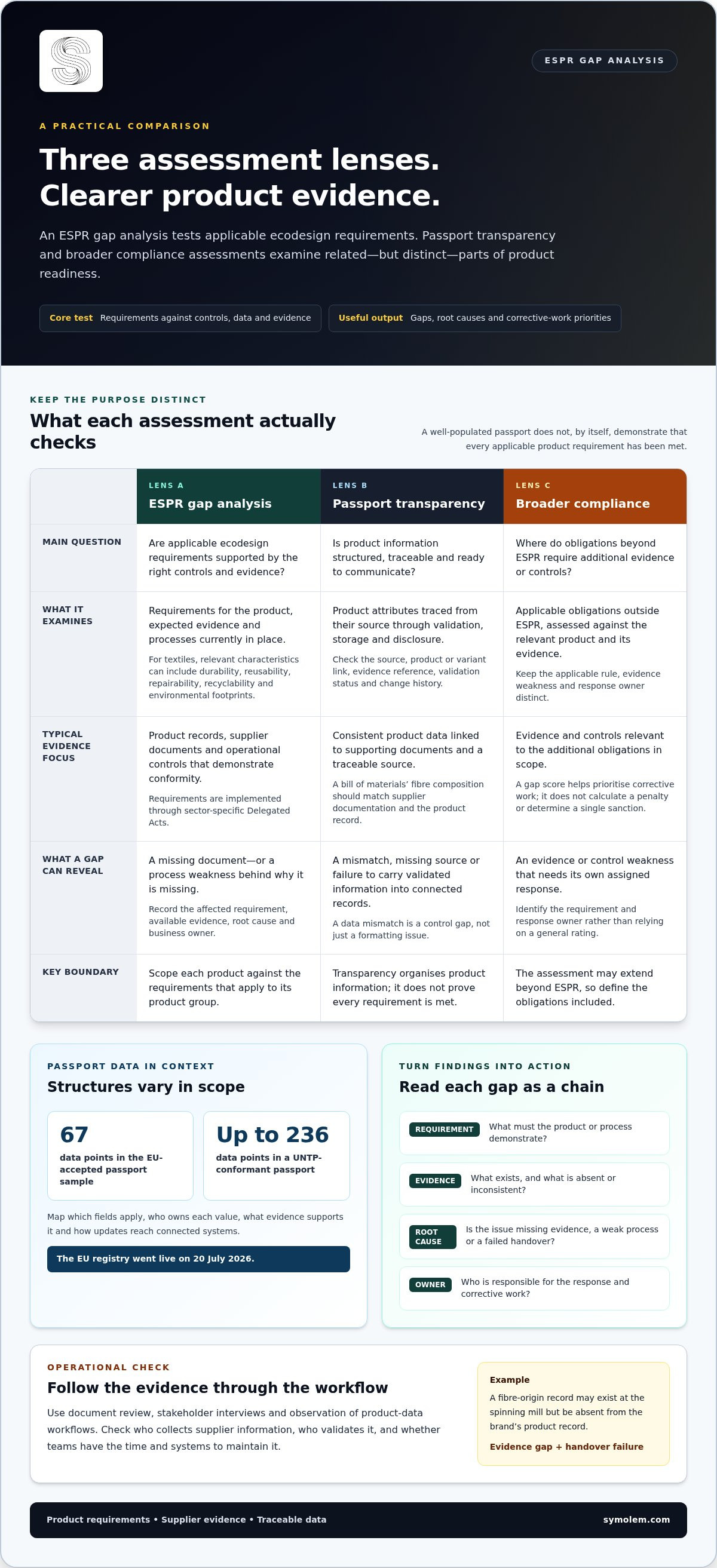
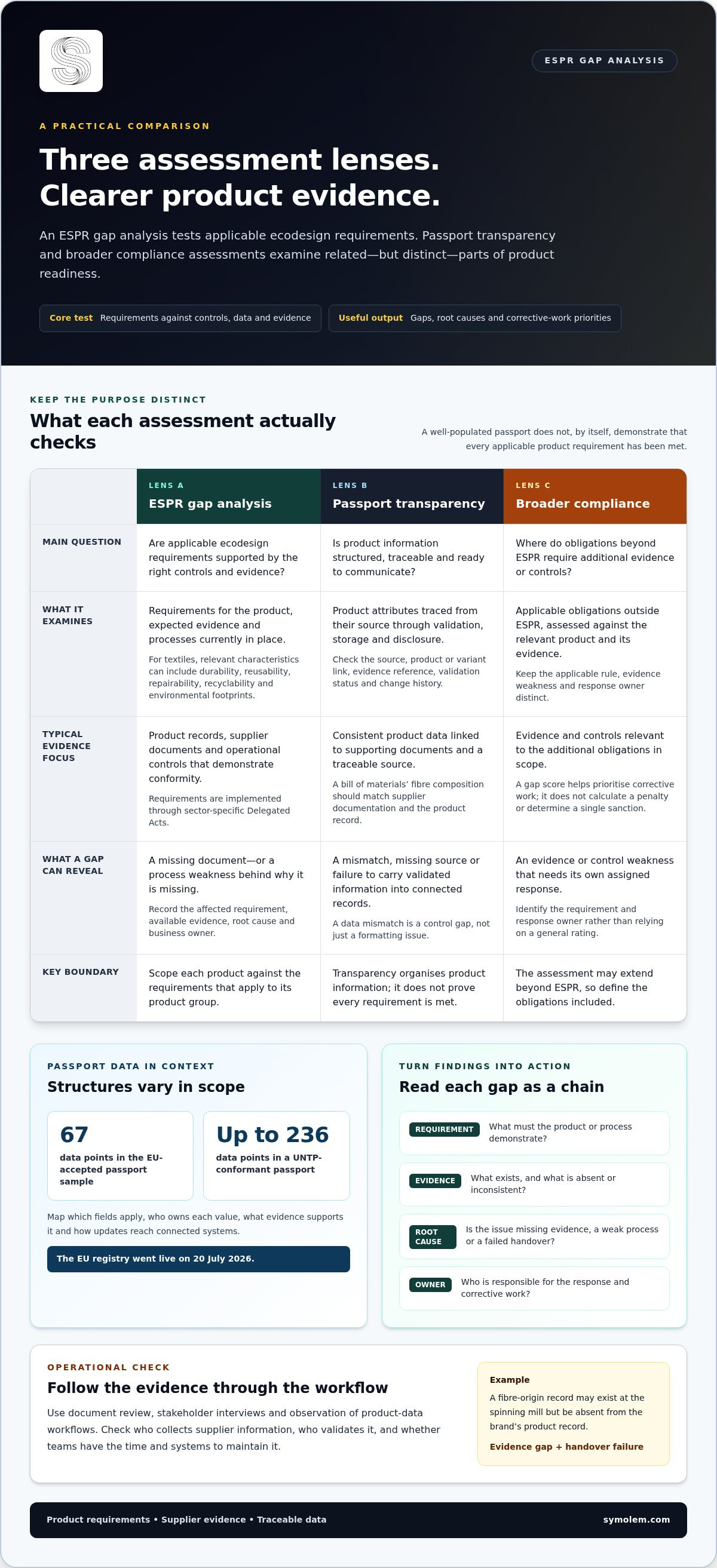
Assess current processes through document review, stakeholder interviews and observation of product-data workflows. Then examine responsibilities and resources: identify who collects supplier information, who validates it, and whether teams have the time and systems to maintain it. A fibre-origin record, for example, may exist at the spinning mill but be absent from the brand’s product record. That points to both an evidence gap and a handover failure.
Defining ESPR Coverage and Assessment Scope
Define ESPR scope by identifying the products and product groups subject to applicable requirements, then mapping the businesses and supply-chain functions responsible for the relevant information. This matters because assessment criteria depend on sector requirements established through Delegated Acts. The regulation does not set identical requirements for every product, so the scope must connect each product to the rules that apply.
For each product, assess relevant sustainability characteristics and supporting data, including materials, product construction and evidence of the processes used. A garment assessment might compare fibre specifications with supplier records and production documents, then identify information needed to substantiate lifecycle-related characteristics. Show which team or supplier controls each record, so missing evidence is assigned to a process rather than buried in a general compliance rating.
Comparing ESPR, Passport, and Broader Compliance Assessments
An ESPR gap analysis tests readiness against applicable ecodesign requirements; a Digital Product Passport focuses on structured product information and transparency. A broader compliance assessment may also examine obligations beyond ESPR. The distinction matters: a well-populated passport does not, by itself, demonstrate that every applicable product requirement has been met.
For a US company selling in the EU, the analysis should identify which requirements apply to its products and where evidence or controls fall short. A gap score does not calculate a penalty or determine a single sanction. Instead, it gives the business a documented basis for prioritising corrective work and assessing market-access exposure against the relevant product requirements. Record the applicable rule, evidence weakness and response owner separately.
Data systems and Digital Product Passport transparency
A Digital Product Passport is only as reliable as the product data behind it. Assess data systems by tracing each product attribute from its source through validation, storage and disclosure. In a fashion business, the fibre composition in a bill of materials should match supplier documentation and the product record used by retail teams. A mismatch is a data-control gap, not just a formatting issue.
Passport structures can differ in scope. The EU-accepted passport sample carried 67 data points, while a UNTP-conformant passport carries up to 236. The EU registry went live on 20 July 2026. These figures make data mapping consequential: teams should identify which fields apply, who owns each value, what evidence supports it, and how updates reach connected systems.
Build traceability around sources, not copied values. For each record, capture its origin, product or variant association, evidence reference, validation status and change history. Then test whether someone can trace a material claim back to its supporting documents. If a spreadsheet says a garment contains a particular fibre but the supplier file covers another product variant, the evidence link is unreliable.
Examine how data moves between procurement, product development and compliance teams. Map hand-offs, identify manual re-entry and compare duplicate records across systems. Assess missing, conflicting and outdated values separately, as each points to a different process weakness. A missing value may mean a supplier response was never collected; conflicting values may signal uncontrolled edits or unclear ownership.
Customer data requests can reveal these weaknesses. Categorise requests by product attribute, evidence source and response difficulty, then use recurring requests to improve data templates and collection workflows. A survey can ask buying teams which product records they repeatedly need, where responses are delayed and which evidence formats are difficult to interpret. Review responses by product category and refine questions when answers do not identify a specific data problem.
Staff training should target actual failure points. Show product teams how to attach evidence to the correct variant, flag uncertainty and escalate conflicting supplier records. Test the process with a sample apparel record, then see whether another team member can retrieve its source documents without relying on informal messages. Clear ownership and controlled access support consistent updates.
Where teams need structured benchmarking, a readiness assessment for ESPR and DPP data can help organise evidence and identify governance gaps.
How to Interpret and Report Gap Analysis Results?
Gap findings become useful only when they explain the difference between current controls and intended performance. Compare policies, actions, targets and reporting against each other, then identify which discrepancies require operational decisions.
When selecting an ESPR gap analysis service, assess its understanding of ESPR requirements, textile supply chains and product evidence. The findings should connect each gap to a clear rationale, supporting evidence and practical corrective action.
Reporting Results and Prioritizing Actions
A gap report records the requirement, current practice, evidence reviewed, identified weakness and operational consequence. This structure matters because a bare “missing” label gives decision-makers no basis for action. Compare written policies with what teams and suppliers actually do, then check whether reported targets align with the evidence collected.
Prioritise findings by considering their relevance to applicable requirements, the products affected, evidence reliability and dependencies between corrective actions. For example, a retailer reviewing a brand range may find that product claims rely on supplier records that cannot be traced to specific styles. Distinguish that evidence failure from the absence of an internal review process, assign each issue an owner, and record its status for management reporting.
Developing Action Plans and Proposed Solutions
An action plan translates each gap’s root cause into a proposed solution, defined objective, accountable owner and time frame. This matters because corrective work must address the failure itself, not merely improve the report’s appearance. If a dyeing house’s records are not linked to the relevant product, for example, the action should establish a reliable product-level evidence hand-off.
Set targets that can be assessed against observable evidence, such as whether a revised workflow captures, reviews and retains required supplier documents. Record dependencies too: a product team cannot validate a material record until sourcing receives its supporting file. Reporting should show which actions are underway, blocked or complete, and whether the proposed solution has resolved the original gap.
Creating an Actionable Roadmap
A roadmap sequences corrective actions so teams can address prerequisites before dependent work. This matters when a policy revision, supplier evidence request and data-system change all affect the same product record. Map each action to its owner, target, required resource and completion evidence, then link it to the finding that prompted it.
For instance, a fashion brand may first define who approves fibre data, then standardise supplier submissions, and finally update product records. Sequence actions according to real dependencies, not departmental preference. Review progress through scheduled reporting, compare completed actions with their targets, and reopen a finding if the evidence still does not demonstrate the intended control. This keeps the roadmap focused on verified improvements, not activity alone.
Gap analysis definition and purpose
A gap analysis compares an organisation’s actual position with a defined target, then identifies the differences and their causes. An ESPR gap analysis service applies that comparison to relevant product requirements, evidence and internal controls, helping teams set corrective priorities.
Setting Scope and Objectives
Scope and objectives define which products, processes and outcomes the assessment will examine. They matter because an undefined review can produce findings without operational focus. Start by selecting product groups, business functions and relevant objectives, then document the boundaries and evidence sources included.
Set objectives in line with the organisation’s mission, strategic goals and improvement priorities. For a fashion brand, this could mean assessing whether product information supports the requirements relevant to selected garments. State the target condition clearly, such as having traceable evidence linked to each assessed product record. This gives the team a defined outcome to compare with actual practice.
An ESG gap analysis takes a broader view, examining an organisation’s environmental, social and governance practices against its chosen objectives or standards. It aims to identify differences between current performance and the intended state. An ESPR analysis is narrower, focusing on product-related requirements within the regulation’s scope. Keeping the purposes distinct prevents broad sustainability findings from obscuring specific product-compliance issues.
Defining the ESPR Gap Analysis Service
An ESPR gap analysis service systematically assesses current product practices and evidence against applicable ESPR requirements. It matters because teams need to know whether a gap stems from missing documentation, a weak process or unclear responsibility. The analysis should connect each finding to a requirement and explain the difference between the expected and actual state.
For example, a brand may hold a fibre specification but lack a controlled method for linking it to the correct garment record. The gap is not simply “data missing”; it may concern product identification, record ownership or evidence handling. Define the issue precisely, then identify the process or control that needs attention.
The assessment should also distinguish findings from remedies. A finding describes the gap and its root cause; an action plan sets out the response, owner and intended result. If supplier evidence is incomplete, the analysis can identify whether the problem lies in the request template, supplier hand-off or internal review. That diagnosis helps direct resources towards the underlying failure.
Finally, use the analysis to support decisions, not to produce a standalone score. A product team can use prioritised findings to direct evidence collection, process changes and follow-up reviews. The useful output is a clear account of the gap between requirements and actual practice, with an action plan tied to defined objectives.
Knowledge, policy, delivery, and communication gaps
Compliance can fail at several connected points: employees may lack knowledge, policies may be incomplete, delivery may diverge from procedure, or communication may break down between teams. Separating these failures helps identify what must change and who can implement it.
Policy Gaps
A policy gap exists when documented rules do not define or support the controls employees need to perform their work. It matters because a written commitment cannot guide routine decisions if staff cannot put it into practice. For example, a fashion brand may require supplier evidence but give its sourcing team no clear process for recording, reviewing or escalating missing documents.
Assess policy against actual working practices. Compare stated requirements with procurement templates, product-data fields and approval records. If a policy calls for verified fibre information but the product team accepts unreferenced supplier declarations, the control is ambiguous or unenforced. Record the precise failure, the affected role and the evidence showing the mismatch.
Knowledge gaps are related to policy gaps but need a different response. Employees may have a documented procedure yet misunderstand which record belongs to a product variant. Use targeted interviews and sample exercises to test whether staff can locate the correct evidence and explain its purpose. Training should address observed errors rather than repeat general sustainability messages.
Communication gaps arise when information changes or loses context as it moves between functions. A sourcing manager might receive a supplier certificate, while product development cannot identify the material or style it supports. Define structured hand-offs, required fields and escalation routes. Then test a record from supplier receipt through internal review to final product documentation.
Delivery Gaps
A delivery gap occurs when implemented activity does not match the policy or target. It matters because formal controls only work when teams apply them consistently across suppliers and products. Compare planned tasks with completed records, then identify where responsibility, capacity or workflow design interrupts delivery.
For example, a dyeing house may provide process documentation, but the brand’s internal review may not connect it to the relevant garment. The delivery failure could involve an incomplete request, an unclear owner or a manual transfer between systems. Identify the cause before choosing corrective action; otherwise, a new policy may leave the operational failure untouched.
Use a structured review of exceptions, overdue requests and rejected records to locate recurring breakdowns. Ask employees who handles each step, what evidence they use and where delays occur. Repeated supplier-response problems may call for revised instructions, while inconsistent internal categorisation may require clearer data definitions. Each finding should identify its root cause and responsible process owner.
Finally, test whether corrective actions bridge the diagnosed gap. Recheck a sample product record after the process changes, and compare it with the original failure. Structure an ESPR readiness review around these policy and delivery findings.
Symolem: Symolem-ID Automated Compliance Screening Automated pre-PO screening platform for fashion retailers and marketplaces to verify third-party brand ranges against 50+ global textile regulations in seconds.
Symolem provides the operational next step when a gap analysis identifies unresolved product risks. Symolem-ID screens third-party fashion brand ranges against 50+ global textile regulations in seconds, giving retailers and marketplaces a per-SKU status: Cleared, Blocked or Missing Evidence before purchase orders are signed.
For brands, the ESPR & DPP Readiness Diagnostic benchmarks readiness against EU ESPR technical standards and UNTP data protocols. Where findings trace to missing supplier records, Regulations Data Retrieval Advisory can pursue chemical test reports, fibre-origin documentation, transaction certificates and packaging weights across Tier 1-3. The assessment findings then connect to specific evidence and process gaps, rather than treating every issue as a generic data problem.
Discuss your ESPR assessment findings with Symolem to identify the next step for your fashion supply chain.
Turn assessment findings into accountable decisions
A gap analysis is valuable when its findings change how product decisions are made. Treat each open issue as an operational responsibility: assign an owner, link the required evidence to the relevant product, and establish how progress will be reviewed. This keeps compliance work tied to purchasing and product governance instead of leaving it as a separate reporting exercise.
An ESPR gap analysis service can help define that next phase. Symolem’s work includes pre-purchase-order screening for retailers, forensic retrieval of missing Tier 1-3 supplier evidence, and auditable social accounting and due diligence for fashion businesses. The appropriate next step depends on whether your priority is assessing readiness, resolving missing records or screening third-party brand ranges.
Bring your current findings and the decision they need to support. Contact Symolem about your ESPR gaps and identify a practical way forward for your team.
Frequently Asked Questions
How to Implement Gap Analysis Recommendations?
Put recommendations into the decisions and systems where the identified failure occurs. If a supplier record is repeatedly accepted without a product reference, update the intake control so staff cannot close the review without recording that link. Test the revised control on a new submission, review exceptions with the process owner, and retain evidence that the changed procedure works in practice.
How to Prepare for Gap Analysis?
Prepare by agreeing access, ownership and boundaries before the assessment begins. Identify who can explain product-data workflows, who controls supplier correspondence and which system holds the authoritative records. Make a representative sample available with relevant versions and history, not just the latest summary. Record exclusions too, so reviewers and decision-makers understand what the findings cover and what they do not.
Why Is a Gap Analysis Important?
A gap analysis helps decision-makers distinguish controlled compliance work from assumptions. For example, a buying team can determine whether a brand’s product status rests on reviewed evidence or an untested declaration. This distinction supports sounder escalation and purchasing decisions, while helping management focus on control failures that could affect product approval or continued trading.
What Is Gap Analysis and How Does It Work?
Gap analysis is a structured comparison that locates differences between a defined requirement and observed practice. An assessor selects the area under review, examines how work is actually performed, and tests whether available evidence supports that practice. Process owners then review the findings, helping distinguish a genuine control failure from a misunderstanding or isolated record error.
What’s in a Gap Analysis Template?
A template can also capture assessment boundaries, review date, evidence version and confidence in each finding. These fields help later reviewers see whether a conclusion relied on a current record or an incomplete sample. Include a closure test that states what would demonstrate resolution, such as an approved control operating during a subsequent product review. This makes the template useful for follow-up, not just initial documentation.
What ESPR Requirements and Delegated Acts Are Currently in Force or Expected?
The European Union’s ESPR framework is implemented through Delegated Acts that define specific requirements for product sectors. For practical tracking, maintain a product-group register that distinguishes the regulation’s framework from applicable sector requirements and records each measure’s legal status. Do not treat a planned or discussed measure as an operative product obligation; apply requirements according to the relevant adopted legal text.
What Information and Documents Are Needed to Conduct an ESPR Gap Analysis?
Beyond product evidence, prepare the identifiers and context needed to interpret records correctly. Ensure each style or variant can be matched across internal product systems, supplier files and review records. Include document versions and relevant correspondence when they explain a change or discrepancy. This helps assessors establish whether records refer to the same product and whether a conclusion reflects the evidence available at review.
What Are the Steps, Timeline, and Deliverables of an ESPR Gap Analysis?
The work generally proceeds through scope agreement, evidence review, process assessment, findings validation and presentation of results. Timing depends on the breadth of products, accessibility of records and coordination required across suppliers and internal teams. Useful outputs include a prioritised finding register and a follow-up tracker with owners and closure criteria. Agree on these outputs and review arrangements at the outset so teams can incorporate findings into governance and purchasing workflows.