Expert DPP Implementation for Fashion: Consultancy Guide
What if the first DPP implementation decision shouldn’t be which platform to buy? For fashion brands, a DPP implementation consultancy should first establish whether product evidence is complete, verifiable and owned by accountable teams. Without that foundation, fragmented records and missing Tier 1-3 documents can simply be transferred into a new system without resolving the underlying gaps.
The pressure is already operational. Product information may sit across internal systems, supplier spreadsheets and certificates held by a spinning mill in India, a dyeing house in Turkey or a CMT factory in Portugal. Teams need a workable way to identify what exists, verify its reliability and assign responsibility for what’s missing, before choosing how records will be transferred.
This guide explains what effective DPP implementation consultancy for fashion should deliver, how to assess organisational readiness and how to prioritise work around real product and supplier gaps. It also shows why implementation is an evidence and governance exercise, not consumer app development. Symolem verifies and structures product compliance records, then assigns a Verification ID to prepare them for transfer to a selected DPP provider or retail onboarding system.
Key Takeaways
- Define implementation through accountable evidence workflows and named outputs, not a technology purchase alone.
- Distinguish structured product records, supporting evidence, verification and the passport interface before planning system handover.
- Assess DPP implementation consultancy fashion approaches by deliverables, evidence ownership, supplier reach, verification and transfer responsibilities.
- Sequence implementation from scope and evidence mapping through retrieval and verification to data transfer, with clear retailer and brand workstreams.
- Retailers can prioritise pre-PO checks for third-party ranges, while brands can focus on preparing auditable product records for onboarding.
Table of Contents
- Why Fashion DPP Implementation Consultancy Must Start With Evidence
- Separate DPP Records, Verification, and Passport Technology
- Compare Fashion DPP Consultancy Approaches by Deliverables and Accountability
- Build a Sequenced DPP Implementation Roadmap for Fashion Operations
- Choose Evidence-Led DPP Implementation Support That Fits Your Role
Why Fashion DPP Implementation Consultancy Must Start With Evidence
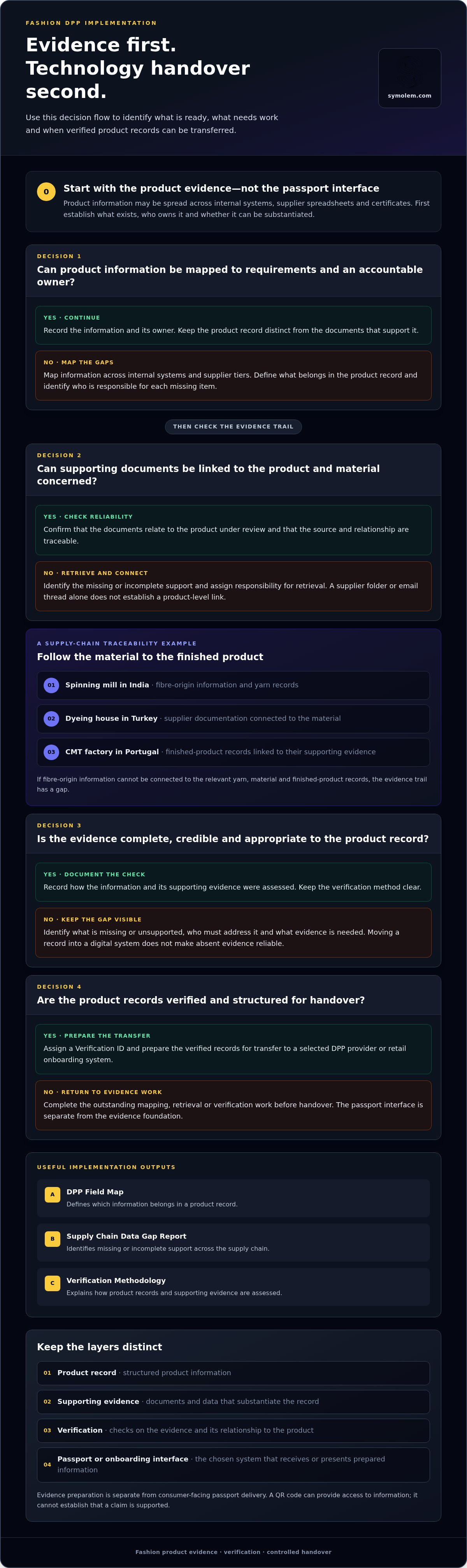
Start with the records, not the interface. Effective DPP implementation consultancy fashion work maps product information to relevant requirements, identifies who owns each record, checks whether supporting evidence is credible and structures verified data for transfer. It cannot make absent or unsupported supplier documentation reliable simply by moving it into a digital system.
Evidence readiness is the work of mapping, retrieving and verifying product records; consumer-facing passport delivery is the separate work of presenting approved information through a chosen system. This distinction matters: fashion businesses need to establish what they can substantiate before deciding how product information will be displayed. A DPP implementation consultancy fashion project should address that operational sequence.
For a concise overview of the policy concept, see the EU Digital Product Passport. The practical test for a business remains whether its product information can be traced to credible records and responsible owners.
For a visual introduction to the subject, watch this overview:
What a fashion DPP implementation consultancy should solve
Effective implementation links product data to applicable requirements and operational owners. It identifies gaps across internal systems and supplier tiers, then sets out how evidence will be retrieved, checked, maintained and approved. The result should be a usable record structure, not a disconnected collection of documents.
For example, a DPP Field Map can define which information belongs in a product record, while a Supply Chain Data Gap Report identifies missing or incomplete support. A Verification Methodology explains how records are assessed. Together, these outputs help teams prepare verified information for transfer into a selected DPP provider or retail onboarding system.
Why product evidence creates the first implementation bottleneck
Consider a garment made with yarn from a spinning mill in India and assembled at a CMT factory in Portugal. If the brand cannot connect the fibre-origin information to the relevant yarn, material and finished product records, the product-level evidence trail has a gap. A product team may hold a bill of materials while supplier documentation sits in email threads, uses inconsistent descriptions or cannot be linked to the item under review.
Adding a QR code does not repair that break. It can provide a route to information, but it cannot establish that an environmental or origin claim is supported by evidence. The underlying record still needs a source, a clear relationship to the product and a verification process.
The exposure differs by role. A brand may struggle to respond when a retailer requests substantiation for products it sources and sells; a retailer may face its own commercial and compliance exposure when onboarding third-party ranges without adequate evidence. The exact legal position depends on the applicable rules and circumstances, so implementation should map obligations rather than assume every party carries identical duties.
Symolem’s product compliance intelligence platform and evidence advisory retrieves Tier 1-3 documentation, verifies and structures product records, and assigns a Verification ID for transfer to a chosen DPP provider or retail onboarding system. That is evidence preparation, not consumer passport app development.
Separate DPP Records, Verification, and Passport Technology
A DPP is not one file, one QR code or one database. Implementation involves distinct layers: structured product records, the documents and data that support them, checks that establish whether those records are substantiated, and the interface through which users access relevant information. Treating these as interchangeable creates gaps in responsibility and makes handover harder to control.
The EU DPP Registry became operational on 20 July 2026. It provides a central registry for Digital Product Passports, including legal, machine-readable product records. That does not make the Registry a substitute for a brand’s source documents or evidence controls. The product record communicates structured information; supporting records establish its basis; verification assesses the relationship between the two.
Where evidence advisory ends and DPP provider functions begin
Evidence work takes place before transfer. A reviewer checks whether a record is complete, whether its supporting documentation relates to the product concerned, and whether the verification method is recorded. For example, fibre-origin information should be connected to the relevant product and material records, rather than simply stored in a supplier folder without a traceable link.
Symolem verifies and structures product compliance records, then assigns a Verification ID to prepare verified records for transfer. It does not issue a consumer passport. A selected DPP provider manages the passport system and its consumer-facing access interface; a retailer’s onboarding system may also receive the prepared records for its own product review processes.
This boundary matters commercially. A brand can control evidence collection and product-record integrity without being the passport technology provider. A retailer can receive structured records for onboarding and pre-purchase checks without assuming that a passport interface itself proves every claim.
Why interoperability depends on governed source data
Transfer works only when source data is identifiable and controlled. Product lifecycle management (PLM) records may hold specifications and bills of materials; enterprise resource planning (ERP) systems may contain product identifiers and commercial records; supplier files may include test reports or fibre-origin documents; transaction records may support material or chain-of-custody information. Their terminology, identifiers and update cycles can differ.
Teams therefore need to define who owns each field, who can approve a change and which version is authoritative. If a supplier updates a fibre declaration, for instance, the business needs a way to determine whether the revised record applies to a specific product, production period or material lot. Without version control and clear ownership, a technically transferable record may still be unreliable.
A DPP implementation consultancy for fashion should map these sources and responsibilities before preparing records for transfer. For protocol-specific detail, the article’s UNTP passport explainer can provide a deeper account of the data framework. The central operational question remains the same: can each field be traced to a governed source and reviewed evidence?
Symolem’s DPP evidence verification work supports that preparation through structured records and a Verification ID for transfer to a selected provider or retail system. Teams defining this boundary can use Symolem’s product compliance evidence approach as part of their implementation planning.
Compare Fashion DPP Consultancy Approaches by Deliverables and Accountability
Compare approaches by what they leave behind, not by the ambition of their presentations. A strategy document, a software environment and a verified evidence pack solve different problems. For DPP implementation consultancy in fashion, the useful test is whether teams can identify missing records, assign responsibility for closing gaps and hand over structured information with its verification status intact.
Approach
Typical outputs
Ownership, supplier reach and verification
System handover
Strategy-only
Recommendations and high-level roadmap.
Usually defines internal responsibilities at a broad level; supplier evidence retrieval and record-level verification may remain with the brand.
May outline future system needs without preparing verified records for transfer.
Software-led
Configured data fields, workflows or system connections.
Can organise submitted information, but ownership, supplier follow-up and verification depend on the operating model.
Focuses on platform transfer or integration; incomplete source evidence remains unresolved.
Evidence-led
DPP Field Map, Supply Chain Data Gap Report and Verification Methodology.
Connects missing records to products, suppliers and accountable owners; documents how evidence is reviewed.
Prepares verified product records for a selected provider or retail onboarding system.
Integrated implementation support
Evidence outputs alongside a Data Architecture Specification and Sequenced Roadmap.
Sets out internal ownership, supplier engagement and the verification process across the agreed scope.
Defines how prepared records move into the selected system and what information must accompany them.
These are typical distinctions, not guarantees about every engagement. Scope and named deliverables should reflect the product range, sourcing structure and operating model. A brand with centralised product records and established supplier contacts has different retrieval needs from one managing multiple material sources, subcontractors and document systems.
Which implementation outputs make progress auditable
A DPP Field Map links required product information to its source record and identifies the team responsible for maintaining it. A Supply Chain Data Gap Report makes work actionable by connecting missing or incomplete evidence to the relevant product, supplier and internal owner. A Verification Methodology records what was reviewed and how a status decision was reached, while a Data Architecture Specification and Sequenced Roadmap define the intended data structure and order of implementation.
How to assess supplier evidence and implementation ownership
Take a chemical test report from a dyeing house in Turkey. The workflow should establish which supplier and material it covers, whether it relates to the garment under review, where the record is held and who within the brand can approve its use. It should also identify the supplier contact responsible for retrieving or clarifying the document.
A supplier declaration may point to a source, but it is not automatically equivalent to retrieving and reviewing the underlying evidence. Strong implementation support makes that distinction visible, records unresolved gaps rather than concealing them, and assigns next steps to named operational owners. That is what turns consultancy outputs into a process procurement, compliance and product teams can track.
Build a Sequenced DPP Implementation Roadmap for Fashion Operations
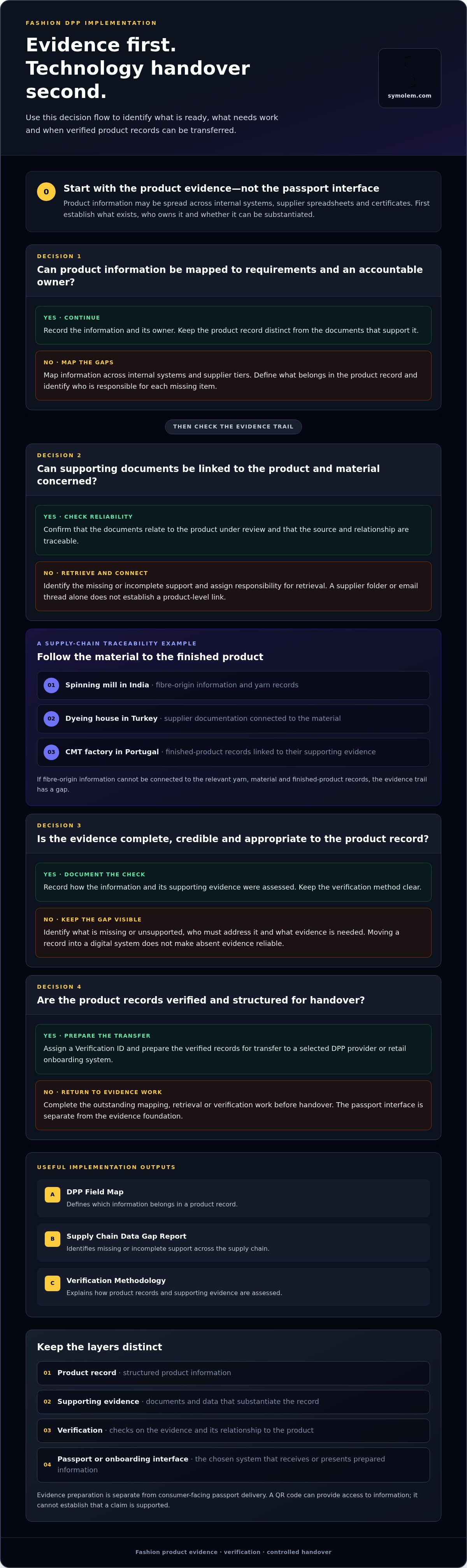
A workable roadmap makes each stage dependent on a defined output, not an assumed level of readiness. For DPP implementation consultancy fashion, the sequence should expose evidence gaps before they become system-transfer problems, while keeping brand supplier retrieval and retailer pre-purchase screening connected through shared product records. Use a pilot to test ownership, retrieval routes and approval steps, not to assume textile-specific requirements are settled.
- Define scope. Identify the product ranges, markets, teams and supplier tiers in scope, and record which requirements need to be assessed.
- Map product information. Connect required fields to existing records, source systems and accountable owners. A textile DPP data requirements checklist can support detailed field-level review.
- Prioritise evidence gaps. Categorise missing or weakly supported records by product, supplier and operational importance, then assign retrieval responsibilities.
- Retrieve and verify. Obtain source documents from internal teams and relevant supplier tiers; assess whether they support the product records and document the review outcome.
- Prepare and transfer. Structure verified records for the selected DPP provider or retailer onboarding system, with clear ownership for subsequent updates.
Choose a pilot range that tests the real operating model: products with different materials, suppliers or evidence conditions can reveal where processes break down. Treat findings as a way to improve data governance and workflows. Don’t present the pilot as confirmation that every future regulatory specification is final.
Sequence brand-side supplier evidence retrieval
For brands, prioritise missing fibre-origin records, chemical test reports, transaction certificates and packaging weights according to product gaps and supplier dependencies. Assign retrieval and review responsibilities across sourcing, production and compliance, with named contacts at relevant Tier 1-3 suppliers. Where it forms part of the organisation’s due diligence workflow, include auditable social accounting evidence on worker welfare and fair wages.
A spinning mill’s fibre-origin documentation, for example, may need to be connected to the material and product records used by production. If a document is missing, record the gap and retrieval owner rather than treating a supplier statement as equivalent proof. This creates a clear hand-off from supplier follow-up to internal review and verification.
Integrate retailer pre-PO screening into the roadmap
Retailers should place third-party brand ranges into compliance screening before purchase orders are signed. Symolem-ID screens ranges against 50+ global textile regulations in seconds, providing per-SKU Cleared, Blocked or Missing Evidence status. That result gives buying and compliance teams a defined point to address gaps before proceeding with a purchase decision.
The product record is where the workstreams meet: brands retrieve and verify supplier evidence, while retailers assess submitted product information before onboarding or ordering. A practical DPP implementation consultancy fashion roadmap should account for both workflows and their shared product records. The free compliance assessment, which requires no sign-up, offers a low-friction way to explore readiness gaps. For a roadmap grounded in product and supplier evidence, start a free compliance assessment.
Choose Evidence-Led DPP Implementation Support That Fits Your Role
Implementation priorities depend on where your organisation sits in the product chain. Retailers need a reliable way to assess third-party ranges before committing to orders; fashion brands need to retrieve, verify and maintain evidence across suppliers and product records. Effective DPP implementation consultancy for fashion connects these workstreams without treating either as a substitute for the other.
Symolem is a product compliance intelligence platform and evidence advisory. It verifies and structures product compliance records and assigns a Verification ID for transfer to a selected DPP provider or retail onboarding system. It does not develop consumer passport apps. The distinction keeps accountability clear: evidence must be established before technology presents it.
For retailers and marketplaces: screen before the purchase order
Retail teams can bring third-party brand ranges into compliance screening before purchase orders are signed. Symolem-ID screens ranges against 50+ global textile regulations in seconds and returns a per-SKU status of Cleared, Blocked or Missing Evidence. These outcomes give buying, merchandising and compliance teams a practical basis for resolving gaps before a purchase decision is finalised.
A Missing Evidence status is a signal to resolve the relevant documentation gap, not proof that a product is compliant or non-compliant. Retailers can use that distinction to route questions to the appropriate brand contact and keep procurement decisions connected to the evidence available for each product. Screening before the PO creates a control point within the buying workflow.
Screen third-party brand compliance before signing the PO. Explore Symolem-ID or run a free product scan.
For fashion brands: retrieve and verify supply-chain proof
For brands, the immediate task is often supplier retrieval. A chemical test report from a dyeing house, fibre-origin documentation from an upstream supplier, transaction certificates and packaging weights may sit with different contacts and in separate record systems. Forensic Tier 1-3 evidence retrieval connects those documents to the products and materials they support, while documenting gaps that still need attention.
Internal ownership matters too. Sourcing may coordinate supplier responses, production may confirm material and factory links, and compliance may review whether records support the intended product information. Where relevant to the organisation’s due diligence workflow, social accounting evidence can also be prepared for review. The output is an auditable evidence base, not an assumption that supplier declarations alone establish every claim.
Verified records can then be structured for transfer into a chosen DPP provider or retail onboarding system. That handover connects supplier evidence to product-level information while preserving the Verification ID and the basis for review.
Need to retrieve missing Tier 1-3 supplier evidence or substantiate social accounting for retail stockists? Take the 5-minute Free Assessment or Book an Advisory Consultation.
Make the Next DPP Decision Evidence-Led
The next step is not to commit to a passport interface before the operating model is clear. Choose DPP implementation consultancy for fashion that turns evidence gaps into assigned actions, keeps verification distinct from presentation, and prepares records for a controlled handover. That gives teams a practical basis for decisions as requirements and implementation plans develop.
Retailers and marketplaces can strengthen procurement decisions by placing product compliance checks before purchase orders are signed. Fashion brands can focus on closing supplier evidence gaps and preparing records that can be reviewed and transferred. Both paths depend on clear accountability for the information behind each product.
For retailers and marketplaces: Screen third-party brand compliance before signing the PO. Explore Symolem-ID or run a free product scan.
For fashion brands: Need to retrieve missing Tier 1-3 supplier evidence or substantiate social accounting for retail stockists? Take the 5-minute Free Assessment or Book an Advisory Consultation.
Start with the evidence and ownership questions your team can act on now. A disciplined first step can make the next implementation decision clearer and more manageable.
Frequently Asked Questions
What does a DPP implementation consultancy do for a fashion brand?
It turns implementation questions into assigned work, rather than leaving teams with recommendations alone. For example, a brand can maintain an evidence register that records the product affected, the source document, the internal reviewer and the next action. DPP implementation consultancy fashion should make it possible to see whether a gap requires supplier follow-up, an internal decision or further review, and who is accountable for moving it forward.
Does a DPP implementation consultancy build the Digital Product Passport?
No. A consultancy can prepare and assess product records, while the selected provider delivers the consumer-facing passport experience. Symolem verifies and structures product compliance records and assigns a Verification ID for transfer to a chosen DPP provider or retail onboarding system; it doesn’t build or issue consumer passports. In practice, this lets a brand retain its selected provider while improving the records that will be supplied to it.
How should fashion companies prepare for DPP implementation?
Start by assigning an internal lead who can coordinate product, sourcing, compliance and technology teams. Then define how decisions will be recorded, who approves changes to product information and how unresolved questions are escalated. Before expanding the work, use a selected product range to test whether staff can locate source records and complete the approval process. Check textile-specific regulatory details against current requirements as the programme develops.
What evidence should a fashion DPP implementation programme retrieve from suppliers?
Relevant records may include fibre-origin documents, chemical laboratory tests, transaction certificates and packaging weights, depending on the product and the information being substantiated. For each record, capture which supplier provided it, which material or product it relates to, and where the source file is held. If a document covers only one material input, don’t treat it as evidence for every component in the finished garment.
How can retailers assess third-party fashion brands before signing a purchase order?
Retailers can place a product-level evidence review within their buying workflow and agree who handles each unresolved status. Symolem-ID screens third-party ranges against 50+ global textile regulations in seconds, with per-SKU Cleared, Blocked or Missing Evidence statuses before purchase orders are signed. Teams should record the follow-up and procurement decision for each affected product; screening supports that process but doesn’t replace legal review or supplier remediation.
Can a fashion brand use its existing DPP provider with evidence advisory support?
Yes. Evidence advisory can prepare information for the provider a brand has selected, without requiring the brand to replace that provider or build a separate consumer interface. Symolem verifies and structures product compliance records and assigns a Verification ID for transfer to the chosen DPP provider or a retail onboarding system. Before handover, teams can map product identifiers and record fields so that information remains associated with the correct product.
What should a DPP implementation consultancy deliver?
Deliverables should let teams test whether the work is usable, not simply document intent. For each output, agree an owner, an approval route and a clear completion condition, such as whether product records can be traced to source material and gaps have an assigned next action. The scope should reflect the brand’s product range and sourcing structure, so teams can apply the outputs to real records rather than a generic example.
For Retailers & Marketplaces: Screen third-party brand compliance before signing the PO. Explore Symolem-ID or run a free product scan.
For Fashion Brands: Need to retrieve missing Tier 1-3 supplier evidence or substantiate social accounting for retail stockists? Take the 5-minute Free Assessment or Book an Advisory Consultation.